How post-war optimism clashed with political reality and doomed Europe’s first major defense integration effort
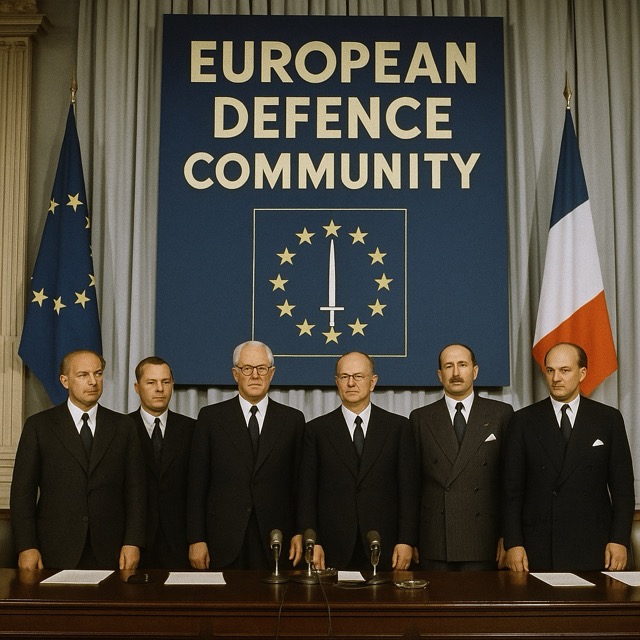
The European Defence Community (EDC) remains one of the most striking examples of a grand vision that failed to materialize in post-war Europe. Conceived in the early 1950s, the EDC was a bold attempt to create a unified European army, transcending national boundaries in favor of a collective security force. It was an initiative born out of the devastation of World War II, and shaped by the growing Cold War threat posed by the Soviet Union.
The EDC proposed a supranational military structure where forces from six founding European countries—France, West Germany, Italy, and the Benelux nations—would be integrated under a single command. At its core, the plan aimed to avoid German rearmament under a purely national framework, while strengthening Western Europe’s military capabilities as part of the Atlantic alliance.
The treaty establishing the EDC was signed in 1952. However, it never came into force. The most critical blow came in 1954 when the French National Assembly refused to ratify it. Ironically, it was France—one of the principal architects of the project—that delivered the final rejection. Concerns over national sovereignty, loss of control over military forces, and political instability played into the defeat.
The failure of the EDC had significant consequences. It ended any immediate prospect of European military unification and highlighted the limits of integration in the realm of defense. In its place, NATO continued to grow as the primary security framework in Europe, reinforcing the transatlantic bond over an autonomous European path.
Scholars and policymakers have revisited the EDC’s collapse for decades. Many see it as a premature idea—too far ahead of its time. While economic cooperation through the European Coal and Steel Community found traction, defense integration touched sensitive national interests and fears of diminished sovereignty.
Despite its failure, the EDC planted seeds for future efforts. Over time, initiatives like the Common Security and Defence Policy (CSDP) and Permanent Structured Cooperation (PESCO) have aimed to revive aspects of the EDC’s original vision, albeit more cautiously and incrementally.
Today, as geopolitical tensions rise once again, calls for deeper European defense integration are re-emerging. The lessons of the EDC are more relevant than ever: unity in defense is as politically complex as it is strategically desirable. Whether Europe will finally achieve what the EDC attempted remains one of the continent’s enduring questions.



 The Tower Post