From War-Torn Country to Global Runways
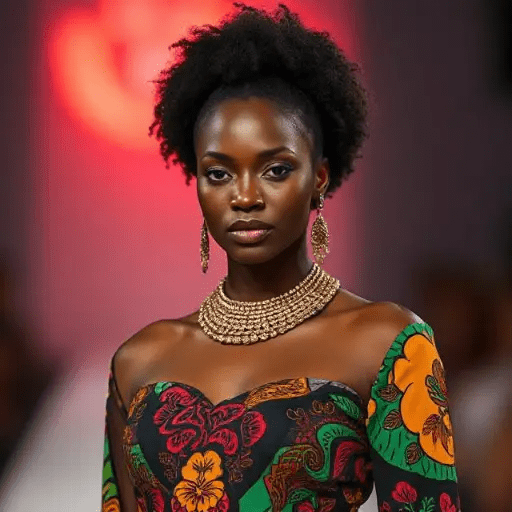
The fashion world has taken notice of a new wave of models hailing from South Sudan, a country plagued by civil war and poverty. These models, with their striking features and resilient spirits, are breaking barriers and defying stereotypes on the catwalks of London, Paris, and Milan.
Arop Akol, a 20-year-old model from South Sudan, has walked for luxury brands in London and Paris, sharing the runway with Naomi Campbell at an Off-White show. Akol’s journey began when she was just 11 years old, watching modeling online and dreaming of a career in the fashion industry. Three years ago, she was scouted by a UK agency and has since become a sought-after model, appearing on numerous fashion magazines and catwalks.
But Akol’s story is not unique. Models like Anok Yai, Adut Akech, and Alek Wek, all from South Sudan or with South Sudanese heritage, are dominating the fashion scene. Wek, who was scouted in a London car park in 1995, has appeared on numerous Vogue covers and modeled for top brands like Dior and Louis Vuitton.
Industry insiders attribute the popularity of South Sudanese models to their unique features, including their dark skin, high cheekbones, and striking height. However, some believe that it’s not just their physical beauty that’s in demand, but also their resilience and determination.
Akur Goi, a South Sudanese model who has worked with designers like Givenchy and Armani, believes that her countrywomen are sought after for their ability to overcome adversity. Goi, who was born in Juba but fled to Uganda as a child, has a theory that South Sudanese models are in demand not just for their physical beauty, but for their “resilience” too.
“We have been through so much as a people,” Goi says. “We’ve experienced war, famine, and displacement. But despite all this, we have managed to hold on to our culture, our traditions, and our beauty. I think that’s what makes us so attractive to the fashion industry.”
The fashion industry’s increasing demand for diversity is also contributing to the rise of South Sudanese models. Lucia Janosova, a casting agent at First Model Management, notes that South Sudanese models are just one of many nationalities being sought after for their unique features and qualities.
“We’re looking for models who are not just beautiful, but who also have a story to tell,” Janosova says. “South Sudanese models have a unique perspective on the world, and that’s what makes them so compelling.”
However, the journey to success is not without its challenges. Many South Sudanese models face difficulties with their families, who often view modeling as a taboo profession. Some have even been prevented from pursuing their careers due to their family’s disapproval.
“My family didn’t want me to become a model,” says Akol. “They thought it was a shameful profession, but I knew that it was my chance to make a better life for myself. I was determined to succeed, no matter what.”
Despite these obstacles, South Sudanese models like Akol and Goi are determined to succeed. They are proud to represent their country and are using their platform to break down stereotypes and challenge the status quo.
As the fashion industry continues to evolve, it’s clear that South Sudanese models are here to stay. With their striking features, resilient spirits, and determination, they are taking the world by storm and redefining the concept of beauty on the global stage.
A New Era of Diversity
The rise of South Sudanese models is part of a broader trend towards greater diversity in the fashion industry. With the increasing demand for models of different ethnicities, ages, and abilities, the traditional notion of beauty is being challenged.
“The fashion industry is finally starting to reflect the world we live in,” says Janosova. “We’re seeing more models of different backgrounds, ages, and abilities. It’s a more inclusive and diverse industry than ever before.”
For South Sudanese models like Akol and Goi, this is a welcome development. They are proud to be part of a movement that is challenging traditional notions of beauty and promoting greater diversity and inclusion in the fashion industry.
“We’re not just models, we’re ambassadors for our country,” says Goi. “We’re proud to be South Sudanese, and we’re proud to be part of this movement towards greater diversity and inclusion.”
Breaking Down Barriers
The rise of South Sudanese models is also helping to break down barriers and challenge stereotypes about the country and its people.
“People often think of South Sudan as a country in crisis, but that’s not the whole story,” says Akol. “We have a rich culture, a beautiful language, and a strong sense of community. We’re not just victims of war and poverty, we’re survivors.”
Goi agrees, saying that the fashion industry has given her and other South Sudanese models a platform to showcase their culture and traditions.
“We’re not just models, we’re representatives of our country,” says Goi. “We’re proud to be South Sudanese, and we’re proud to be part of this movement towards greater diversity and inclusion.”
As the fashion industry continues to evolve, it’s clear that South Sudanese models are here to stay. With their striking features, resilient spirits, and determination, they are taking the world by storm and redefining the concept of beauty on the global stage.
A Bright Future Ahead
For Akol and Goi, the future is bright. They are confident that they will continue to succeed in the fashion industry and use their platform to promote greater diversity and inclusion.
“We’re just getting started,” says Akol. “We’re excited to see what the future holds, and we’re proud to be part of this movement towards greater diversity and inclusion.”
Goi agrees, saying that the rise of South Sudanese models is just the beginning.
“This is just the start of something big,” says Goi. “We’re proud to be part of this movement, and we’re excited to see what the future holds.”




 The Tower Post