Over 4,000 National Guard Soldiers and 700 Marines will be stationed across California for at least two months
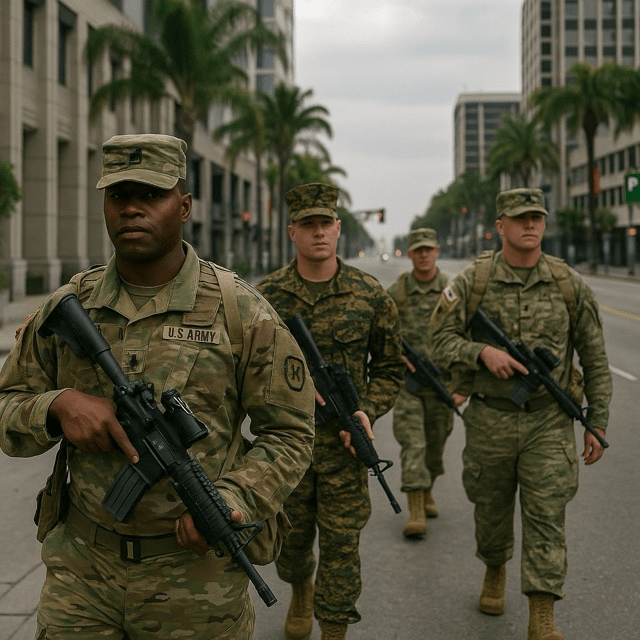
In a move that underscores growing concerns over public safety and civil stability, California officials have announced the deployment of more than 4,000 National Guard troops and 700 U.S. Marines to various urban centers throughout the state. The operation, which is set to last a minimum of two months, aims to bolster law enforcement efforts and ensure the protection of critical infrastructure.
According to state and federal sources, the decision was made following a comprehensive risk assessment involving escalating crime rates, civil unrest, and fears of organized disruptions in major metropolitan areas. The deployment will focus on cities such as Los Angeles, San Francisco, Sacramento, San Diego, and Oakland.
Governor Gavin Newsom, in a press briefing, framed the move as a “temporary but necessary measure to support local authorities in maintaining peace and safety.” He emphasized that the deployment does not indicate martial law or the suspension of civil rights, but rather a coordinated effort to reinforce strained law enforcement capacities.
Troops will be assigned to high-visibility locations, including transit hubs, government buildings, and commercial districts. Their duties will be primarily supportive in nature—assisting with surveillance, logistics, emergency response, and crowd management—while sworn police officers continue to lead public order operations.
The inclusion of 700 Marines is particularly noteworthy. While traditionally focused on overseas military missions, their role in this context will be limited to logistics and rapid-response capabilities. Military commanders have stated that strict rules of engagement are in place to ensure that operations adhere to constitutional norms and civilian oversight.
The deployment has elicited mixed reactions from the public and civil society groups. Supporters argue that the presence of uniformed personnel will act as a deterrent to crime and unrest, helping restore public confidence. Critics, however, raise concerns over the militarization of civilian spaces and the long-term implications for democratic governance.
Civil liberties organizations have issued calls for transparency and oversight, urging both state and federal agencies to publish clear guidelines on the scope of the mission, accountability mechanisms, and post-deployment evaluations.
This isn’t the first time California has turned to the National Guard in times of crisis. However, the addition of active-duty Marines sets a new precedent for federal-military involvement in domestic matters. With tensions high and public discourse polarized, the success of this mission may hinge on careful communication, disciplined operations, and a clear exit strategy.
As the troops begin to arrive and integrate with local law enforcement, all eyes will be on California—both for the effectiveness of the deployment and for its broader implications on national policy concerning military involvement in civil affairs.


 The Tower Post