German conservative leader voices strong opposition to possible takeover of Commerzbank by Italian lender UniCredit
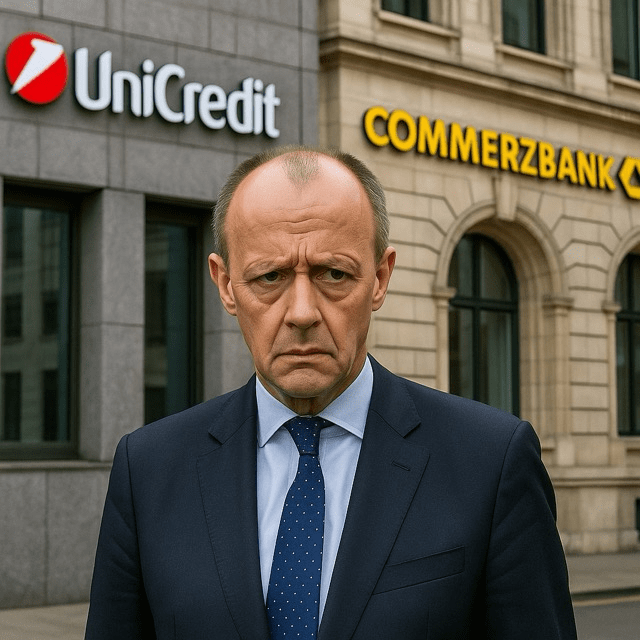
Friedrich Merz, leader of Germany’s Christian Democratic Union (CDU), has launched a scathing attack on Italian banking giant UniCredit over reports of a potential acquisition of Commerzbank. Speaking at a press conference in Berlin, Merz described UniCredit’s interest as a “hostile approach” and declared it “completely unacceptable,” insisting that Commerzbank must remain under German control.
The comments follow increasing speculation in financial markets that UniCredit, one of Italy’s largest banks, is actively exploring options to acquire Commerzbank, Germany’s second-largest lender. The move has raised concerns in political and economic circles in Germany, where fears of foreign control over critical financial infrastructure are growing.
“Germany cannot afford to lose another pillar of its banking sector to foreign interests,” Merz stated. “Commerzbank plays a strategic role in financing our small and medium-sized enterprises. Its independence is essential to national economic stability.”
Commerzbank has long been a central player in the German banking landscape, particularly known for its ties to the country’s powerful Mittelstand sector. The potential takeover by UniCredit has reignited debates around cross-border mergers in the EU and the extent to which national interests should influence financial consolidation.
While UniCredit has not made an official bid, reports suggest that exploratory talks have taken place at the highest levels. The Italian bank’s CEO, Andrea Orcel, has previously expressed interest in expanding UniCredit’s footprint in northern Europe, and acquiring Commerzbank would represent a bold strategic leap.
Merz’s intervention signals growing political resistance to such a deal. He urged the German government and financial regulators to “closely examine any foreign acquisition attempt” and ensure that the country’s financial sovereignty is not undermined.
The German Ministry of Finance has so far declined to comment on the matter, but sources indicate that the government is monitoring developments with caution. Public sentiment also appears wary, with labor unions and consumer associations calling for transparency and protection of domestic jobs.
Financial analysts are divided on the merits of a UniCredit-Commerzbank merger. Some argue that it could create a more competitive pan-European banking group capable of challenging global rivals. Others warn of the complexities involved, including regulatory hurdles, integration risks, and cultural differences between the two institutions.
UniCredit has remained tight-lipped amid the controversy, issuing only a generic statement reaffirming its “long-term commitment to the European banking market.”
The situation reflects broader tensions in European finance, where market dynamics are increasingly intersecting with national sensitivities. As EU leaders push for greater integration, the case of Commerzbank may become a litmus test for how much sovereignty member states are willing to cede in the name of consolidation.
For now, Merz’s firm stance adds significant political weight to the resistance against the takeover, making it clear that any such move will face intense scrutiny not only in boardrooms, but also in the Bundestag.




 The Tower Post