A Strategic Operation Targets Tehran’s Military Elite and Nuclear Minds
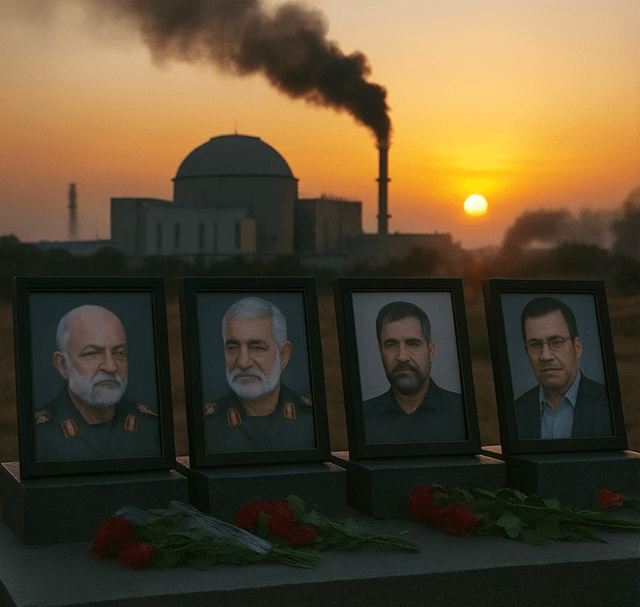
In the early hours of June 13, 2025, Israel carried out a series of precision airstrikes deep inside Iranian territory, marking the most significant strike on Iran since the end of its war with Iraq. The operation, executed by the Israeli Air Force and supported by intelligence from Mossad, was aimed at crippling Iran’s nuclear weapons program and dismantling its military command structure. The attacks resulted in the deaths of multiple high-ranking Iranian commanders and prominent nuclear scientists, signaling an escalation in the covert war between the two nations.
Among the military figures confirmed killed were Major General Hossein Salami, the long-standing commander-in-chief of the Islamic Revolutionary Guard Corps (IRGC); Major General Mohammad Bagheri, who served as Iran’s chief of staff overseeing both the IRGC and the regular army; and Gholamali Rashid, head of the IRGC’s Khatam al-Anbia headquarters. Additional sources reported that Amir Ali Hajizadeh, commander of the IRGC Aerospace Force, also perished when an underground command center was struck .
The strikes did not only target military leadership. Among the nuclear scientists killed were Fereydoun Abbasi-Davani, a former head of Iran’s Atomic Energy Organization; Mohammad Mehdi Tehranchi, president of Islamic Azad University and a leading figure in civilian nuclear research; and several others including Abdolhamid Manouchehr, Ahmad Reza Zolfaghari, Amirhossein Feghi, and Motalibizadeh. These scientists had been instrumental in advancing Iran’s uranium enrichment and reactor development projects .
Israeli Prime Minister Benjamin Netanyahu described the operation as a necessary preemptive strike to prevent Iran from acquiring a nuclear weapon capability, stating that the elimination of key personnel was essential to degrading the program’s momentum. Iran’s Supreme Leader Ali Khamenei denounced the strikes as a blatant act of aggression and vowed that Tehran would respond decisively to avenge the losses.
International reaction was swift. The United Nations Security Council convened an emergency session, calling for restraint from all parties and emphasizing that targeted killing of scientists violates the norms of international law. European Union foreign ministers issued a joint statement urging both sides to return to diplomatic channels, warning that further military escalations could destabilize the wider Middle East region .
Analysts suggest that by removing top commanders and scientists, Israel has bought itself critical time to delay Iran’s nuclear advancements. However, the move risks hardening Iranian resolve and could provoke retaliatory strikes by the IRGC’s missile force or allied militias in the region. As both nations brace for possible counterattacks, the June 13 strikes represent a dangerous turning point in a conflict that has so far been fought largely in the shadows.


 The Tower Post