Amid Supply Chain Shifts and Geopolitical Tensions, Hanoi Seeks New Strategies to Sustain Growth
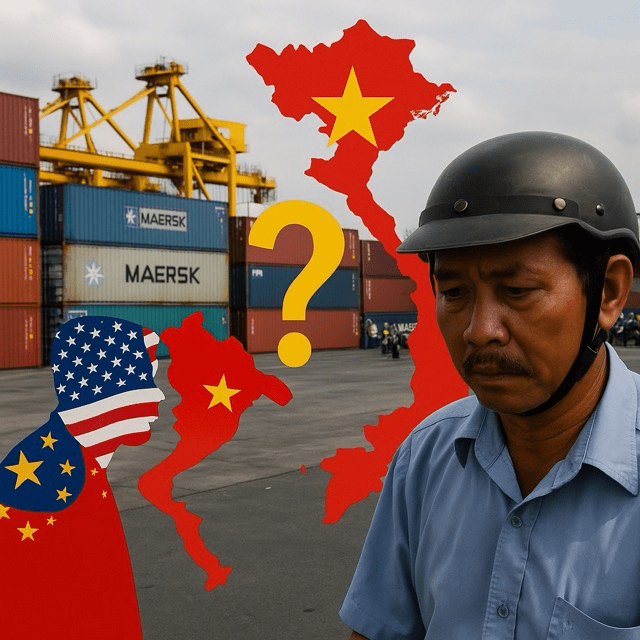
Over the past two years, Vietnam emerged as a favored alternative to China for manufacturing companies looking to sidestep the fallout from the U.S.–China trade war. Its competitive labor costs, improving infrastructure, and participation in multiple free trade agreements attracted investment in electronics, textiles, and consumer goods. Yet this surge in demand has exposed Vietnam to fresh vulnerabilities. With export growth heavily reliant on U.S. markets and key multinationals shifting operations, the Southeast Asian nation now risks being the trade war’s biggest loser. The critical question: does Hanoi have a plan B to safeguard its economic trajectory?
Vietnam’s GDP expanded at an annual pace of 6.4% in 2024, driven largely by export-oriented manufacturing and foreign direct investment (FDI). U.S.-bound shipments accounted for roughly 30% of its total exports, up from 18% in 2018. Sectors such as smartphones, laptops, and apparel saw double-digit growth as firms relocated assembly lines. Moreover, tariff exemptions under the Comprehensive and Progressive Agreement for Trans-Pacific Partnership (CPTPP) and the EU–Vietnam Free Trade Agreement (EVFTA) bolstered export competitiveness. But rapid expansion has tightened domestic labor markets, driving annual wage growth above 8% in key industrial hubs.
The downside of these gains is twofold. First, Vietnam’s overdependence on U.S. demand leaves it exposed to policy shifts. A second round of U.S. tariffs, stricter rules of origin, or technology export controls could trigger production slowdowns and job losses. Second, supply chain bottlenecks—such as congestion at ports around Ho Chi Minh City and a shortage of skilled engineers—threaten to erode the very advantages that attracted investors. Recent reports indicate average container ship delays increased by 25%, and key factories faced intermittent power outages at a cost of millions per week.
In response, Vietnamese authorities have begun exploring Plan B measures. A central pillar is market diversification. Targeting emerging markets in Africa, the Middle East, and Latin America could mitigate reliance on the U.S. While current exports to these regions stand below 10%, Hanoi is negotiating new trade pacts, including the Regional Comprehensive Economic Partnership (RCEP) with ASEAN neighbors, Japan, South Korea, Australia, and New Zealand. Enhanced rail and road corridors under the Kunming–Singapore Connectivity initiative aim to lower logistics costs and open inland trade routes to China and beyond.
Domestically, the government is accelerating structural reforms to upgrade value chains. Investment in vocational training aims to address the skills gap—over 40% of factories in Vietnam cite labor shortages in fields like electronics assembly and advanced materials. Special economic zones (SEZs) with streamlined regulations, such as the Dong Van III Hi-Tech Park, offer incentives for research and development and higher-value manufacturing. Authorities have also launched tax breaks for startups in fintech and green technology, hoping to nurture an innovation ecosystem that can complement low-cost assembly operations.
Another pillar of Plan B is strengthening domestic consumption. Although household spending grew by 7% in 2024, it remains low relative to GDP, at roughly 35%. To boost local demand, policymakers are considering subsidies for solar appliances, expanded social housing projects, and a digital payment infrastructure to drive e-commerce outside major cities. These measures could help create a more balanced growth model less tied to export volatility.
However, hurdles remain. Vietnam’s banking sector is burdened with non-performing loans and a high loan-to-deposit ratio, limiting credit flow to small and medium enterprises (SMEs). Infrastructure gaps—especially in renewable energy and inland waterways—require an estimated $300 billion in investment by 2030. Political considerations, including public resistance to land acquisition for large industrial parks, complicate project execution.
Given these challenges, experts argue that Vietnam’s ability to implement Plan B hinges on international cooperation and pragmatic policy choices. Strengthening ties with the EU, Japan, and South Korea for financing and technology transfer could reduce FDI dependency on Western multinationals facing trade disputes. At the same time, gradual banking reforms and public–private partnerships can unlock resources for infrastructure and vocational training.
In conclusion, Vietnam’s rise in the shadow of the U.S.–China trade war is no accident. Yet as geopolitical tensions evolve, the same forces that presented an opportunity also carry new risks. Hanoi’s emerging Plan B—centered on market diversification, value-chain upgrading, and domestic demand growth—signals awareness of these threats. Whether these strategies translate into resilient, inclusive growth will test Vietnam’s policymaking agility in the years ahead.



 The Tower Post