Factional chessboards, dynastic whispers, and the silent veto of the Revolutionary Guards
Introduction
At eighty‑six, Supreme Leader Ayatollah ʿAli Khamenei remains the political and theological apex of the Islamic Republic, yet the question of succession has moved from covert seminarian debate to open strategic planning. The deaths of President Ebrahim Raisi (May 2024) and of long‑time Expediency Council chairman Sadeq Larijani (February 2025) erased two once‑plausible heirs and brought Tehran’s elite to the uncomfortable admission that the revolution has no automatic mechanism for generational renewal. With each hospitalization of the Leader, three factions—clerical conservatives, security hawks, and pragmatic traditionalists—tighten their alliances and sharpen their knives.
1. Mojtaba Khamenei – the dynastic gambit
The Supreme Leader’s second son, Mojtaba (b. 1969), already commands informal authority over the Office of the Leader, several large bonyād charity‑business conglomerates, and liaison channels with the powerful Islamic Revolutionary Guard Corps (IRGC). Supporters frame him as the only figure able to guarantee doctrinal continuity and institutional stability. Critics counter that a father‑to‑son transition would echo the very monarchy the 1979 revolution overthrew, invigorating a protest movement that has not wholly subsided since the 2022–23 “Woman, Life, Freedom” uprising.
2. Ayatollah Alireza Arafi – the technocratic principalist
Head of the Qom Seminaries and a member of both the Guardian Council and the Assembly of Experts, Arafi (b. 1958) embodies a blend of scholarly credentials and regime‑loyal pragmatism. Fluent in Arabic and English, he has led delegations in intra‑Shiʿi outreach to Najaf and Sunni dialogue forums, making him attractive to diplomats searching for a less confrontational Iran. His weakness is the absence of a personal constituency in the security services, which remains the real kingmaker.
3. Ayatollah Hashem Hosseini Bushehri – the consensus builder
First vice‑chair of the Assembly of Experts, Bushehri (b. 1955) is viewed as a compromise candidate acceptable to both the clerical old guard and to mid‑ranking commanders of the IRGC. He lacks Mojtaba’s financial levers and Arafi’s international exposure, but his reputation for mediation could unify a fragmented elite in the immediate aftermath of Khamenei’s death.
4. Wild cards and institutional innovation
Other names—Ayatollah Mohammad‑Mahdi Mirbagheri, Intelligence Minister Esmaeil Khatib, or even a triumvirate resembling the brief 1989 interregnum—surface in private briefings. The 1989 constitutional amendments allow the Assembly of Experts to replace the single‑leader model with a Leadership Council, an option reportedly discussed in its closed March 2025 session as an insurance policy should the vote split.
How the selection works
*Vacancy*: Upon Khamenei’s death or incapacitation, leadership temporarily falls to a three‑man committee (the president, the judiciary chief, and a cleric delegated by the Expediency Council).
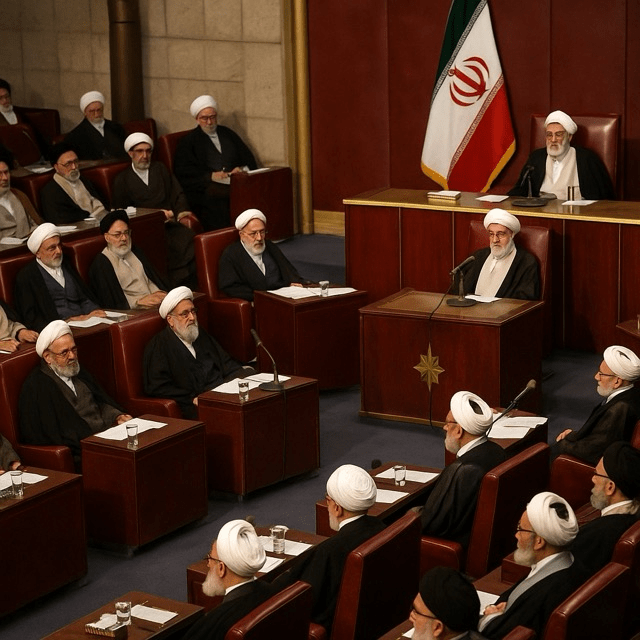
*Deliberation*: The 88‑member Assembly of Experts convenes within days; a two‑thirds majority (59 votes) is customary, though not legally explicit.
*IRGC ratification*: No article of the constitution mentions the IRGC, yet every senior officer interviewed since 2009 affirms that the Guards will “defend the revolution” if an unpalatable figure is chosen. That unspoken veto function makes alignment with the corps a de facto prerequisite.
Domestic and external variables
The calculus is shaped by three pressures: (1) public legitimacy after the 2022–23 protests; (2) economic crisis under renewed U.S. oil sanctions and the 2025 dip in Chinese purchases; and (3) regional security, including Israel’s 2025 strikes on IRGC sites in Syria. Each crisis pushes the elite toward continuity—but also magnifies the cost of an unpopular choice.
Media optics and public narrative
State television has begun airing documentaries on the 1989 succession, a subtle reminder that “seamless” transfer is possible. Reformist newspapers banned since 2023 circulate online PDFs dissecting Mojtaba’s business interests, while Telegram channels linked to the IRGC boost stories casting Ayatollah Arafi as an erudite but firm overseer of the revolution’s next stage. Underground satire magazines lampoon any cleric over sixty as “Ayatollah Windows 95,” a sign of generational impatience.
The regional factor
For Riyadh and Abu Dhabi, a Mojtaba succession signals policy continuity and thus predictable rivalry. Ankara unofficially prefers an academic like Arafi, hoping for easier dialogue on Syria and Iraq. Moscow and Beijing express neutrality but privately lobby for anyone capable of signing long‑term hydrocarbons contracts unhampered by sanctions fears.
Possible timelines
Health bulletins released in April 2025 hint at Khamenei’s steady but fragile condition; most insiders believe the country enters a heightened alert phase the moment the Leader is hospitalized overnight. Regulations require the Assembly to meet within ten days. Given travel constraints on elderly members, the secretariat has run simulations to conduct a quorum with as few as seventy clerics present.
Scenarios in brief
*Baseline continuity*: Mojtaba confirmed within a week; IRGC issues message of allegiance; limited protests in major cities suppressed with minimal force.
*Institutional compromise*: Arafi or Bushehri elected after a multi‑ballot showdown; Mojtaba appointed head of the Leader’s Office and given broad supervisory powers.
*Fragmentation*: Leadership Council installed provisionally, indicating no consensus; risk of factional contest spilling into public arena, especially if economic shocks mount.
Conclusion
The succession is less a coronation than a negotiated cease‑fire among clerical scholars, security chiefs, and business oligarchs. At present Mojtaba Khamenei leads the field, not because he is beloved, but because he is feared the least by those who matter. Yet the Iranian system prides itself on improvising under pressure: an Ayatollah Arafi or a leadership council could still emerge if dynastic optics threaten to ignite the streets. Whoever inherits the black turban must master both theology and triage; the Islamic Republic’s margin for error has never been thinner.


 The Tower Post