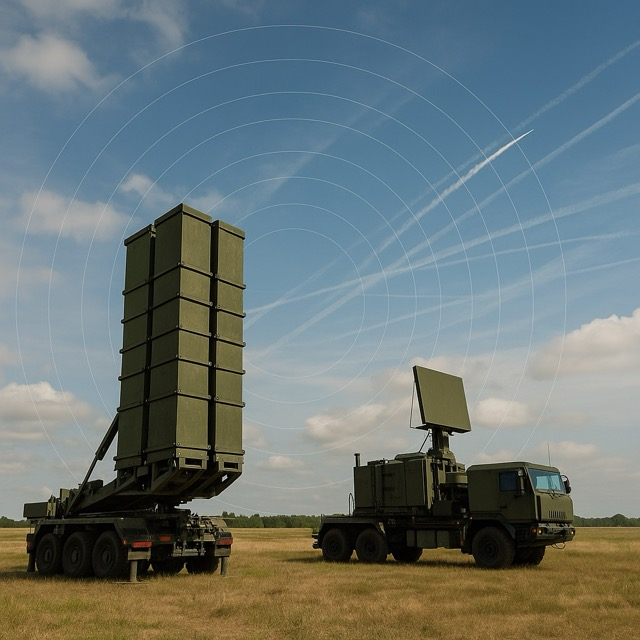
Despite its proven capabilities, Europe is hesitant to adopt the Franco-Italian SAMP/T system as the cornerstone of its emerging air defense strategy.

As Europe accelerates plans to build a continent-wide missile defense shield in the face of growing threats from Russia, Iran, and rogue actors, one key question lingers: why is the EU not embracing the SAMP/T system — one of its own indigenous solutions — as the core of its strategy?
SAMP/T (Sol-Air Moyenne Portée/Terrestre), co-developed by France and Italy under the Eurosam consortium, has long been touted as a capable, NATO-interoperable medium-range surface-to-air missile system. It is battle-tested, mobile, and already deployed by several European nations. Yet, despite its strategic advantages and European pedigree, SAMP/T is being sidelined in favor of broader, more multinational solutions — and, in some cases, American-made systems like the Patriot.
According to defense analysts, the reasons are more political than technical.
“The EU has never fully unified its defense procurement strategy,” said Brigadier General Markus Reitz, a defense policy advisor in Berlin. “Each country has its own preferences, budgets, and industrial lobbies. While SAMP/T is respected, it’s not universally embraced.”
One of the main reasons behind the hesitation is Germany’s leadership of the European Sky Shield Initiative (ESSI), launched in 2022. The ESSI aims to create an integrated air and missile defense architecture across 19 European countries. Its initial procurement choices notably favored the U.S.-made Patriot system and Israel’s Arrow 3 interceptor — a decision seen by some as a snub to European defense industry autonomy.
France, which champions SAMP/T, has been noticeably absent from the ESSI framework. Paris has expressed concerns over relying on non-European defense systems and has pushed for greater strategic sovereignty — but to limited effect.
“The EU’s defense cohesion is still fragmented,” noted Sofia Carli, an analyst with the European Defence Agency. “The failure to rally around SAMP/T reveals deep divides in defense philosophy, procurement politics, and even transatlantic alignment.”
The SAMP/T system, particularly in its upgraded SAMP/T NG (New Generation) variant, boasts advanced radar technology and intercept capabilities against ballistic and cruise missiles. It recently gained renewed attention after being deployed in Ukraine by Italy and France to help shield Kyiv from Russian aerial threats.
Still, despite its credentials, SAMP/T faces competition not just from American alternatives, but also from newer national initiatives like Germany’s IRIS-T SLM and the multinational TWISTER program.
Critics argue that sidelining SAMP/T undermines Europe’s ambition to become strategically autonomous in defense production. Supporters of the system say that investing in indigenous solutions not only secures supply chains but also reinforces Europe’s technological leadership.
Yet proponents of the current approach say interoperability with NATO and shared funding pressures make American systems more politically viable.
“There is a practical logic to going with what is widely used and already integrated,” said Jens Albrecht, a former NATO logistics officer. “Patriot has scale, credibility, and broad adoption. That matters when speed is essential.”
While the EU’s long-term defense autonomy remains a stated goal, the present reality suggests a patchwork strategy driven by national interests, external dependencies, and strategic pragmatism.
For now, SAMP/T remains a powerful but underutilized asset — a symbol of Europe’s ongoing struggle to speak with one voice on defense.