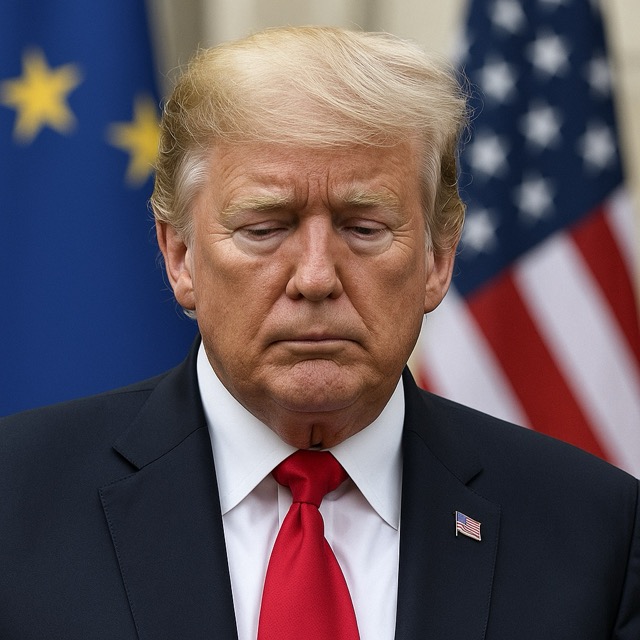
Facing U.S. pressure on Ukraine, NATO, and trade, Brussels chose appeasement over confrontation — and exposed its strategic vulnerability to the world.

As summer dawned across Europe, diplomatic circles braced for what some feared could become a seismic break in transatlantic relations. Tensions between the European Union and the United States — exacerbated by disagreements over NATO spending, support for Ukraine, and trade imbalances — had reached their highest level in decades. The phrase ‘transatlantic divorce’ no longer sounded alarmist. It felt imminent.
Yet, that rupture has been narrowly averted — at a cost. Over a series of emergency summits, closed-door negotiations, and increasingly public overtures, European leaders have walked back key positions and softened their rhetoric in a bid to pacify Donald Trump, who has returned to the White House with renewed political vigor and a transactional view of alliances.
At the heart of the rift was Ukraine. With Trump skeptical of continued military aid, the U.S. threatened to scale back its support unless Europe dramatically increased its share of funding. In response, EU nations fast-tracked a €60 billion defense package and committed to long-term military and reconstruction aid to Kyiv — a move some European officials admitted was ‘coerced, but necessary.’
On NATO, the situation was equally tense. Trump revived his 2020s-era threats to withdraw U.S. troops from Europe unless all NATO members met the 2% GDP defense spending target. Within weeks, Germany, Spain, and Belgium announced new military budgets that finally crossed the threshold. Critics argue it was less about security and more about appeasement.
Meanwhile, on trade, the EU dropped long-held objections to a new bilateral agreement on tariffs and agricultural quotas, widely seen as favoring American exports. ‘We had to give something,’ said one French trade negotiator. ‘Otherwise, we risked losing everything.’
While EU leaders framed their concessions as pragmatism in the face of geopolitical uncertainty, others see it as capitulation. ‘Europe blinked first,’ said Polish analyst Marta Król. ‘If Washington ever doubted the EU’s strategic unity, those doubts are gone. The bloc has shown it will bend under pressure.’
The consequences of that perception could be long-lasting. Already, China, Russia, and Turkey are recalibrating their approaches to Brussels, viewing it as diplomatically pliable and economically dependent on American security guarantees. European Commission insiders fear that the loss of credibility could undermine the EU’s global influence for years to come.
In Brussels, there is talk of launching a ‘Strategic Autonomy 2.0’ initiative to reaffirm European independence. But many diplomats privately acknowledge that the damage is done. ‘The idea that Europe could lead itself — that illusion has cracked,’ said one senior EU official. ‘We were reminded, forcefully, who calls the shots.’
For now, the immediate crisis has passed. Ukraine continues to receive weapons, NATO is intact, and trade tensions have eased. But the political and reputational cost for Europe is clear: in choosing to avoid conflict with the U.S., the bloc has publicly revealed its limits.
And as the world watches, it is not only America that now sees a weaker Europe — it is everyone else, too.