New documents and travel records suggest an Iranian nuclear scientist and four associates flew to Moscow on diplomatic service passports last August. Their cover story masked meetings at Russian institutes that work on dual‑use technologies. What, exactly, were they doing there?
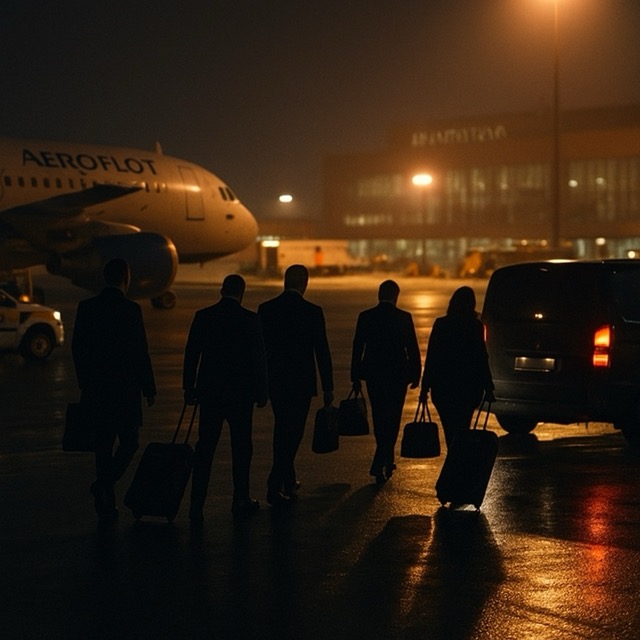
A commercial flight from Tehran touched down at Moscow’s Sheremetyevo International Airport. Among the passengers, according to documents and travel records seen by the *Financial Times*, was Ali Kalvand, a 43‑year‑old Iranian nuclear physicist. He was accompanied by four associates. On paper, they presented themselves as employees of a small Tehran consulting shop called DamavandTec. In reality, all five traveled on diplomatic service passports—an unusual privilege for a private consultancy. Their four‑day Moscow itinerary, reconstructed from correspondence and corporate filings, included visits to Russian research centers that develop “dual‑use” technologies: equipment with legitimate civilian applications but potential relevance to nuclear weapons design and testing. Iranian officials insist their program is strictly peaceful. Western governments read the trip very differently, as a bid to keep weapons‑related know‑how sharp without triggering a formal breach of international commitments.
THE COVER STORY—AND WHAT PIERCED IT
The delegation framed its visit as a routine scientific exchange. Letters sent ahead by DamavandTec spoke of discussions on electronic devices and potential avenues for broader collaboration with Russian labs. Yet multiple features raised flags for Western analysts: the sequentially issued service passports; the presence, according to several officials, of a counter‑intelligence officer; and the résumés of at least two travelers linked by the U.S. and European authorities to Iran’s Organization of Defensive Innovation and Research—better known by its Persian acronym, SPND. SPND, established in 2011 by the late Mohsen Fakhrizadeh, is designated by Washington as a successor to elements of Iran’s pre‑2003 weapons program. Tehran rejects that characterization. But the paper trail around the Moscow visit—first detailed in the FT and echoed by regional outlets— suggests this was no ordinary academic tour.
WHO WENT—AND WHY IT MATTERS
Beyond Kalvand, the roster, according to the FT account and follow‑up reporting, included Rouhollah Azimirad, a scientist widely known to Western services for senior roles within SPND; Javad Ghasemi, previously tied to a sanctioned procurement front; and Soroush Mohtashami, an expert on neutron generators. Neutron generators have benign industrial and medical uses, but are also integral to certain nuclear detonation systems. The combination of expertise points squarely at the ‘weaponization’ shelf of nuclear knowledge—the set of diagnostics, triggers and specialty materials that shorten the path from enriched uranium to a credible device, without necessarily producing one.
WHAT RUSSIAN LABS COULD OFFER
Travel letters and meeting notes indicate the group’s appointments included facilities associated with veteran Russian physicist Oleg Maslennikov and visits to institutes that make electron accelerators and klystrons—components used to power high‑energy systems and, in some configurations, to simulate the forces in an implosion. One letter from DamavandTec to a Russian supplier months before the trip expressed interest in radioactive isotopes, including tritium, as well as strontium‑90 and nickel‑63. All have peaceful uses; tritium, in particular, is also tightly controlled because it can boost a nuclear warhead’s yield. The FT said it saw no proof the isotopes were actually provided. But the shopping list itself is a proliferation red flag, experts note.
MOSCOW’S CALCULUS
Why would Russia entertain such a visit? Since its full‑scale invasion of Ukraine, Moscow has tightened strategic links with Tehran, importing Iranian drones and pursuing deeper energy, defense and nuclear‑industry ties. Rosatom engineers continue to work at Iran’s Bushehr nuclear power plant, and officials on both sides have discussed additional reactors and new financing arrangements. For the Kremlin, scientific exchanges that fall short of overt treaty violations offer leverage: a way to reward a wartime partner and needle the West while retaining deniability. Russian officials have not publicly endorsed the FT’s account; their standing line is that cooperation with Iran is confined to civilian energy. Still, the overlap between dual‑use research and weapons‑adjacent know‑how is precisely what unsettles non‑proliferation officials.
TEHRAN’S POSITION—AND THE UNRESOLVED GRAY ZONE
Iran’s leadership says it does not seek nuclear weapons, citing a religious edict by Supreme Leader Ali Khamenei and emphasizing the country’s right to peaceful technology. After years of on‑again, off‑again diplomacy, the 2015 nuclear accord (JCPOA) is moribund, and International Atomic Energy Agency safeguards probes remain contested. In that gray zone, trips like the Moscow delegation take on outsized importance. They do not prove a dash to a bomb. But they suggest Iran aims to preserve, and in some areas upgrade, the specialized skills and components that would reduce the time and uncertainty involved if a political decision were ever made.
HOW WE KNOW WHAT WE KNOW
The FT’s reconstruction draws on internal Iranian correspondence, travel manifests and corporate records. Several think tanks and media outlets reviewed or echoed the findings in recent days, with Western officials adding context about the delegates’ affiliations and skill sets. While some specific technical requests—like isotope orders—could plausibly serve civilian labs, the totality of the itinerary aligns with long‑standing Western concerns about SPND’s mandate. Absent on‑the‑record Russian and Iranian documentation, some details remain circumstantial. But that is often the nature of proliferation reporting: it is a mosaic assembled from partial but mutually reinforcing pieces.
IMPLICATIONS FOR NON‑PROLIFERATION
First, the episode will likely harden calls in Washington and European capitals for tighter export controls on high‑end electronics, radiological materials and specialized machine tools bound for Eurasian middlemen. Second, it complicates already fraught diplomacy at the IAEA, where member states have sparred over resolutions criticizing Iran’s lack of transparency. Third, it adds a new layer to the Russia–Iran partnership: civil nuclear cooperation that is lawful on paper but politically radioactive when paired with sensitive lab visits. Each of these trends raises transaction costs for legitimate Iranian research while incentivizing clandestine procurement networks—a vicious circle familiar to anyone who has tracked the region’s nuclear file.
WHAT TO WATCH NEXT
Watch for formal responses from Tehran and Moscow addressing the FT’s reporting; for any new U.S. or EU sanctions targeting DamavandTec, identified delegates, or Russian entities named in travel letters; and for signals from the IAEA Board of Governors this autumn as it weighs how to handle Iran’s outstanding safeguards issues. Also monitor whether Iran and Russia move ahead with additional power‑reactor projects or credit lines—steps that, while civilian, could deepen technical interdependence. Finally, keep an eye on academic output: in open‑source proliferation work, fresh dissertations and journal articles often foreshadow the next wave of capabilities.
BOTTOM LINE
The quiet arrival at Sheremetyevo last August was a small episode with outsized significance. It points to an Iran determined to preserve weaponization‑adjacent expertise, and to a Russia willing to host sensitive visitors under the umbrella of civilian science. Neither fact, on its own, proves illicit activity. Together they underscore how the world’s non‑proliferation regime is being tested by gray‑zone cooperation—conducted in daylight, documented in corporate filings, and designed to stay just this side of a red line.


 The Tower Post