Growers cheer a long-sought shield against Mexican competition, while importers and shoppers brace for higher prices and tighter supplies.
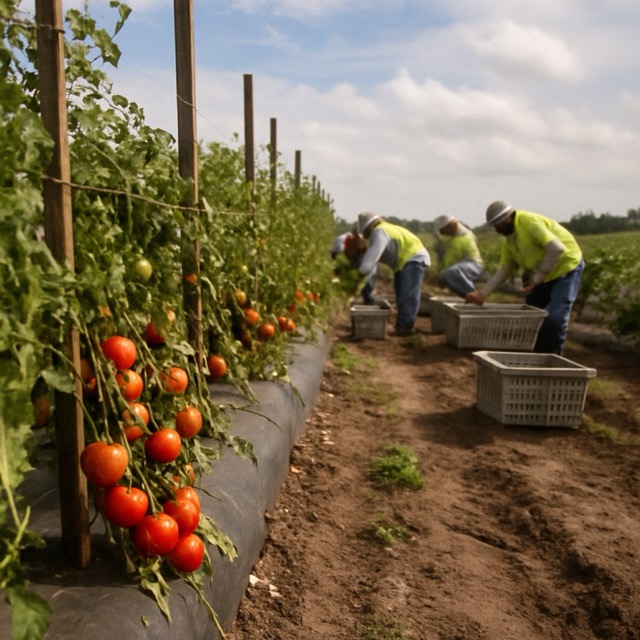
In the 1990s, tomato fields blanketed Florida. More than 60,000 acres were planted across the state, from the sandy soils of Homestead to the hard land around Immokalee. Today, less than half of that land is still in cultivation. For many Florida growers, the culprit has a name: Mexico. They argue that a surge of lower‑priced, greenhouse and shade‑house tomatoes from across the border steadily pushed them out of the market and off the land.
Now the industry has a new ally in Washington. In mid‑July, the U.S. Commerce Department, with the backing of President Donald Trump, ended a years‑old price‑floor agreement with Mexico and imposed a 17% anti‑dumping duty on most fresh Mexican tomatoes. The move instantly reshaped one of North America’s most fought‑over produce trades. Mexican exporters—who now supply roughly two‑thirds to 70% of the fresh tomatoes sold in U.S. stores—warn of supply disruptions. Florida growers call it a long‑overdue course correction.
“We’ve been saying for decades that we don’t need a handout—we need a level field,” said a grower in Collier County, who asked not to be named while contracts are renegotiated. “If the rules are finally enforced, we can compete.”
The duty revives a fight that dates to the 1990s, when NAFTA dismantled tariffs and a series of ‘suspension agreements’ set minimum prices for Mexican tomatoes instead of duties. Florida’s acreage shrank all the same. According to state and federal data, Florida’s open‑field tomato plantings are now about 24,000 acres—less than half the footprint reported around 1990—and the state’s grower base has dwindled from hundreds of shippers to a few dozen. Mexico, meanwhile, poured billions into protected agriculture, delivering consistent “on‑the‑vine” and Roma varieties all winter, just as U.S. shoppers demanded year‑round color and uniformity.
Economists say the 17% duty will not rewrite the market overnight. Much will hinge on how long it stays in place, how strictly it is applied at the ports, and whether Mexico and the U.S. negotiate yet another deal. But the immediate effects are already rippling through contracts. Importers are inserting surcharge clauses; retailers are revising circulars; and food‑service buyers are planning tighter specs or smaller portions. Early estimates from industry groups suggest the tariff could lift U.S. retail tomato prices by mid‑ to high‑single digits in the coming months, with tighter supplies for cherry and vine‑ripe specialties most likely.
For Florida growers, the question is whether protection buys enough time to reinvest. Tomato is an expensive crop to grow in the state’s humid climate: labor, fertilizer, fuel, insurance, plastic mulch, fumigants and food‑safety compliance costs have all climbed. Harvest wages—largely paid to H‑2A guest workers—are up sharply over the last decade. Hurricanes, floods and plant diseases such as late blight and bacterial spot have forced frequent resets. Many farms have already diversified into cucumbers, peppers and specialty crops or sold land for development.
Still, there is room to gain back share, growers argue, particularly in the winter window when Florida historically supplies the bulk of U.S. field‑grown tomatoes. A tariff, they say, could narrow the price gap enough for buyers to choose domestic fruit if quality holds. Several packers are testing greater volumes of vine‑ripe harvests and upgraded cooling to better compete with greenhouse tomatoes on taste and shelf life.
Importers counter that the duty punishes efficiency and will leave consumers paying more for less. Mexico’s protected agriculture—spanning Sinaloa, Baja California and the central highlands—has produced steady winter volume and a wide array of sizes and flavors. In a typical year, tomatoes from Mexico account for around $3 billion in export value to the U.S. They have also become embedded in domestic distribution: fleets, inspection teams and cold‑chain facilities that keep supermarket shelves stocked from November through April.
“We’re already seeing hesitation on long‑term contracts for the holiday season,” said a South Texas importer. “If buyers shift to spot loads while we all wait for legal guidance, the price swings could be bigger than the tariff itself.” Mexico’s government has signaled it will challenge the duty, even as exporters explore interim pricing and logistics workarounds. Some growers are expected to pause plantings if margins look thin under the new regime.
The White House casts the measure as targeted and fair. Commerce officials say they scrapped the 2019 suspension agreement because it failed to stem “unfairly priced” imports, citing years of disputes over quality inspections, reference prices and enforcement. The antidumping order, they argue, merely restores remedies available since the mid‑1990s investigation first concluded Mexican exporters sold below U.S. market value.
What happens next will determine whether Florida’s tomato economy stabilizes or continues to shrink. If the duty stays, acreage could inch up as growers secure financing for stakes, transplants and packing lines. Equipment dealers in the eastern Everglades report a pickup in inquiries. But if a new deal narrows or suspends duties—as has happened repeatedly over the last 30 years—buyers may revert to Mexico’s larger assortment of greenhouse fruit. A broader U.S.–Mexico trade quarrel would compound the uncertainty, potentially inviting retaliation on other farm goods and complicating supply chains that stretch from Sonora to South Florida.
Consumers will see the outcome in their carts. Vine‑ripe clusters and cherry tomatoes may be the first to climb, while mature‑green rounds from Florida could gain space on retail tables if prices converge. Restaurants that rely on sliced Romas for sandwiches and burgers are modeling portion changes or seasonal menu swaps. In the longer run, investment in domestic protected agriculture—greenhouses in the Great Lakes and high‑tech facilities in the South—could accelerate if buyers prize supply security over the lowest landed cost.
For the workers who pick the fruit, the calculus is personal. In Immokalee, where labor groups have campaigned for stronger standards and better pay, a busier harvest would be welcome. But advocates warn that protection alone won’t fix the boom‑bust cycle that has whipsawed crews for decades. They are urging buyers to maintain human‑rights commitments and farm audits even as contracts flip.
In the end, Florida’s tomato future may hinge on execution as much as policy. If growers can deliver consistent flavor and reliability at prices buyers can accept, a 17% duty could be a bridge back to relevance. If not, it will register as another chapter in a long trade dispute that did little to change how Americans buy their most popular vegetable.
Either way, the stakes are tangible. The crop once covered more than 60,000 Florida acres; today, it’s a fraction of that. The next few harvests will show whether those fields are poised for a modest comeback—or whether the state’s tomato era is nearing its sunset.



 The Tower Post