As Israel readies a Gaza City takeover and the UN warns of famine, domestic dissent grows and families of hostages press for a general strike.
For nearly two years, the Gaza war has unfolded in full view of a world that appears powerless to stop it. The latest turn came on Sunday, August 10, when Israeli Prime Minister Benjamin Netanyahu held a rare, lengthy press conference for foreign reporters in Jerusalem. He set out a hard‑line endgame and repeated the terms on which his government says the war could finally stop. To supporters, the message offered clarity after months of drift. To critics, it read like an open‑ended mandate for more bloodshed in a territory already pushed to the edge.
The five conditions Netanyahu listed are stark. First, the complete disarmament of Hamas. Second, the release of all remaining hostages. Third, the demilitarization of the Gaza Strip. Fourth, Israel’s continued “overriding” security control, including a buffer zone to prevent cross‑border attacks. Fifth, the establishment of a new civilian administration in Gaza that is “peaceful” and explicitly not run by Israelis. Netanyahu insisted these demands do not amount to a permanent occupation, and he stressed that Israel’s goal is to “free Gaza from Hamas,” not to govern it.
The practical implications are profound. Disarmament and demilitarization would require sustained Israeli access and enforcement. “Overriding” security control and a border buffer suggest a long Israeli presence, whatever label is used. And the call for a new civilian authority that is neither Hamas nor the Palestinian Authority raises a basic question: who, exactly, would govern? Arab capitals, floated as possible partners in various “day after” schemes, have shown little appetite to assume responsibility for Gaza’s administration while fighting continues and the humanitarian system is near collapse.
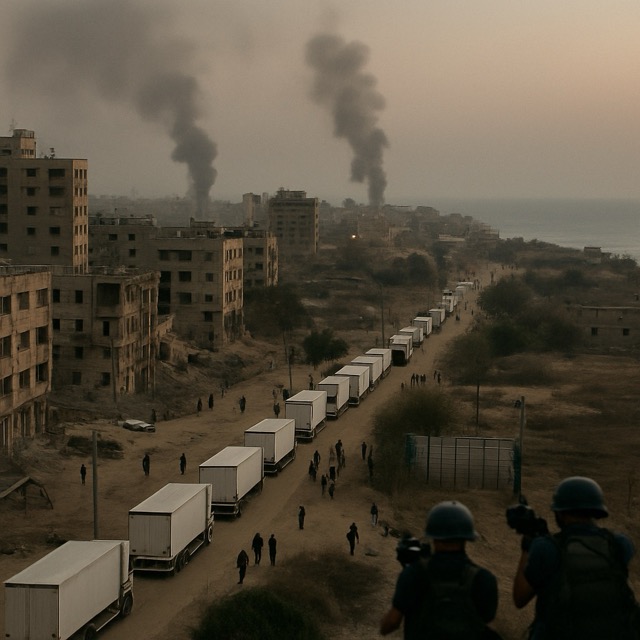
Netanyahu argued that Israel already controls most of Gaza and that a swift, concentrated offensive could “finish the job” if civilians are relocated to designated safe areas. Even on paper, the humanitarian arithmetic is unforgiving. United Nations agencies describe a territory where displacement is constant, sanitation is broken and food scarcity is acute. Pediatric malnutrition has become a grim barometer of the war’s toll, with doctors in field clinics reporting children arriving listless and dangerously underweight. Aid organizations say only a fraction of the required assistance has entered the strip in recent weeks, and that convoys and warehouses remain vulnerable to the fighting.
On the most incendiary allegations — widespread hunger and children dying from lack of food and care — Netanyahu used unusually combative language. He accused Hamas and portions of the international media of spreading a “global campaign of lies,” and he said several widely reported starvation cases were “fake.” He also blamed the UN for logistical failures and Hamas for diverting aid. Humanitarian officials counter that field assessments and mortality data point in the opposite direction and that any major expansion of combat around Gaza City would make distribution nearly impossible.
If the press conference was designed to shape global opinion, the follow‑up phone call was aimed at Washington. On Sunday, according to official readouts, Netanyahu spoke with U.S. President Donald Trump about Israel’s plan to seize Gaza City and press remaining Hamas strongholds. The conversation came after a week of public sparring over the humanitarian picture, including moments when Trump openly rejected Israeli denials that images of emaciated children were fabricated. For now, the administration has not moved to block the operation; instead it has pressed Israel to shorten timelines, reduce civilian harm and accept more robust aid mechanisms.
Europe, meanwhile, is sounding the loudest alarm bells. Italy’s foreign minister, Antonio Tajani, warned that any invasion risks turning into “a Vietnam for Israeli soldiers” — a concise expression of a wider fear: seizing and holding dense urban terrain could prove slow, casualty‑heavy and strategically counterproductive. Germany has curbed some military exports, and several European governments have urged Israel to reverse course, citing the risk to civilians and to the remaining hostages. At the UN, officials speak of “another calamity” in the making and have urged an immediate halt to plans to take Gaza City.
At home, Netanyahu faces a different kind of pressure. Tens of thousands of Israelis have poured into the streets of Tel Aviv and other cities, denouncing the Gaza City plan, demanding a cease‑fire deal to bring hostages home and calling for a nationwide general strike. Families of captives, who have become the conscience of the protest movement, argue that an expanded offensive imperils their loved ones and narrows the path to a negotiated release. Opinion surveys suggest most Israelis prioritize a deal for the hostages over further battlefield gains, even as the government argues that military pressure is the best leverage to secure any agreement.
Into this ferment stepped Ehud Olmert, the former prime minister who led Israel during the 2008–09 conflict with Hamas. In interviews published this week, Olmert called the Gaza City plan “insensate” — a war without a plausible strategic payoff — and urged Israelis to wield the bluntest instrument of civil pressure: a general strike. It is a remarkable intervention from a figure who once ordered major operations in the strip. Olmert argues that only a mass, nation‑stopping protest can force the government to rethink before it commits to a campaign that will, in his view, cost many soldiers’ lives and kill many uninvolved Palestinians.
Within Israel’s security establishment, the debate is technical and fraught. Reports in Israeli media describe pushback from senior commanders over the scope and sequencing of the Gaza City plan, including warnings about the danger it poses to the remaining hostages and about the feasibility of policing a vast urban area for months on end. Netanyahu has tried to neutralize those concerns by promising speed — he talks of a campaign measured in weeks — but planners quietly game out timelines that stretch far longer. Each week of fighting creates more humanitarian need and deepens Israel’s diplomatic isolation.
For Gazans, already displaced multiple times and living amid rubble, the calculus is brutally simple: food, water, shelter and safety. Aid officials say only a sliver of necessary supplies has entered the strip in recent weeks; clinics are overwhelmed; and malnutrition, disease and trauma interact in lethal ways. Strikes have killed journalists and aid workers, prompting diplomatic flare‑ups with international media and humanitarian groups. Israel insists it is facilitating deliveries and that Hamas’s theft and intimidation are the principal obstacles. On the ground, UN staff and local volunteers describe a race against time.
Is there an exit ramp? Netanyahu’s five conditions offer one, but only in the abstract. Hamas would have to disarm and release all hostages; Gaza would be demilitarized; Israel would retain security primacy; and some new civilian authority — neither Hamas nor the Palestinian Authority — would emerge to govern. No party in the current picture can deliver that package. Hamas shows no sign of surrendering; the Palestinian Authority lacks legitimacy and leverage in Gaza; Arab states are reluctant to assume responsibility without a political horizon; and Israel’s coalition politics incentivize maximalist goals that leave little room for compromise.
The wider regional picture is no less volatile. Cross‑border fire along Israel’s northern frontier has periodically escalated into days of exchanges, with the risk of a larger war always present. In the Red Sea and the Gulf, shipping disruptions and drone clashes have become part of the background noise of a broader Iran‑Israel confrontation. Tehran and its allied militias treat Gaza as one front among many; Israel sees their hand in every escalation. The United States continues to act as the principal shock absorber, seeking to keep crises compartmentalized while managing a deteriorating diplomatic climate.
What, then, might change the trajectory? Pressure from allies has not yet done it. Nor have UN statements, angry editorials or sanctions threats. Hamas calculates that time and international outrage are on its side; Israel calculates that military pressure is the only language Hamas understands. The variable both sides still fear is domestic Israeli politics. If families of hostages, unions and business leaders coalesce around a general strike, and if that strike shuts down ports, flights and commerce for more than a day or two, the government could face an ultimatum from its own streets rather than from foreign capitals.
For now, the war continues under the eyes of a watching world. Seizing Gaza City may become the conflict’s most consequential gamble — militarily, morally and politically. Whether it ends the war or entrenches it will depend not only on battlefield outcomes and international pressure, but on something closer to home: whether Israelis, as Olmert suggests, are willing to stop the country in order to stop the war.
Sources
- Times of Israel, “Netanyahu says Israel not looking to occupy Gaza but to ‘free it from Hamas’,” Aug. 10, 2025.
- i24NEWS, “Netanyahu: ‘our goal is to liberate Gaza from Hamas, not to occupy it’,” Aug. 10, 2025.
- Reuters, “Israel approves plan to take control of Gaza City,” Aug. 8, 2025; and “Netanyahu says new Gaza offensive will start soon,” Aug. 10, 2025.
- Reuters, “Netanyahu, Trump discuss Israel’s Gaza offensive plans,” Aug. 10, 2025.
- The Guardian live coverage, “UN warns Gaza faces ‘starvation…’ as Netanyahu defends Gaza City plan,” Aug. 10–11, 2025.
- PBS/AP coverage of Netanyahu’s press events and Security Council reactions, Aug. 10, 2025.
- Il Messaggero interview cited by multiple outlets: Italy FM Antonio Tajani warns of a ‘Vietnam’ risk, Aug. 10, 2025.
- La Repubblica interview, “Olmert: ‘Gaza plan is senseless; Israelis can stop it with a general strike’,” Aug. 11, 2025.
- Times of Israel, “Masses rally… families of hostages push for a general strike,” Aug. 9–10, 2025.




 The Tower Post