A 22-year-old journalist who left the Strip in April recounts the terror of reporting the war — and asks why the world still looks away.
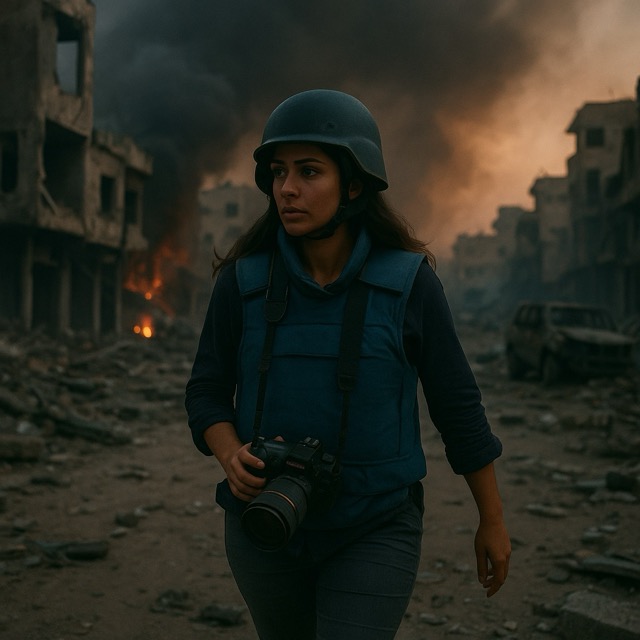
BEIRUT / LONDON – She is 22. For safety we will call her Leila. In April she crossed the border and boarded a flight to Europe with two changes of clothes, a camera wrapped in a sweater and a string of phone numbers scribbled in the margin of a notebook. She keeps the blue vest she used to wear while reporting — the one that normally says PRESS — folded at the bottom of a suitcase in a rented room.
“I didn’t take it for protection,” she tells us, twisting the strap of her camera. “I wore it so they could aim more precisely.” The words land like gravel. Leila says she saw colleagues die while doing the basic work of journalism: filming, asking names, waiting for confirmation. She left Gaza in April 2025 after months of documenting bombardments, displacement and hunger, then burying friends and moving again. “I could not sleep. I could not keep my hands steady. But I felt worse when I stopped.”
In recent days, the killing of multiple journalists in Gaza has again forced the question of protection for the press into the center of the world’s attention. The Committee to Protect Journalists (CPJ) and Reporters Without Borders (RSF) say this is the deadliest conflict for reporters since their records began; counts vary by methodology, but both groups have documented hundreds of media workers killed since October 7, 2023, most of them Palestinian. Their names now punctuate vigils from Ramallah to Rome.
Israel’s military says it does not intentionally target journalists and has accused some local reporters of belonging to militant groups — allegations news organizations and watchdogs reject and which independent bodies have urged to investigate. After a strike this week that killed Palestinian media workers near Gaza City’s Al‑Shifa Hospital, calls for an independent inquiry grew louder, including from the United Nations and press‑freedom groups. The clash of narratives is familiar; the scale of the death toll is not.
Leila’s account is both intensely personal and painfully ordinary. She describes a morning of ‘fire belts’ — waves of munitions rolling across a neighborhood — and the afternoon she interviewed a father outside a tent city who could no longer taste food. She recalls the first time she learned to record voice notes with a blanket over her head to muffle the blasts, and the night her editor told her to stop transmitting because the signal might make them a target. “I kept thinking: if I die, at least please let the video upload first,” she says.
Her testimony is part of a pattern documented by local unions and international organizations: power cuts and network blackouts that make verification harder; restrictions on international media access; the physical and psychological exhaustion of working in a place where almost nothing is safe. CPJ, RSF, the International Federation of Journalists and others have pushed for humanitarian corridors and protective equipment, while the Foreign Press Association repeatedly demands unfettered access for outside reporters. In practice, Gaza’s chronic isolation means most of what the world sees is produced by the same handful of local journalists who were living the story long before it became headline news.
Context matters. The war began after Hamas’s October 7 attacks on Israel, which killed roughly 1,200 people and led to mass abductions. Israel’s campaign in Gaza since then has killed tens of thousands of Palestinians and displaced nearly the entire population, according to UN and health‑agency tallies. Aid agencies warn of famine conditions and the collapse of healthcare. In July and August, strikes intensified around Gaza City again as ceasefire talks stalled. Civilians — including those who report the war — continue to absorb the shock.
Leila left in April when a route briefly opened, after months of trying. She does not want the details printed — the broker’s name, the checkpoint sequence — for fear others will be punished. She is now piecing together a freelance life between Arabic and English, pitching stories to editors she has never met in person. Some nights she wakes up panicked because the sky is too quiet. “In Gaza I learned to work while afraid,” she says. “Outside, I am learning to sleep while safe.”
What she cannot accept, she says, is the silence. “I survived. Many did not. I am asking why you do nothing,” Leila says, her voice steady. She is not addressing one government — any government — so much as a public that, in her view, has become numb. The plea has echoed across social media since the weekend’s killings: protect journalists; open the borders to aid; hold those responsible to account. In capitals that have condemned attacks on the press, concrete steps are slower to tally.
Israel’s government insists its campaign targets Hamas and other armed groups, and that it investigates alleged wrongdoing by its forces. Human rights organizations say those mechanisms lack credibility and call for independent, international inquiries; the UN human rights office and some European governments have joined those calls. The laws of war are clear: journalists are civilians and must be protected. Proving intent in the fog of urban combat is complicated, but the pattern of fatalities has prompted extraordinary alarm among media advocates.
In conversations with peers, Leila toggles between grief and the ordinary anxieties of a 22‑year‑old. She worries about visas and tuition and rent, and whether she will ever feel at home in a city where the wind smells different. She also worries about work: that editors will call only when the worst happens; that audiences will eventually look away. “I don’t want to be famous for dying,” she says. “I want to be known for my stories.”
Her phone is a ledger of loss. Scroll and you find the newsroom WhatsApp groups now frozen; the selfie taken the morning a colleague was killed; the GPS pin that marks where she last saw her neighborhood standing. The press vest is a relic from another life, one she cannot quite abandon. “Sometimes I put it on,” Leila admits. “I remember how heavy it felt. I remember how people looked at us: like we were both witnesses and targets.”
If there is a path forward, it threads through the mechanics of accountability and the practicalities of safety. Press‑freedom groups want protective clauses written into ceasefire arrangements; insurers and editors are being urged to provide trauma support; universities are expanding remote fellowships for displaced reporters. None of it substitutes for a durable political solution or for real access on the ground. But it may keep more journalists alive long enough to do their jobs.
Leila, for now, is staying put. She checks in daily with friends still inside Gaza — those who moved north again to chase a signal; those who sleep in the stairwell because it is the only place without windows; those who still carry cameras and keep lists of names. She is writing a long piece about a doctor who built a hospital ward out of plywood. She says she will go back when she can. “I do not want to be the story,” she says. “I want to keep telling it.”
Her demand is blunt: stop normalizing the killing of journalists. Count them. Name them. Investigate every strike. Extend visas and safe passage to those who flee and the right to work to those who stay. Do not confuse neutrality with indifference. “You can argue politics forever,” Leila says. “But you cannot argue with a camera that has recorded a death.”
Editors’ note: This interview has been condensed and the subject’s name changed for security reasons. Allegations of deliberate targeting are the witness’s account; the Israeli military denies intentionally targeting journalists. This article draws on verified reporting from press‑freedom organizations and international agencies about casualty figures, restrictions on access and recent incidents involving media workers in Gaza.
Sources (accessed August 12, 2025):
• CPJ — “Israel kills Al Jazeera journalists in targeted Gaza City airstrike,” Aug. 10–12, 2025. https://cpj.org/2025/08/israel-kills-al-jazeera-journalists-in-targeted-gaza-city-airstrike/
• CPJ — Full coverage: Israel–Gaza war (journalist casualties, analysis). https://cpj.org/full-coverage-israel-gaza-war/
• Reuters — “Israel bombards Gaza City overnight…,” Aug. 12, 2025 (context and casualty estimates). https://www.reuters.com/world/middle-east/israel-bombards-gaza-city-overnight-hamas-leader-due-cairo-bid-salvage-ceasefire-2025-08-12/
• Reporters Without Borders — Call for emergency UN Security Council meeting after targeted strike kills media workers, Aug. 2025. https://rsf.org/en/gaza-rsf-calls-emergency-un-security-council-meeting-after-targeted-israeli-strike-kills-six-media
• AP News — “Israel targets and kills Al Jazeera correspondent Anas al‑Sharif…,” Aug. 2025. https://apnews.com/article/mideast-wars-gaza-journalist-jazeera-c7d73f1d3cfa3d24fb4ce5a294c08d32
• UN OCHA / ReliefWeb — Humanitarian Situation Update (Gaza), Aug. 2025. https://reliefweb.int/report/occupied-palestinian-territory/humanitarian-situation-update-311-gaza-strip

 The Tower Post