Economies of scale and factory automation are set to push down costs for armour and artillery as Europe accelerates rearmament, the CEO tells investors.
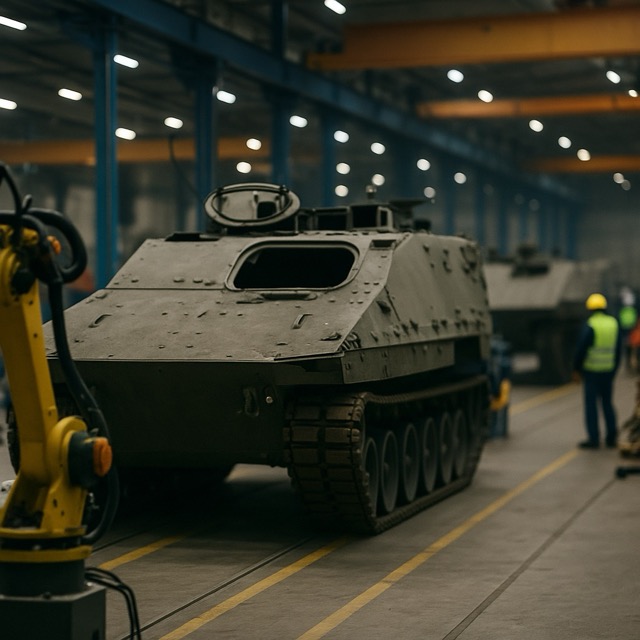
DÜSSELDORF – Germany’s largest arms maker believes some of its most expensive products are heading in the opposite direction. Armin Papperger, chief executive of Rheinmetall, said this week that the cost of tanks, armoured vehicles and heavy artillery is likely to fall over the next several years even as European defence budgets expand. The reason, he argued, is straightforward: a surge of multi‑year orders that finally allows industry to run at true scale, paired with a new generation of automated lines.
“When you build a few dozen platforms a year, every hour of labour and every supplier pause shows up in the price,” Papperger told analysts and journalists. “When you build in the hundreds, with robotics and repeatable modules, unit costs come down.” It is an industrial logic that has long governed the civil automotive sector and is now, he says, reshaping Europe’s land‑warfare business.
The claim lands amid Europe’s most aggressive rearmament drive in decades. Berlin is preparing a wave of procurement — including as many as 3,000 Boxer 8×8 vehicles and thousands more infantry fighting vehicles — as part of a broader plan to rebuild the Bundeswehr. Similar programmes are under way from Warsaw to Stockholm, while EU schemes channel money toward ammunition, missile and air‑defence production. For prime contractors from Rheinmetall to KNDS and Patria, the pipeline is suddenly long and predictable.
For Rheinmetall specifically, the order book has swelled to more than €63 billion in the first half of the year, and the company expects it could top €120 billion by mid‑2026 if German and NATO orders arrive on schedule. Management still guides for 25–30% sales growth in 2025 with an operating margin in the mid‑teens, despite a second quarter in which contract awards were pushed to the right during Germany’s government transition.
Ammunition shows the dynamic most clearly. Since 2022 the group has poured cash into propellant plants, fuze lines and projectile assembly across Germany, South Africa, Spain and other sites. Executives say the expansion is finally large enough to reverse the post‑pandemic price spiral: as factories run three shifts and suppliers sign longer contracts for explosives and metals, shell prices have begun to ease. Rheinmetall now targets around 1.5 million 155‑mm rounds a year by 2027, compared with a small fraction of that before Russia’s full‑scale invasion of Ukraine.
The strategy on vehicles mirrors that playbook. The Boxer, a modular 8×8 developed with KMW, is being ordered in blocks big enough to smooth the learning curve for welding, hull machining and turret integration. The same is true, executives say, for Puma infantry fighting vehicles and for Leopard‑family programmes in which Rheinmetall supplies turrets, guns and upgrades. Standardisation across customers — identical drivetrains, fire‑control computers and protection kits — is meant to limit costly mid‑run changes.
Automation is the other lever. At new Rheinmetall facilities in Germany and Central Europe, robots now handle repetitive and precision‑critical stages like hull seam welding, bore finishing on 120‑mm guns, and the placement of explosive fills. Digital “twins” track each hull, turret and projectile from raw steel to final test, feeding back data to cut scrap rates and maintenance downtime. The company says the result is higher throughput with fewer stoppages — and lower unit costs.
There are caveats. In July, Rheinmetall won its largest‑ever ammunition contract for its South African subsidiary, yet the civilian automotive business remains a drag and the ramp‑up is expensive. A new site in Weeze, where the group will produce components for the F‑35 fighter, weighed on margins in the latest quarter. And even with robotics, bottlenecks persist in chemicals such as nitrocellulose and in specialised castings.
Pricing power, too, is a moving target. While Papperger insists the company has not raised price lists to pass through general inflation, margins ultimately depend on throughput, warranty performance and how governments structure risk in long‑term frameworks. Many buyers are now demanding open‑book contracts and indexation clauses; large orders arrive with strict domestic‑content rules and penalties for delay. The upside for industry is visibility: 10‑ and 15‑year schedules allow suppliers to invest.
For the Bundeswehr, economies of scale could save billions if they materialise. Berlin’s plan envisions an unprecedented refresh of its armoured fleet over the next decade, with concurrent buys of Boxer and Patria vehicles and upgrades for Leopard tanks and Puma IFVs. Deliveries are slated to stretch to the mid‑2030s. Defence planners say block orders should lock in lower per‑unit prices, but warn that training and sustainment — crews, spare parts, depots — will determine lifetime costs.
The broader European picture is similar. According to industry disclosures and satellite imagery analysis published this summer, arms factories across the continent are expanding at roughly triple their pre‑war pace, adding new halls for shells, rocket motors and air‑defence systems. EU programmes, including the Act in Support of Ammunition Production and its follow‑on funds, are helping to reduce financing risk for new capacity. Even so, analysts note that engines for long‑range missiles and explosive fillers remain constrained, creating competition for inputs that could slow cost declines.
Rheinmetall’s push into automation is as much about labour as it is about speed. Germany faces shortages of welders, machinists and test engineers. The group has responded with apprenticeship pipelines, more modular subassembly work that can be distributed among suppliers, and collaborative robots that can be overseen by fewer, higher‑skilled operators. Management argues that these changes, while capital‑intensive, will pay off as volumes stabilise.
Shareholders are watching execution. After a multi‑year rally that turned Rheinmetall into a DAX heavyweight, the stock wobbled last week when quarterly results missed consensus on contract timing and ramp‑up costs. Analysts broadly kept positive ratings, betting that the backlog and fresh German programmes will outweigh near‑term bumps. The company’s guidance leaves room for upside if large framework agreements land in the second half.
For governments, falling sticker prices would be politically useful. Higher defence budgets are colliding with pressures to fund healthcare and social programmes. Cheaper platforms, or at least slower cost growth, could mute criticism as procurement plans swell. But procurement officials caution that the test will be reliability: equipment must arrive on time and perform as promised. Several European armies have pushed suppliers to agree to stricter availability targets and faster spare‑parts logistics.
On the ground, the immediate impact will be felt first in ammunition. European stockpiles of 155‑mm shells have been depleted by Ukraine’s needs and training demands. Rheinmetall says each new batch run reduces cycle time and waste; unit prices, while still elevated compared with 2019, are already trending down as suppliers sign multi‑year deals for steel bodies, explosive fills and fuzes. If artillery lines hit nameplate in 2026‑27, officials expect a clearer downward trend.
Armoured vehicles will take longer. New lines for hull welding and turret assembly require months of qualification before the first serial deliveries. Even then, early units cost more as teams climb the learning curve. The promised savings, Papperger says, appear once factories settle into rhythm and software updates are delivered in blocks rather than piecemeal.
Beyond Europe, Rheinmetall is chasing growth in the United States and Australia and has pledged to localise production where possible. The group has also signalled interest in broadening into naval systems through partnerships — a hedge against swings in the land‑warfare cycle. For now, however, the company’s centre of gravity remains tanks, infantry vehicles and artillery, and the bet is that more volume plus more automation will bend the cost curve.
The next twelve months will show whether that thesis holds. If Berlin finalises the massive armour framework deals now in draft and EU funds continue to de‑risk new capacity, suppliers across the Rheinmetall ecosystem say they can plan in years rather than quarters. That is when factories invest, scrap rates fall and prices follow. In an industry accustomed to scarcity and small lots, scale is itself a revolution.
Sources:
• Financial Times — “Rheinmetall chief says tanks to get cheaper as defence spending surges,” Aug. 12, 2025.
• Reuters — “German defence group Rheinmetall cites contract delays in forecast miss,” Aug. 7, 2025.
• Reuters — “Germany prepares huge orders for jets, armoured vehicles,” July 29, 2025.
• Reuters — “Rheinmetall expects robust 2025 sales amid Europe’s defence push,” Mar. 12, 2025.
• Rheinmetall press release — “Rheinmetall wins major order for artillery ammunition,” July 2–3, 2025.
• Financial Times — “Europe builds for war as arms factories expand at triple speed,” Aug. 2025.

 The Tower Post