In 2025, waves of one‑way UAV attacks on bases and oil infrastructure reveal the limits of Baghdad’s control over Iran‑aligned militias—and the enduring threat from ISIS cells.
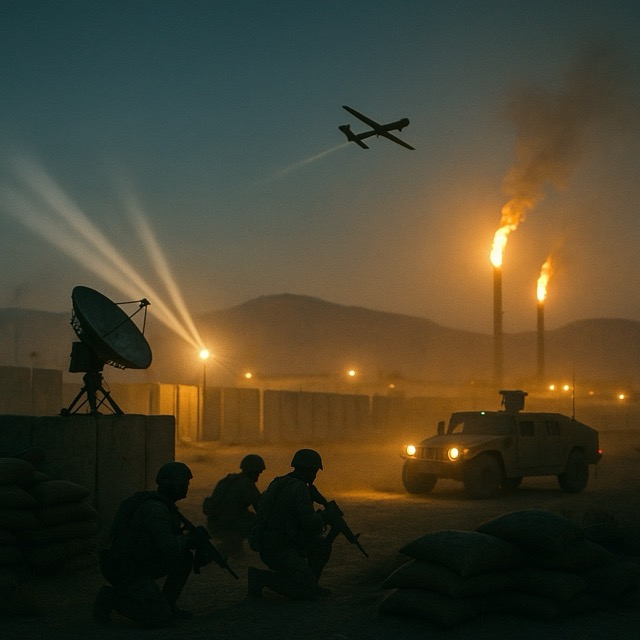
BAGHDAD —The first half of 2025 has underscored a stubborn truth about Iraq’s security landscape: the country is living through an uneasy, low‑to‑medium‑intensity conflict in which state forces, Iran‑aligned militias and the remnants of the Islamic State group (ISIS) jostle for power and leverage. The most visible sign of that struggle has been a rash of one‑way drone strikes that have hit military sites and critical energy infrastructure from the Baghdad belt to the Kurdistan Region. The attacks have not produced mass casualties, but they have exposed gaps in air defenses, rattled investors, and raised fresh questions about who ultimately holds the monopoly on force.
A summer of drones. On June 24, Iraqi authorities said several military sites and bases operated by the security forces were targeted by small unmanned aircraft, with two army radar systems—at Camp Taji, north of the capital, and at Imam Ali air base in Dhi Qar province—reported as severely damaged. No casualties were recorded, but the incidents triggered an immediate investigation from the prime minister’s office and highlighted the vulnerabilities of point‑defense assets against low‑cost UAVs.
Then, in mid‑July, one of the most disruptive salvos in years struck the northern energy heartland. Over three days between July 14 and 16, drones hit or forced shutdowns at multiple oil fields across the Kurdistan Region, including Khurmala, Sarsang, Tawke, Peshkabir and Ain Sifni. Regional authorities described the material damage as significant. Operators including Norway’s DNO and Gulf Keystone Petroleum temporarily suspended production at key assets while teams assessed impact. At the peak, officials and company statements indicated output fell by roughly 140,000–150,000 barrels per day—about half the region’s reported production—before gradual restarts. There were no reported injuries.
No group claimed responsibility for the oil‑field strikes, but Kurdish security officials pointed to suspected launch areas where factions within the Popular Mobilization Forces (PMF) hold sway. The United States and the United Kingdom condemned the targeting of civilian energy infrastructure, and Baghdad ordered inquiries while Erbil appealed for stronger protection of vital facilities and workers. The incidents fit a broader pattern: northern gas and oil installations—including the Khor Mor gas complex—have faced repeated drone harassment in recent years, undercutting electricity supply and complicating investment.
The militia–state knot. The summer’s shocks coincided with Prime Minister Mohammed Shia’ al‑Sudani’s push to discipline armed groups that, while legally folded into the PMF, still operate with degrees of autonomy. On July 27, an armed raid by fighters linked to Kataib Hezbollah on Baghdad’s Agriculture Directorate sparked a gun battle with federal police that left three people dead. A government investigation blamed rogue actors inside the PMF; within days, al‑Sudani ordered the removal of commanders from two brigades and referred suspects to the judiciary—his strongest move yet to impose accountability.
Analysts say the posture reflects a narrow path: Baghdad needs the PMF as part of its security architecture and political coalition, yet it must curb formations that risk dragging Iraq into regional conflagrations or attacking state institutions. Indeed, during June’s sharp Israel–Iran escalation, Iraq‑based factions largely heeded calls for restraint and avoided direct attacks on U.S. facilities in Iraq. Weeks later, however, a domestic wave of unclaimed drone strikes hit energy sites—demonstrating how restraint toward external adversaries does not preclude calibrated pressure at home.
Diplomacy has tried to keep pace. On August 11, Ali Larijani, secretary of Iran’s Supreme National Security Council, visited Baghdad for talks that produced a memorandum on security coordination along the countries’ long border. Iraqi officials framed the step as part of an effort to prevent security breaches by any side using Iraqi territory or airspace during regional crises—an implicit nod both to pro‑Iran factions inside Iraq and to reported overflights by foreign militaries. For al‑Sudani, balancing Tehran and Washington while asserting state primacy remains a daily act of political geometry.
ISIS in the shadows. While drones dominate headlines, Iraq’s counter‑insurgency against ISIS continues as a grinding, intelligence‑led campaign focused on rural belts and mountain redoubts—especially along the Hamrin‑Makhoul arc and in parts of Diyala, Kirkuk and Salah al‑Din. Security officials and independent researchers report that ISIS has been attempting to reactivate sleeper cells and recruit since the spring, taking advantage of regional distractions and the seams between federal and Kurdish‑controlled areas. U.N. and Western estimates put the group’s active cadre in the low thousands across Iraq and Syria, far below its peak but still sufficient to mount IED ambushes, extortion and sporadic raids.
Iraqi special forces and federal police conduct near‑daily raids, often supported by aerial surveillance and precision strikes. For now, the tempo of ISIS violence remains well below levels seen several years ago, but the group’s ability to regenerate when pressure eases—particularly in disputed territories—keeps planners wary. Efforts to better integrate intelligence between the defense and interior ministries, and to tighten cross‑border coordination with Syria, are central to maintaining momentum.
An international mission in transition. The U.S.‑led coalition that returned in 2014 to help defeat ISIS is preparing to wind down its formal mission in Iraq in 2025, with a shift toward a more conventional bilateral security relationship and the closure of some longstanding bases. NATO Mission Iraq, a separate, non‑combat advisory and capacity‑building effort requested by Baghdad, continues to expand training and institutional support for the defense establishment. The transition reflects confidence in Iraqi forces’ capabilities, but it also raises the stakes for the government to manage militia dynamics and sustain pressure on ISIS without as much international scaffolding.
Energy, livelihoods and law. The mid‑July drone strikes did more than dent production figures; they spotlighted how insecurity intersects with the Kurdistan Region’s fiscal troubles and long‑running disputes with Baghdad over budget transfers and oil governance. Human‑rights advocates warn that damaging energy infrastructure risks secondary harms—interruptions to electricity supply, knock‑on effects for public services, and new pressure on already‑stretched provincial budgets. With teachers and health‑care workers in the region already facing delayed or partial salaries, the latest disruptions risk deepening social strain unless a durable fiscal settlement is reached.
What comes next depends on whether the state can narrow the space in which armed factions operate autonomously—and whether regional actors refrain from turning Iraq into a launchpad or a battleground. Strengthening layered air defenses around critical sites; professionalizing the PMF under clear legal authorities; and deepening cooperative mechanisms with the Kurdistan Regional Government could all reduce risk. So, too, could a transparent investigative track that actually publishes findings on major attacks and holds perpetrators to account—including those embedded within state structures.
For ordinary Iraqis, the question is simpler: can the country’s institutions protect them and the economy at the same time? The answer, in 2025, remains provisional. The state has chalked up tactical wins against ISIS cells and shown flashes of resolve against undisciplined militias. But without consistent enforcement, credible deterrence and a politics that puts public safety above patronage, the drones will keep coming—and Iraq’s slow‑burn conflict will continue to smolder.
Reporting notes: This article draws on official Iraqi statements and open‑source reporting (June–August 2025) by Reuters, the Associated Press, Human Rights Watch, NATO Mission Iraq publications, and reputable research institutes.

 The Tower Post