Rivals are converging on the same finish line: a workable, fault‑tolerant quantum computer by the end of the decade. The road there runs through error correction breakthroughs, modular hardware, and a scramble for talent and fabs.
MOUNTAIN VIEW / YORKTOWN HEIGHTS — The two most visible antagonists in quantum computing are, unexpectedly, aligned on a date. Both Google and IBM now tell investors, customers and governments that a full‑scale, production‑grade quantum computer is feasible before the decade closes. Not a lab curiosity, not a benchmark win, but a system that can run fault‑tolerant algorithms end to end — with enough logical qubits to solve problems classical supercomputers cannot touch.
That posture marks a shift from years of demos and milestone one‑upmanship. Since 2019, when Google declared a controversial “quantum supremacy” experiment, the conversation has matured from raw qubit counts to quality, scaling and, above all, error correction. IBM, for its part, has pivoted from ever‑bigger chips to architectures that privilege stability and modular growth. The result is a race defined less by marketing and more by engineering: who can stitch thousands of noisy physical qubits into hundreds of dependable logical ones, and keep them running long enough to do useful work.
Why 2030 no longer sounds like science fiction
Two ingredients are driving new confidence. First, cumulative progress in error correction — the software‑with‑hardware discipline that encodes a single logical qubit across many physical qubits and continuously detects and fixes faults. Break‑even experiments over the past two years showed that better codes, calibration and control electronics can push logical error rates below the best physical ones. Second, advances in modularity and cryogenic integration have lowered the friction of adding more qubits without killing coherence. Taken together, the field has moved from proving that error correction works to tallying how many racks, cryostats and wafers are needed to hit target logical‑qubit counts.
Different playbooks, shared destination
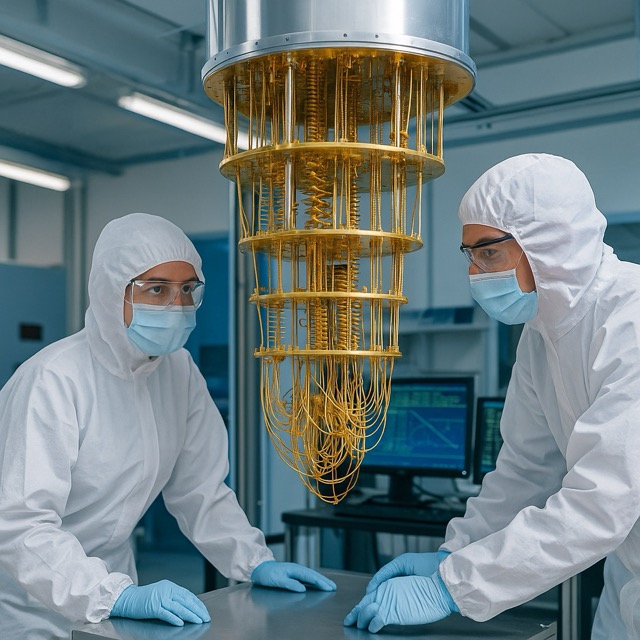
Google is betting on tiled arrays of superconducting qubits, fast feed‑forward control and aggressive error‑correction codes that exploit its custom control stack. Its near‑term roadmap calls for modular clusters — think multiple dilution refrigerators linked with cryo‑microwave interconnects — each hosting patches of code‑distance‑growing logical qubits. The company argues that tighter hardware‑software co‑design will reduce overheads so that useful logical qubits arrive with fewer physical qubits than skeptics expect.
IBM, by contrast, has emphasized stability and predictable growth. After years of transmon scaling and a shift to higher‑fidelity ‘quality‑first’ chips, Big Blue is rolling out a second‑generation System Two fleet designed to network multiple processors through cryogenic links and, over time, optical interconnects. Its pitch: a grid of smaller, cleaner modules that can be composed into a larger machine — a data‑center‑like approach to quantum capacity that dovetails with enterprise customers and cloud delivery.
What a ‘workable’ system actually means
The phrase has a precise definition inside labs. A workable, full‑scale machine must: (1) provide a stable pool of logical qubits with error rates low enough to run hours‑long circuits; (2) support fast, reliable mid‑circuit measurement and feed‑forward; (3) deliver compiler toolchains that map algorithms to hardware without exploding overhead; and (4) pass independent verification that the output cannot be reproduced by classical machines. By those criteria, neither Google nor IBM is there yet — but both say their error budgets and control stacks finally point to a credible path.
The killer apps take shape
Forget vague talk of “breaking encryption tomorrow.” The first economically meaningful wins are more prosaic and lucrative: chemistry for battery materials and catalysts; simulation of strongly correlated systems relevant to chips and superconductors; tail‑risk estimation in finance; and optimization inside logistics and manufacturing. All require long, structured circuits that punish errors and reward architectures with fast feedback and low‑latency control — precisely where today’s efforts are concentrated.
The walls that still stand
• Overhead math. Even with better codes, a single logical qubit can consume hundreds to thousands of physical qubits. Budgets that look fine on a whiteboard can collapse in the face of calibration drift, cross‑talk and thermal noise.
• Wiring and heat. Routing control lines and readout for tens of thousands of qubits through a dilution refrigerator is a brutal packaging problem. Teams are experimenting with cryo‑CMOS, multiplexed control and photonic links to move signals without dumping heat.
• Verification. Proving quantum advantage for practical workloads demands new benchmarks and audit trails. Customers will expect cryptographic‑style proofs and reproducible workflows, not just press releases.
• People. Full‑stack quantum needs RF engineers, low‑temperature physicists, compiler writers and error‑correction theorists in the same room. The talent market is tight; poaching wars are real.
Standards, governance and the crypto question
As timelines compress, the policy conversation grows louder. Governments want credible roadmaps for post‑quantum cryptography adoption and timelines for migrating critical systems. Both companies support the move to lattice‑based standards in public‑key infrastructure even as they race to build machines that, in theory, could threaten legacy algorithms years down the line. Expect customers to demand ‘crypto impact statements’ alongside any claims of algorithmic breakthroughs.
Who gets paid — and when
Follow the money. The near‑term market will be dominated by cloud access to early fault‑tolerant prototypes, consultancy‑style co‑development of algorithms and toolchains, and premium support on hybrid classical‑quantum workloads. Hardware sales will trail services; think mainframe economics rather than smartphone cycles. Investors should watch utilization rates on quantum cloud platforms and whether customer pilots convert into multi‑year commitments tied to specific chemistry or optimization goals.
A crowded track outside the duopoly
Google and IBM are not alone. Photonic‑qubit startups tout room‑temperature scaling; trapped‑ion players argue for superior fidelities even if clocks run slower; neutral‑atom outfits promise flexible geometries. Several contend they can reach fault tolerance sooner with smaller teams and bespoke architectures. Whether those bets intersect the end‑of‑decade timeline or land just after it, the competition is forcing Google and IBM to show not just roadmaps, but progress visible to users.
Signals to watch between now and 2030
• Annual, audited logical‑error‑rate reports — not just physical gate fidelities.
• Growth in code distance achieved on full‑stack systems accessible via cloud, with third‑party replication.
• Demonstrations of mid‑circuit feed‑forward at scale, integrated with compilers that ordinary developers can use.
• End‑to‑end runs of chemistry or optimization workloads where independent labs verify quantum advantage beyond classical heuristics.
• Evidence that modular clusters can be added without degrading coherence — the litmus test for true scaling.
The bottom line
The next four years will decide whether quantum leaves the lab and enters the data center. Google and IBM believe they can cross the line by the end of the decade; the difference now is that they are publishing the engineering math to back the claim. If error correction continues to compound and modular designs hold up under load, the first workable, fault‑tolerant systems will arrive not as a single ‘big bang’ chip but as the quantum equivalent of a server rack — humming, upgradeable and, finally, useful.




 The Tower Post