ASEAN-brokered truce ended the July 24–28 firefights, but August brings landmine injuries, dueling accusations and a test of regional diplomacy
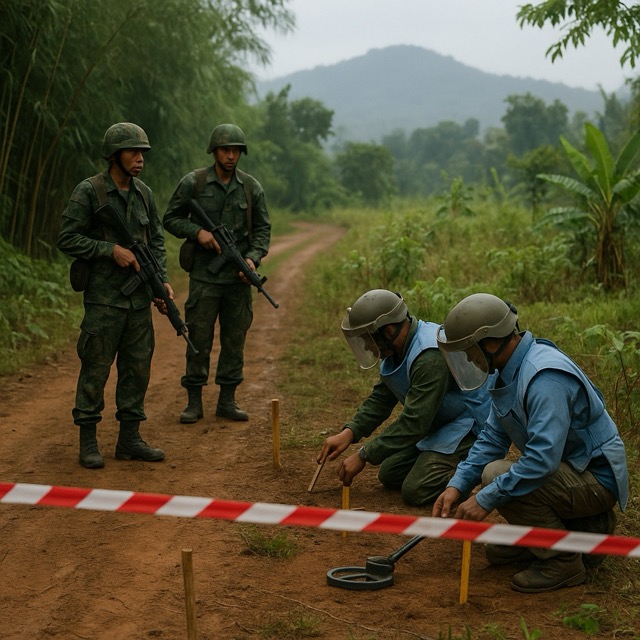
SURIN PROVINCE / ODDAR MEANCHEY — Two weeks after Thailand and Cambodia agreed to an “immediate and unconditional” ceasefire, the frontier remains anything but quiet. Patrols still move warily along red-dirt tracks that cut through bamboo thickets and cassava fields. Warning tape flutters beside suspected mine belts. And from Bangkok to Phnom Penh, officials trade statements that mirror the border’s jagged contour: cautious, brittle and edged with blame.
The five days of firefights that erupted on July 24 ended at midnight on July 28, after marathon talks in Putrajaya led by Malaysia — this year’s ASEAN chair. The deal, hailed as a vital first step, froze positions along multiple flashpoints dotted across the 800‑kilometer frontier, many near temple complexes and undemarcated ridgelines. But a ceasefire is not a settlement, and August has already underscored how vulnerable the truce remains.
On August 12, a Thai soldier was badly wounded when he stepped on a landmine roughly a kilometer from the Ta Moan Thom temple in Surin province, according to the Thai army. Bangkok accused Cambodian forces of violating both the ceasefire and the Ottawa Treaty’s ban on antipersonnel mines. Phnom Penh rejected the charge, insisting any explosives were remnants of past conflicts and faulting Thai patrols for straying from agreed routes. The incident was the fourth mine blast reported in recent weeks, and the rhetoric was swift: each side accused the other of playing politics with the ceasefire.
Local residents feel the ceasefire’s fragility in practical ways. Markets that emptied during the shelling have refilled only partially. Aid groups say hundreds of thousands fled during the late‑July fighting; many have trickled back, but uncertainty lingers. Cambodian migrant workers — the backbone of industries from poultry to construction in Thailand — have streamed home by the hundreds of thousands amid safety fears and confusing rumors. Economists warn of a looming income shock for families dependent on remittances; some lenders are already fielding calls about loan deferrals.
A border with long memories
The current flare‑up traces old lines. Disagreement over maps drawn in the French colonial era left swathes of the boundary undemarcated. Past skirmishes clustered around sacred sites like Preah Vihear and the Ta Krabey/Ta Moan temple group, where geography and symbolism collide. July’s escalation followed months of tension, including deadly incidents in May, and quickly spread along several sectors as artillery, rockets and, on at least one day, airpower were brought to bear. By the time the guns fell silent, scores were dead and more than 300,000 civilians had been displaced, according to officials and relief groups.
Malaysia’s mediation was as much a signal as a solution. The optics of Thai and Cambodian leaders seated next to Prime Minister Anwar Ibrahim in Putrajaya mattered: the region policing its own crisis. The terms were spare — stop shooting, open channels, keep talking — but they created political space for follow‑on steps. Within days, defense ministers gathered in Kuala Lumpur to refine arrangements and, crucially, to discuss monitors.
Monitors — with limits
On August 7, the two sides agreed to allow ASEAN observation teams to help watch the ceasefire. The interim mechanism, led by Malaysia and drawing from regional defense attachés, is slated to operate from bases in each country rather than straddling the contested terrain itself — a concession to sovereignty that also limits what monitors can directly verify. Even so, the presence of outside eyes has already influenced behavior: field commanders say they spend more time on hotlines than on forward moves, and the heaviest weapons have stayed quiet.
The monitors cannot, however, defuse the core source of August’s tension: mines. Thailand says newly laid antipersonnel devices have been found in “ready‑to‑deploy” condition on or near patrol routes, pointing to specific Soviet‑designed models. Cambodia counters that it has long been a champion of demining, that any finds are legacy munitions in old belts warped by weather, and that Thai troops are pushing beyond agreed lines. Either way, every blast slices into public confidence. For villagers, the dispute is not abstract; it is the risk of a footstep in the wrong place.
The human ledger
The fighting’s civilian cost spans both sides of the frontier. In late July, evacuation centers in Thailand filled with families from border hamlets, classrooms turned into dormitories, and small businesses shuttered in towns like Phu Sing and Kantharalak. Across the line, Cambodian provinces such as Oddar Meanchey and Banteay Meanchey saw surges of displaced people sheltering in pagodas and warehouses. Aid workers describe shortages of clean water, cooking gas and basic medicines, compounded by monsoon downpours that turned camps into mud.
Then there are the migrants. Thailand hosts well over a million Cambodian workers in normal times. After the fighting erupted, buses and pickup trucks ferried tens of thousands home within days; by mid‑August, officials and reporters were counting returnees in the hundreds of thousands. For families who borrowed to finance migration, a forced homecoming can flip household balance sheets from fragile to broken. “We can endure a slow week at the factory,” one returning worker said, “but not zero.” Employers on the Thai side have begun to complain of labor gaps, a reminder that stability is an economic as well as a security imperative.
Beijing, Washington — and ASEAN’s wager
The ceasefire’s endurance will be shaped by outsiders as well. China, which maintains close ties with both Bangkok and Phnom Penh, used a regional ministerial meeting this week to urge “lasting peace” and offered cooperation on border management and crime suppression. Washington’s top diplomat also pressed for de‑escalation in calls with both governments as fighting peaked in late July. But the actor with the most to prove is ASEAN itself: if the bloc’s monitors help tamp down incidents and build habits of communication, it will bolster a case for regional solutions that travel beyond this border.
What to watch next
Three practical issues will determine whether the truce hardens into stability or frays into another round of escalation.
First, mine action. A joint technical commission — ideally with ASEAN and neutral specialists — could log every explosion, map suspected belts, and agree on urgent clearance in zones where civilians move. Transparency on evidence would lower the temperature around allegations.
Second, lines and language. Even a provisional, shared map of patrol routes, no‑go zones and deconfliction lanes would reduce the risk of accidental contact. So would standardized, bilingual protocols for unit‑to‑unit communication — who calls whom, on what channel, using which grid reference system.
Third, people. Confidence is built by the return of routine: reopening markets, restoring cross‑border trade, switching displacement shelters back to classrooms before the new term, and making sure migrants aren’t punished for leaving or for staying. Small, visible wins will matter more than grand statements.
None of this will resolve the underlying dispute, which ultimately requires painstaking boundary work and political patience. But for now, success should be measured in quiet days: no rockets, no rumors, no fresh red tape cordoning off the footpath to the fields. The ceasefire stopped the shooting. Keeping the peace will take something harder — sustained attention.



 The Tower Post