Netanyahu poised to dictate the terms of Hamas’ surrender as the war enters its final phase
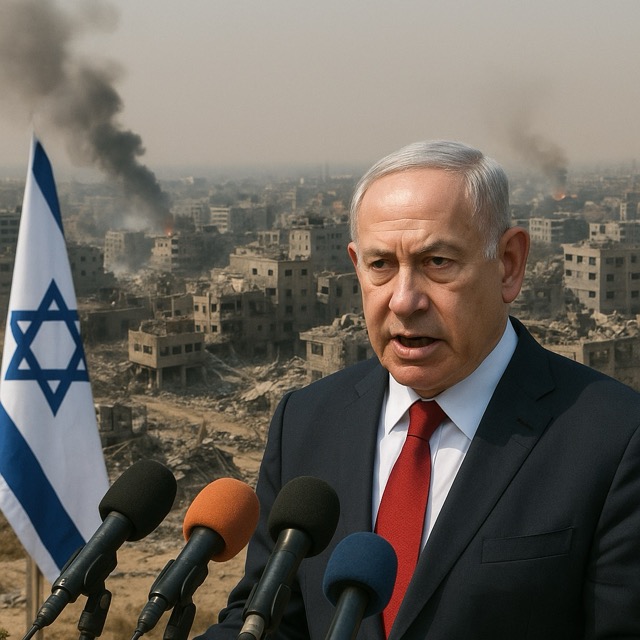
August 2025 – After nearly a year of relentless warfare in Gaza, the conflict appears to be approaching an uncompromising conclusion. Israeli Prime Minister Benjamin Netanyahu, emboldened by months of sustained military operations and broad domestic backing, has made it clear that the war will not end through negotiation, mediation, or partial concessions. Instead, according to officials close to his government, the only acceptable resolution is the complete capitulation of Hamas.
In public statements delivered this week in Jerusalem, Netanyahu asserted that “Israel will not tolerate half-measures” and emphasized that the ceasefires of the past decades—often fragile and short-lived—have only allowed Hamas to rearm, reorganize, and reignite hostilities. This time, he stressed, the calculus is different. The war will end, Netanyahu declared, “only when Hamas lays down its arms and unconditionally surrenders.”
The Human Cost
The war, now in its eleventh month, has exacted a devastating toll on both sides. In Gaza, entire neighborhoods have been reduced to rubble, with the civilian population enduring widespread shortages of food, water, and medicine. International aid agencies have repeatedly sounded the alarm about a humanitarian catastrophe, warning that reconstruction may take decades.
For Israel, the conflict has been equally costly in terms of military expenditure, loss of life, and a deep psychological toll on its citizens. Towns in the south remain under constant threat from sporadic rocket fire, and families have been displaced for months. Yet polls show a majority of Israelis still support Netanyahu’s hard line, convinced that only a decisive military victory will ensure long-term security.
The Diplomatic Front
The international community has watched with increasing concern. The United States, while continuing to supply Israel with defensive support, has privately urged restraint. European leaders have called for a negotiated settlement, while regional powers such as Egypt and Qatar have attempted to broker humanitarian corridors and temporary truces. None of these efforts have succeeded in halting the Israeli advance.
At the United Nations, resolutions demanding an immediate ceasefire have been blocked or watered down. In a rare move, several Arab states that once publicly aligned with Hamas have remained largely silent, wary of direct confrontation with Israel and preoccupied with their own domestic challenges.
Netanyahu’s Calculus
Analysts argue that Netanyahu views this conflict as a historic turning point—not only in Israel’s long struggle with Hamas, but also in his personal political career. Facing ongoing corruption trials and divisions at home, Netanyahu appears determined to cement his legacy as the leader who dismantled Hamas once and for all. His insistence on dictating the terms of surrender reflects a broader strategy: to ensure that no Palestinian armed group can challenge Israeli sovereignty again.
Those terms, officials suggest, are likely to include the complete disarmament of Hamas’ military wing, the dismantling of its tunnel infrastructure, and the handing over of its leadership to Israeli or international custody. Additionally, Israel is expected to demand full control over border security, at least for the foreseeable future, effectively limiting Palestinian self-governance.
The Future of Gaza
What comes after Hamas remains an open question. Some in Israel advocate for an internationally supervised administration, potentially involving Arab partners, to oversee reconstruction and maintain order. Others believe Israel may impose a more direct form of oversight, effectively reshaping Gaza’s governance to prevent any resurgence of militancy.
Critics warn that such a unilateral approach could backfire, fueling resentment among Palestinians and complicating relations with the broader Arab world. Human rights groups have also cautioned that collective punishment of Gaza’s civilian population risks entrenching cycles of hatred that no military solution can resolve.
Conclusion
As August 2025 unfolds, the war in Gaza stands at a decisive juncture. Netanyahu’s government insists that peace can only emerge through Hamas’ total surrender, rejecting half-steps or temporary ceasefires as insufficient. The prime minister appears resolute in his belief that dictating the conditions of capitulation will finally secure Israel’s future.
Whether this vision will bring lasting peace—or ignite further instability—remains uncertain. But for now, one reality is undeniable: the fate of Gaza, and perhaps the trajectory of the Israeli-Palestinian conflict for years to come, hinges on the stark demand of unconditional surrender.

 The Tower Post