
As the World Economic Forum opens amid renewed U.S. unilateralism, leaders confront fractures in the rules-based system and the rise of populist power.
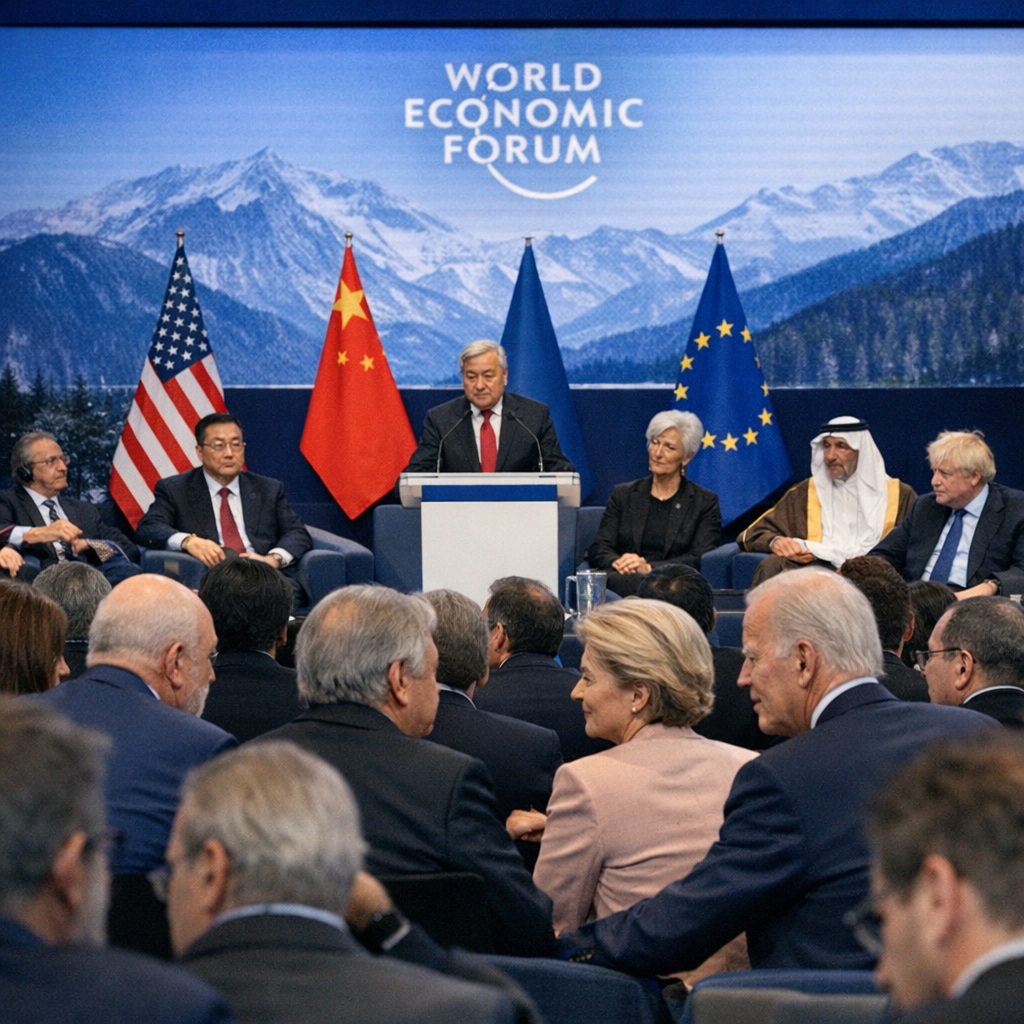
The snow-covered Alpine town once again becomes the temporary capital of global governance this week, but the mood inside its conference halls is markedly different. As political and business leaders gather for the World Economic Forum, the assumptions that long underpinned international cooperation are being openly questioned. Davos is no longer merely a place to fine-tune globalization; it has become a forum for debating whether the global order itself can still hold.
The return of Donald Trump to the center of U.S. political power has cast a long shadow over discussions. His renewed emphasis on “America First” policies, transactional diplomacy, and skepticism toward multilateral institutions has forced allies and rivals alike to reassess their strategies. The effect is not limited to Washington’s relationships; it is reshaping how the world thinks about rules, power, and legitimacy.
For decades, Davos symbolized confidence in a rules-based international system. Trade liberalization, open capital flows, and shared norms were treated as both inevitable and beneficial. This year, that confidence feels fragile. Panels and private meetings alike revolve around a single question: can global cooperation survive in an era defined by geopolitical rivalry and domestic political backlash?
U.S. policy shifts have become a focal point. Trump’s signals on trade, climate commitments, and security alliances have unsettled partners who once relied on American leadership as a stabilizing force. European officials speak more openly about strategic autonomy, while Asian economies quietly hedge their bets, strengthening regional ties even as they seek to avoid direct confrontation with Washington.
The uncertainty has amplified existing fractures. The war in Ukraine, unresolved tensions in the Middle East, and growing competition between major powers have already strained international institutions. Trump’s approach, participants argue, accelerates trends that were already underway: the erosion of trust in multilateral frameworks and the rise of power politics over shared rules.
Business leaders, traditionally among Davos’s most optimistic voices, sound more cautious this year. Executives warn that fragmented trade regimes and unpredictable regulation increase costs and discourage long-term investment. Supply chains, already reshaped by the pandemic and geopolitical shocks, now face the risk of further politicization.
Yet the conversations are not purely defensive. Some see opportunity in the disruption. Advocates of industrial policy argue that the old model of unfettered globalization failed to protect workers and communities, fueling the populist anger now reshaping politics. From this perspective, Trump’s challenge to orthodoxy forces a necessary reckoning with inequality and economic resilience.
Populism, once treated as a temporary disturbance, is now a central theme. Leaders from across continents acknowledge that public trust in elites and institutions has eroded. Davos itself has become a symbol of that disconnect, criticized as an exclusive gathering out of touch with everyday concerns. This year’s organizers have sought to address that perception by highlighting social cohesion, labor transitions, and inclusive growth.
Climate policy remains another fault line. While many governments and companies reaffirm commitments to decarbonization, uncertainty over U.S. engagement complicates global coordination. Smaller countries worry that uneven climate action will distort competition and undermine collective progress, even as extreme weather events underscore the urgency of cooperation.
Behind closed doors, discussions are more candid. Diplomats describe a world moving toward blocs rather than universality. Instead of a single global rulebook, there may be overlapping systems shaped by geography, values, and power. The challenge, they say, is preventing fragmentation from tipping into open conflict.
Despite the anxiety, Davos is not devoid of pragmatism. Participants emphasize adaptation over nostalgia. If the post-Cold War order is fading, they argue, new mechanisms must emerge to manage interdependence. That may mean smaller coalitions, issue-based alliances, and a greater role for regional institutions.
The tone of the meeting reflects this transition. Gone is the assumption that globalization will naturally converge toward liberal democracy. In its place is a more sober recognition of divergence — political, economic, and ideological. The task now is to navigate that divergence without abandoning cooperation altogether.
As the forum unfolds, Davos serves as both a mirror and a warning. It reflects a world unsettled by shifting power and contested values. It also warns that the costs of disengagement could be high. Whether leaders heed that warning remains uncertain.
What is clear is that Davos has entered a new era. No longer a celebration of consensus, it has become a testing ground for competing visions of the future. In the shadow of Trump’s return and a fractured global landscape, the forum’s relevance may depend on its ability to confront uncomfortable truths — and to imagine forms of cooperation suited to a less predictable world.

 The Tower Post