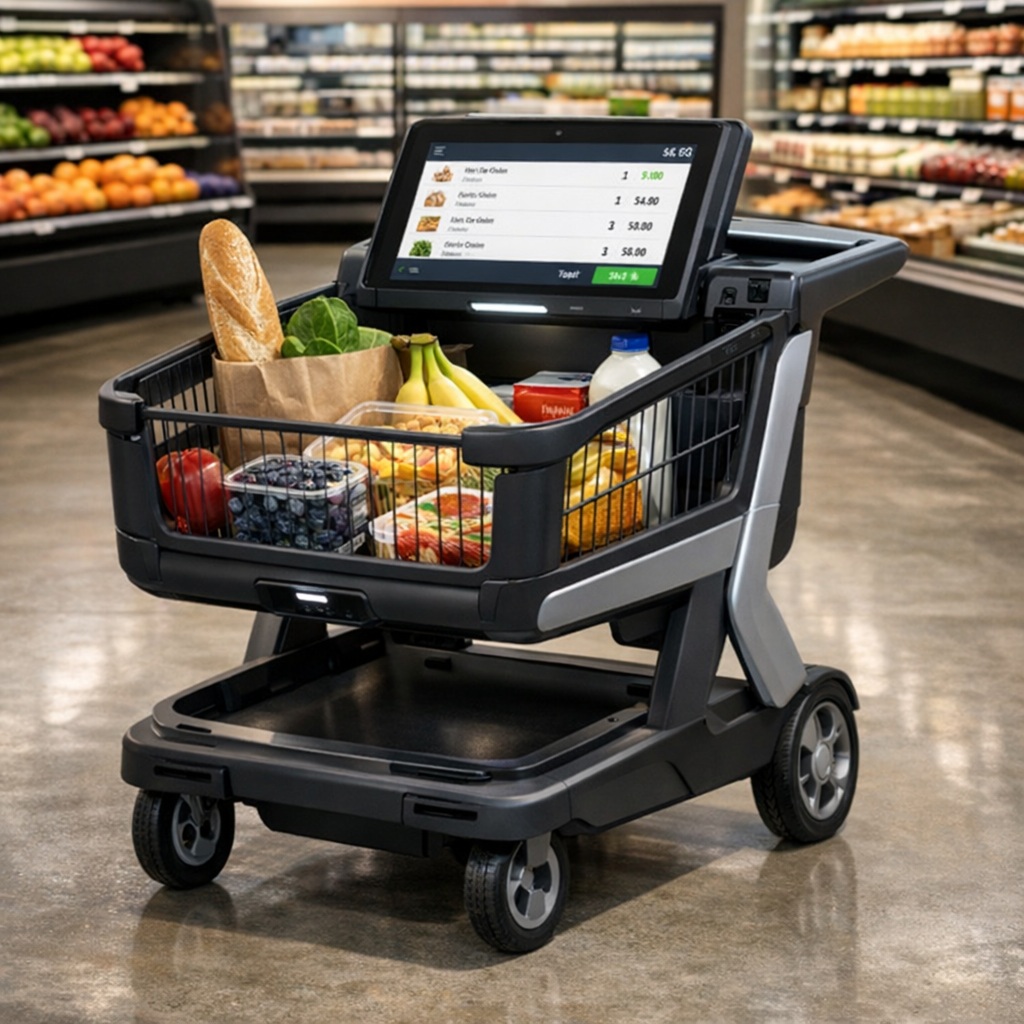
The e-commerce giant upgrades its AI-powered Dash Cart, blending physical retail with digital intelligence to streamline the in-store experience.
Amazon is once again testing the boundaries between online efficiency and brick-and-mortar retail. The company has unveiled a refreshed version of its Dash smart grocery cart, an AI-assisted device designed to make shopping faster, more intuitive, and increasingly frictionless. The rollout signals Amazon’s renewed commitment to reshaping how consumers navigate physical grocery stores at a time when convenience, speed, and personalization have become decisive factors in retail loyalty.
The updated Dash Cart builds on Amazon’s earlier experiments with cashierless shopping, but with a clearer focus on practicality and scale. Rather than transforming entire stores with complex sensor systems, the smart cart places intelligence directly in the hands of shoppers. Customers log in with their Amazon account, place items into the cart, and watch as an onboard screen automatically identifies products, tallies the total, and applies eligible discounts in real time.
At the heart of the refreshed Dash Cart is a more advanced artificial intelligence system. Amazon has improved its computer vision and sensor fusion technology, allowing the cart to better recognize a wider variety of products, including loose produce and irregularly shaped items. The system cross-references weight sensors, cameras, and product databases to reduce errors that previously challenged early smart-cart models.
Visually, the cart has also been redesigned. The new model features a slimmer profile, smoother edges, and a more responsive touchscreen display mounted at eye level. The interface presents a running receipt, personalized recommendations, and alerts for items that match dietary preferences or past purchases. For shoppers accustomed to digital lists and one-click purchases, the experience feels familiar, even reassuring.
Amazon positions the Dash Cart as a solution to one of physical retail’s most persistent pain points: checkout lines. Once shopping is complete, customers can simply exit through a designated lane, with payment processed automatically through their Amazon account. There is no need to unload items onto a conveyor belt or interact with a cashier, a feature that continues to resonate with consumers seeking speed and minimal friction.
Privacy and data use remain central to the conversation. Amazon states that the Dash Cart’s cameras are focused exclusively on items placed in the cart, not on shoppers themselves, and that data collected is used to improve accuracy and personalize the shopping experience. Still, the expansion of AI-powered retail tools is likely to draw scrutiny from regulators and consumer advocates concerned about transparency and consent.
For grocery retailers, the refreshed Dash Cart represents both an opportunity and a challenge. Amazon is offering the technology primarily within its own physical stores, but the broader implication is clear: smart carts could become a competitive necessity. By merging digital convenience with in-store immediacy, Amazon is raising expectations for what a grocery trip should feel like.
Industry analysts note that Amazon’s timing is deliberate. As inflation-sensitive shoppers become more price-conscious, real-time cost tracking and automatic discounts offer a sense of control that traditional carts cannot provide. The Dash Cart’s ability to show totals as items are added may help shoppers manage budgets more confidently, potentially influencing purchasing behavior.
The refreshed Dash Cart is not a complete reinvention, but rather a calculated evolution. It reflects Amazon’s philosophy of iterative innovation, where hardware, software, and data continuously refine one another. While widespread adoption will depend on reliability, store layout compatibility, and consumer trust, the direction is unmistakable.
As Amazon continues to blur the line between e-commerce and physical retail, the Dash Cart stands as a rolling symbol of that convergence. For shoppers, it promises fewer lines and smarter choices. For the industry, it underscores a future where the humble grocery cart is no longer just a container, but a connected platform guiding every step of the shopping journey.




 The Tower Post