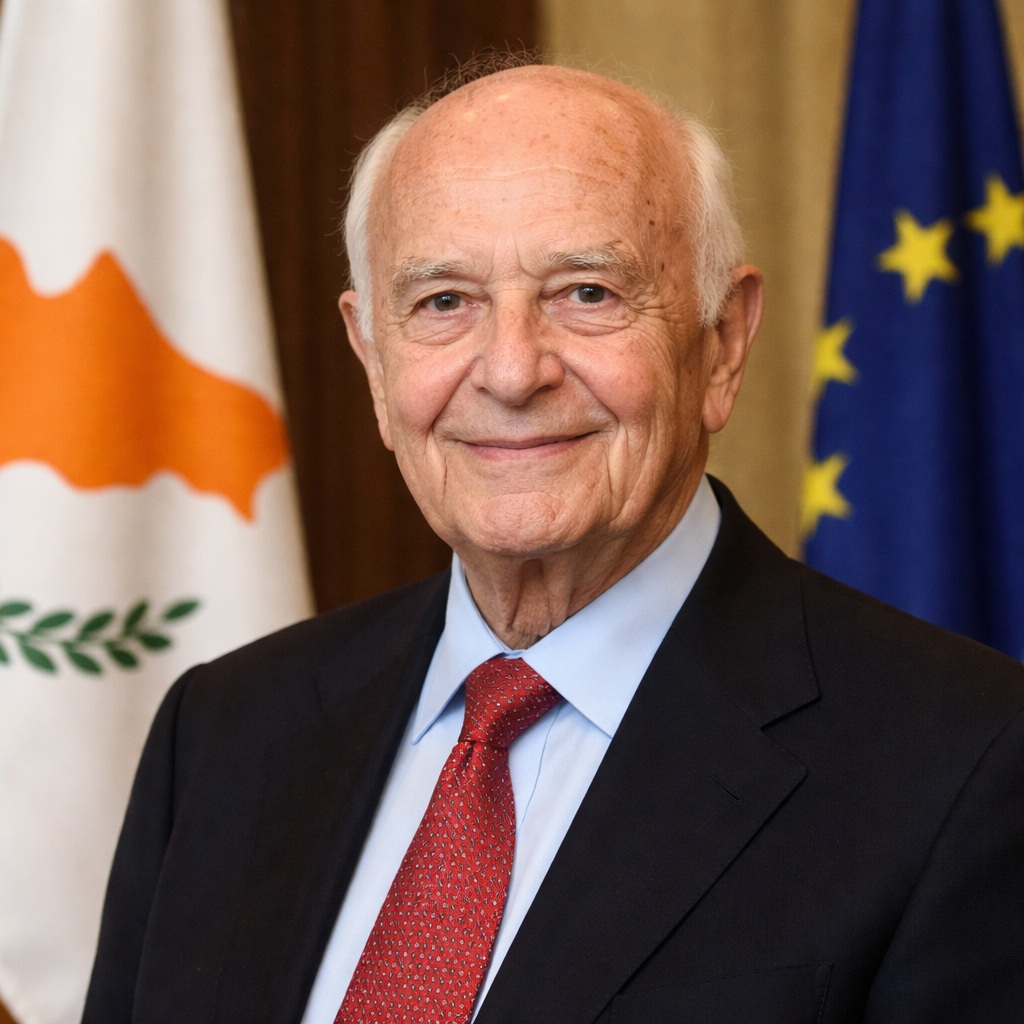
The former president steered the island toward the European Union and helped shape a pragmatic era in Cypriot politics during a decisive phase of continental integration.
George Vassiliou, the former president of Cyprus whose tenure marked a turning point in the island’s modern history and its relationship with Europe, has died at the age of 94. Remembered as a reform-minded leader with a distinctly European outlook, Vassiliou presided over Cyprus at a moment when the Cold War’s end was reshaping borders, alliances, and ambitions across the continent.
Vassiliou’s presidency is most closely associated with Cyprus’s strategic decision to anchor its future within the European project. At a time when the country remained divided and geopolitically exposed, he argued that European integration was not only an economic opportunity but also a framework for stability, democratic consolidation, and international legitimacy. That vision would ultimately culminate years later in Cyprus’s accession to the European Union, a path he helped set in motion and defend against skepticism at home and abroad.
Born into a merchant family and trained as an economist, Vassiliou brought to politics a technocratic sensibility that distinguished him from many of his contemporaries. Before entering public office, he built a successful career in business, gaining experience that informed his belief in open markets, institutional reform, and outward-looking policies. When he assumed the presidency, Cyprus faced structural economic challenges alongside the unresolved division of the island, a reality that defined much of its political life.
Rather than relying on nationalist rhetoric, Vassiliou cultivated a reputation for pragmatism. He emphasized dialogue, confidence-building measures, and alignment with European norms. While the Cyprus problem remained unsolved during his time in office, his approach was widely seen as an attempt to soften entrenched positions and to frame reunification as compatible with a shared European future.
On the international stage, Vassiliou positioned Cyprus as a credible and constructive partner. He strengthened ties with European institutions and member states at a moment when the European Community itself was evolving into a more integrated political union. His advocacy for accession rested on the argument that Cyprus met the cultural, economic, and democratic criteria of Europe, despite its small size and complex security environment.
Domestically, his presidency coincided with efforts to modernize public administration and to encourage competitiveness in the economy. Supporters credit him with fostering a climate of reform and with promoting transparency and professionalism in governance. Critics, particularly from more hardline camps, accused him of excessive concessions and of underestimating the sensitivities surrounding national identity and sovereignty. Yet even detractors acknowledged his consistency and his commitment to a clear strategic direction.
After leaving the presidency, Vassiliou remained an active figure in European affairs. He served in senior roles within EU institutions, further cementing his reputation as one of Cyprus’s most prominent European statesmen. In those capacities, he was known for his quiet diplomacy and for bridging perspectives between larger member states and smaller countries navigating the complexities of integration.
News of his death prompted tributes from across the political spectrum in Cyprus and beyond. European officials recalled him as a leader who believed deeply in cooperation over confrontation and in the power of institutions to tame historical divisions. In Cyprus, many reflected on a political career that unfolded during some of the most transformative decades in the island’s history.
George Vassiliou leaves behind a legacy inseparable from Cyprus’s European trajectory. At a time when the future of the European project itself is again under debate, his life’s work stands as a reminder of an era when integration was embraced as a promise of peace, prosperity, and shared destiny.



 The Tower Post