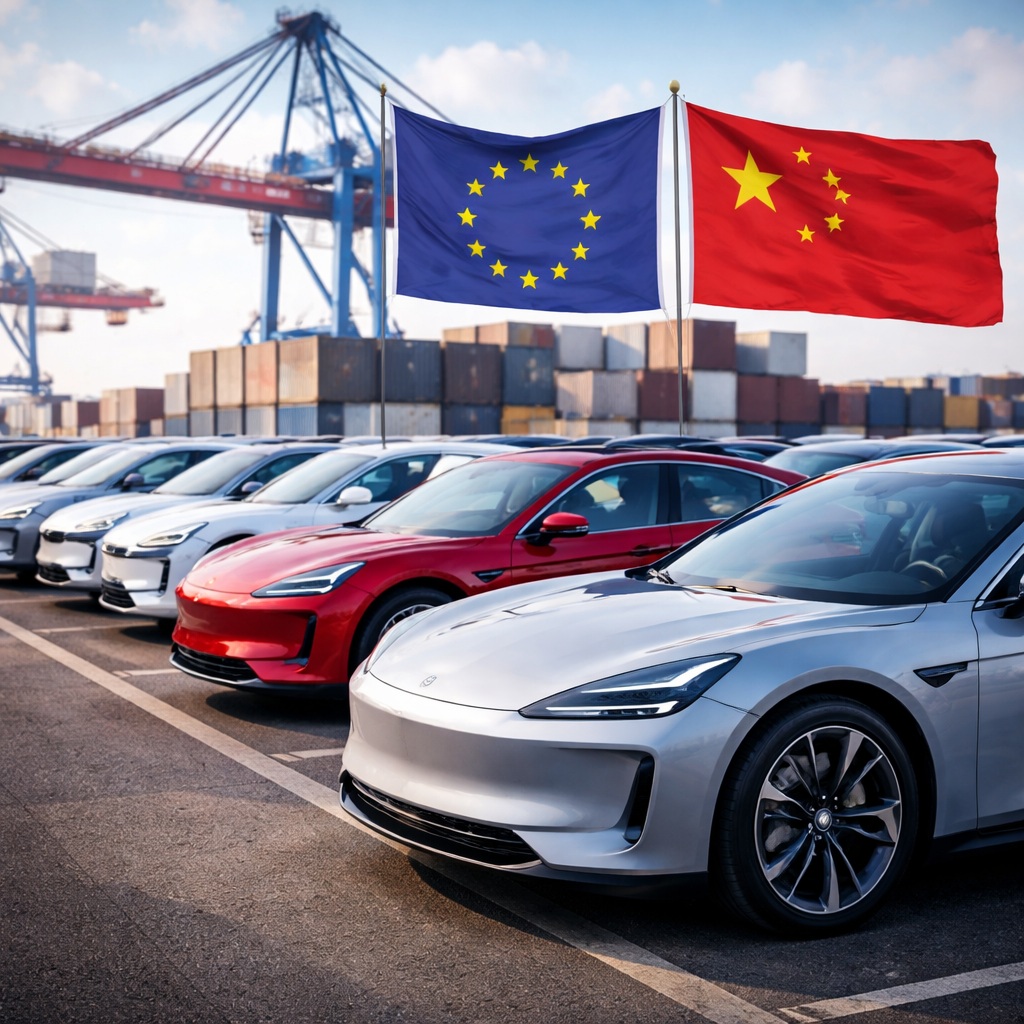
Brussels and Beijing agree on pricing safeguards to calm a dispute over subsidised EV imports, signalling a cautious reset in economic relations
As winter settles over European capitals, policymakers in Brussels and Beijing have chosen a note of conciliation over confrontation. The European Union and China have agreed on a set of measures designed to ease mounting tensions over the surge of Chinese-made electric vehicles entering the European market, a dispute that had threatened to spill into a broader trade war.
At the heart of the agreement is a mechanism aimed at addressing long-standing European concerns about state subsidies supporting China’s fast-growing electric vehicle industry. Rather than moving ahead with sweeping punitive tariffs, EU and Chinese officials have settled on minimum pricing rules for certain categories of electric vehicles exported from China to Europe. The approach is intended to neutralise the alleged effects of subsidies while keeping markets open and supply chains intact.
For European leaders, the deal represents a pragmatic compromise. The rapid influx of competitively priced Chinese electric vehicles has alarmed domestic manufacturers and trade unions, who argue that European firms—already grappling with high energy costs and the expensive transition away from combustion engines—are being undercut by rivals backed by generous state support. At the same time, Brussels has been wary of triggering retaliation from Beijing that could harm European exporters in sectors ranging from luxury goods to industrial machinery.
Chinese officials, for their part, have framed the agreement as recognition of the need for dialogue rather than unilateral action. Beijing has consistently rejected accusations of unfair competition, insisting that the success of its electric vehicle producers is rooted in scale, innovation and efficient supply chains. Still, the compromise on pricing suggests a willingness to accommodate European sensitivities in order to preserve access to one of China’s most important overseas markets.
The agreement comes after months of technical talks and political signalling on both sides. European investigators had been examining whether Chinese manufacturers benefited from subsidies that distorted competition, a process that raised the prospect of additional import duties. Beijing responded with warnings that such measures would violate World Trade Organization principles and damage mutual trust. Against this backdrop, the newly announced framework is being presented as a de-escalation that aligns with international trade rules.
Under the new arrangement, Chinese exporters will commit to selling electric vehicles in the EU above agreed price thresholds. European officials argue that this will help level the playing field without shutting out affordable electric cars that are crucial for meeting climate targets. By avoiding blanket tariffs, the EU hopes to protect consumers from sudden price hikes while giving its own industry breathing space to invest and adapt.
Industry reaction across Europe has been mixed. Some manufacturers welcomed the move as a sign that Brussels is prepared to defend fair competition without resorting to protectionism. Others remain sceptical, questioning whether minimum pricing alone can offset the advantages enjoyed by Chinese firms, including lower production costs and strong domestic demand. Environmental groups, meanwhile, have urged policymakers not to lose sight of the broader goal: accelerating the shift to clean mobility at a pace that meets climate commitments.
In China, state media and industry representatives have emphasised the cooperative tone of the outcome. The electric vehicle sector has become a pillar of the country’s industrial strategy and a symbol of its technological ambitions. Preserving stable trade relations with Europe is seen as essential, especially at a time when global demand is uncertain and geopolitical frictions are reshaping supply chains.
The deal also carries broader implications for EU–China relations. Trade ties between the two have grown increasingly complex, marked by mutual dependence and rising suspicion. Europe relies heavily on Chinese inputs for batteries and critical raw materials, while China views the EU as a key market and a counterweight in a fragmented global economy. By choosing negotiation over escalation in the electric vehicle dispute, both sides are signalling an interest in managing competition without allowing it to dominate the relationship.
Officials involved in the talks have stressed that the agreement is not a final settlement but a framework that will require monitoring and adjustment. Enforcement of pricing commitments, transparency around costs, and compliance with WTO standards will be closely scrutinised. Any perception that the rules are being circumvented could quickly reignite tensions.
For now, however, the mood is one of cautious optimism. The compromise reflects a shared understanding that the transition to electric mobility is too important—and too interconnected—to be derailed by tit-for-tat trade measures. As Europe races to decarbonise transport and China seeks to maintain its industrial momentum, both sides appear to have concluded that cooperation, however uneasy, is preferable to conflict.
Whether this truce holds will depend on how faithfully the measures are implemented and how the global electric vehicle market evolves. What is clear is that, in choosing restraint over retaliation, the EU and China have taken a step toward stabilising a relationship that will play a decisive role in shaping the future of clean transportation worldwide.



 The Tower Post