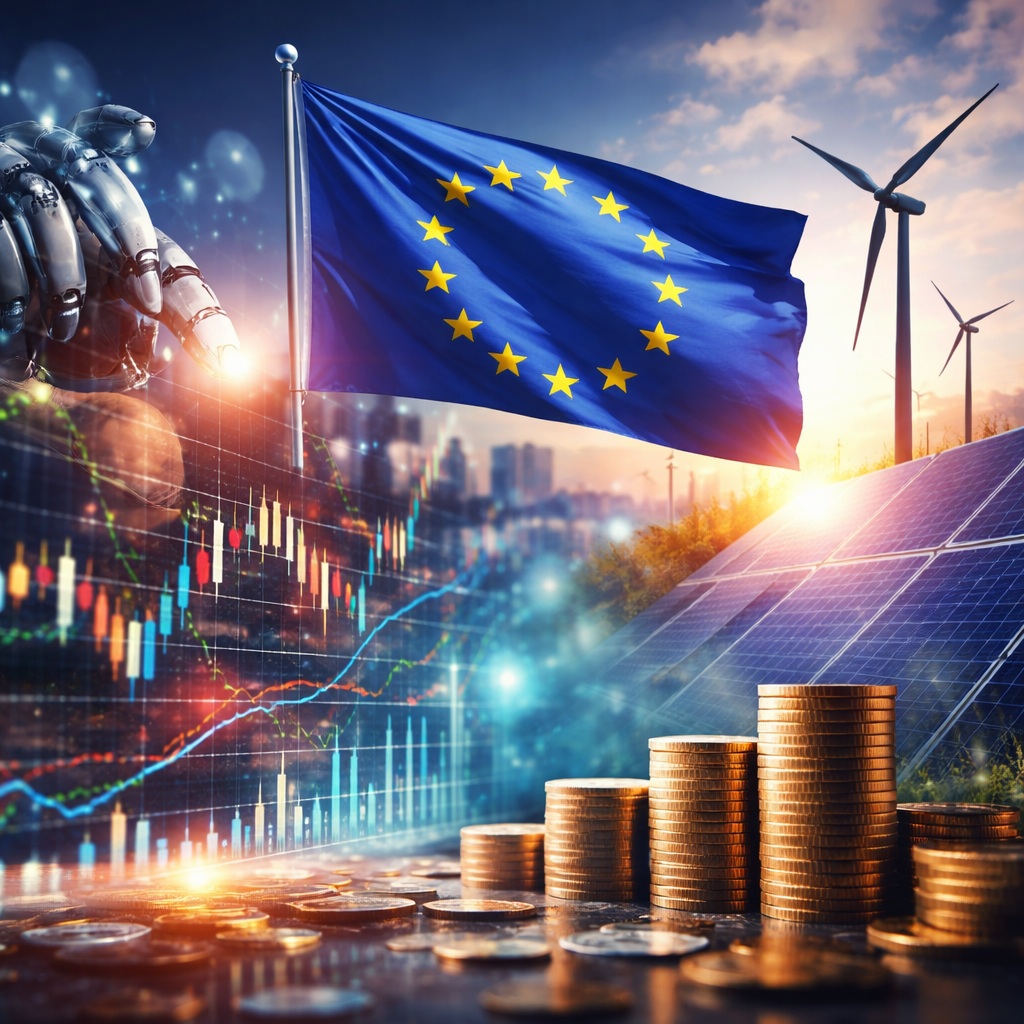
From artificial intelligence demand to shifting energy dynamics, new signals are reshaping Europe’s investment landscape as the year unfolds.
By early January 2026, Europe’s economic narrative is no longer defined by crisis management but by selective acceleration. Growth remains uneven, inflation risks have not fully vanished, and geopolitical uncertainty still frames decision-making. Yet beneath the surface, a set of structural forces is quietly redefining how capital flows across the continent. For investors, understanding these dynamics is less about short-term forecasts and more about identifying where momentum, resilience, and risk are converging.
The following five trends stand out as the most consequential themes shaping Europe’s economic outlook in 2026.
- Artificial intelligence is becoming an industrial demand story
Artificial intelligence is no longer confined to software narratives or venture capital headlines. Across Europe, AI has become a tangible driver of industrial demand, influencing data centers, semiconductors, electricity consumption, and specialized manufacturing.
Northern and Western European economies are seeing a surge in investment linked to cloud infrastructure and high-performance computing. This is translating into stronger order books for electrical equipment, precision engineering, and advanced materials. At the same time, labor markets are beginning to reflect a premium for digital and engineering skills, adding to wage dispersion across regions.
For investors, the key signal is not simply AI adoption but the spillover effects. Countries and companies positioned along the AI supply chain — from energy grids to automation hardware — are likely to capture more durable growth than pure-play software firms facing global competition.
- Energy prices are stabilizing, but the structure of costs has changed
Europe enters 2026 with energy prices far more stable than in previous years, yet structurally higher and more volatile than in the pre-crisis era. The shift away from reliance on a single dominant supplier has improved resilience, but at the cost of higher baseline prices.
This new equilibrium is reshaping competitiveness across sectors. Energy-intensive industries are adapting through efficiency gains, relocation within Europe, or selective capacity reductions. Meanwhile, investment in renewables, storage, and grid infrastructure continues to accelerate, supported by both policy incentives and private capital.
For markets, energy is no longer just an inflation variable. It has become a long-term differentiator between regions and sectors, influencing profit margins, capital expenditure plans, and cross-border investment flows.
- Valuations across European equity markets remain uneven
Despite improving earnings visibility in some sectors, European equity valuations remain fragmented. Export-oriented markets with strong industrial and technology exposure are trading at markedly different multiples compared with domestically focused economies.
This divergence reflects more than cyclical expectations. It highlights investor preferences for balance-sheet strength, pricing power, and exposure to global growth themes. Financials and traditional consumer sectors continue to face skepticism, while companies linked to infrastructure, defense, and digital transformation attract premium valuations.
The opportunity for investors lies in understanding whether these gaps reflect justified structural differences or excessive risk aversion. In several cases, valuations suggest that negative scenarios are already priced in, creating potential for re-rating if macro conditions stabilize further.
- Fiscal policy is becoming more selective, not more restrictive
Contrary to fears of abrupt fiscal tightening, Europe’s public finances in 2026 are characterized by selectivity rather than austerity. Governments are narrowing support measures while preserving spending linked to strategic priorities such as energy security, defense, and industrial policy.
This targeted approach reduces the risk of a sharp fiscal drag on growth while reinforcing sector-specific tailwinds. However, it also increases dispersion within bond markets, as investors differentiate more clearly between countries with credible fiscal paths and those with persistent structural deficits.
For fixed-income investors, the message is clear: sovereign risk in Europe is no longer a uniform asset class. Credit spreads are increasingly driven by national policy choices and long-term growth potential rather than broad monetary conditions alone.
- The European consumer is resilient but cautious
Household balance sheets across much of Europe remain relatively healthy, supported by employment stability and past savings. Yet consumer behavior in 2026 is marked by caution rather than exuberance.
Spending is increasingly value-driven, with demand shifting toward services, experiences, and essential goods rather than discretionary big-ticket items. This pattern favors companies with strong brand positioning and efficient cost structures, while pressuring firms reliant on volume-driven growth.
For investors, consumer data offer an important risk signal. A sustained shift toward caution would reinforce the case for defensive allocations, while any signs of renewed confidence could quickly translate into upside surprises for domestic demand sectors.
Conclusion: A year of differentiation rather than direction
Europe’s economic outlook in 2026 is not defined by a single dominant trend but by growing differentiation. Between countries, sectors, and asset classes, performance gaps are widening as structural factors outweigh broad macro forces.
For investors, the challenge — and opportunity — lies in reading these signals early. Artificial intelligence-driven demand, evolving energy economics, valuation disparities, selective fiscal support, and cautious consumers together form a complex but navigable landscape. In a year where direction matters less than positioning, understanding these five trends may prove decisive.



 The Tower Post