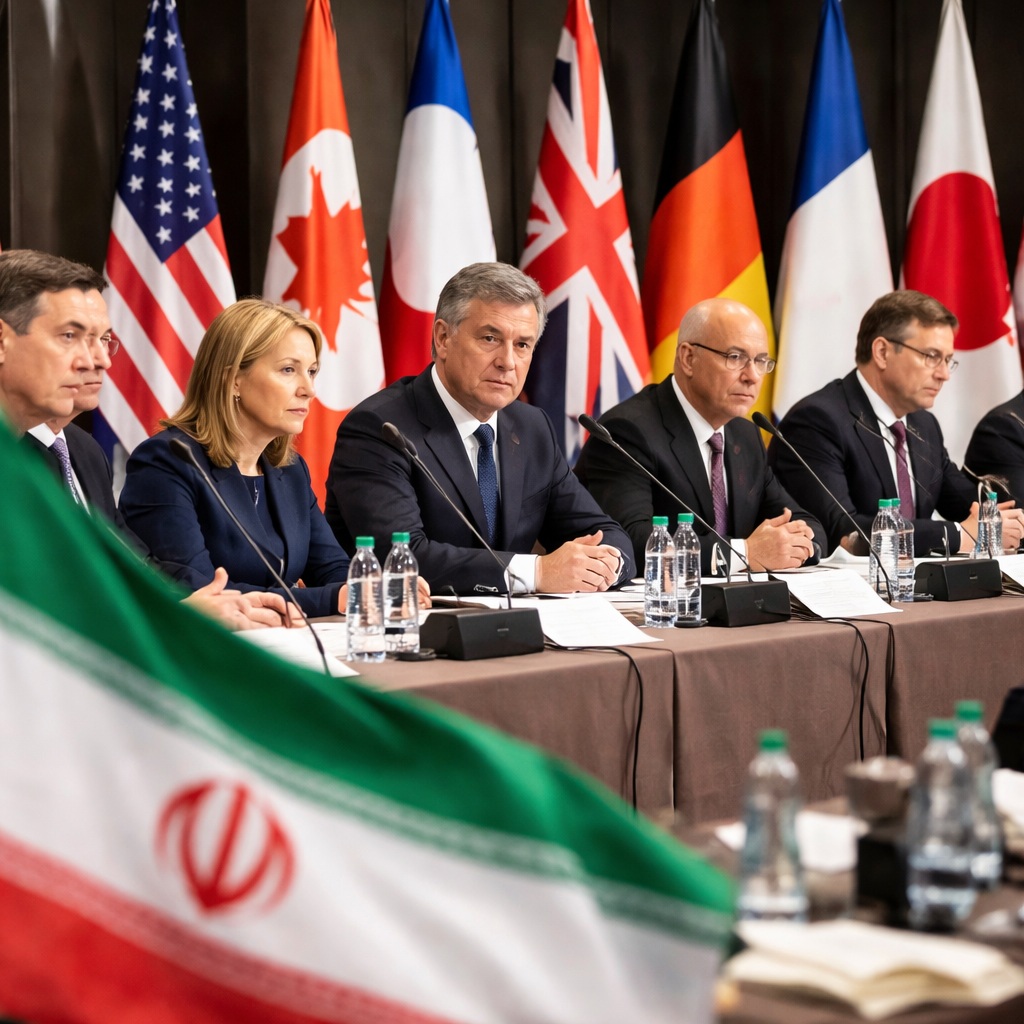
Foreign ministers call for sanctions and coordinated pressure on Tehran while reaffirming commitment to international law and multilateral crisis resolution
G7 foreign ministers have issued a forceful joint statement condemning Iran’s ongoing crackdown on civil liberties and political dissent, signaling renewed resolve among the world’s leading industrialized democracies to confront human rights abuses through coordinated international action. The declaration underscores a broader effort by Europe and its partners to reinforce diplomacy, multilateralism, and respect for international law at a moment of heightened global uncertainty.
Meeting against a backdrop of escalating crises across multiple regions, the foreign ministers described the situation in Iran as deeply alarming. They cited persistent reports of arbitrary detentions, the suppression of peaceful protests, restrictions on freedom of expression, and the use of excessive force by security services. According to the statement, such actions represent a clear violation of Iran’s international obligations and run counter to the universal principles enshrined in the United Nations Charter.
The ministers called for targeted sanctions against individuals and entities deemed responsible for serious human rights violations. These measures, they emphasized, are designed to hold perpetrators accountable while avoiding harm to the Iranian population. The G7 reiterated its support for mechanisms that document abuses and preserve evidence, stressing the importance of accountability as a deterrent against further repression.
European members of the G7 played a prominent role in shaping the tone of the statement, highlighting Europe’s continued engagement in global diplomatic efforts. Officials underlined that human rights are not a regional concern but a core element of international stability. “Respect for fundamental freedoms is inseparable from lasting security,” the statement noted, reflecting a shared view that internal repression often fuels wider regional and international tensions.
Beyond Iran, the declaration situates the issue within a wider framework of global cooperation. The ministers reaffirmed their commitment to resolving international crises through dialogue, diplomacy, and adherence to international law. This message was aimed not only at Tehran but also at a global audience increasingly skeptical of multilateral institutions amid geopolitical rivalries and armed conflicts.
The statement also addressed the importance of maintaining open diplomatic channels, even in periods of acute disagreement. While condemning Iran’s actions in unequivocal terms, the ministers emphasized that diplomacy remains essential to prevent escalation and to create space for de-escalation on related security issues. This includes ongoing concerns about regional stability and the broader implications of Iran’s policies for neighboring states.
Analysts note that the G7’s unified stance reflects lessons drawn from recent years, during which fragmented international responses have often weakened pressure on governments accused of abuses. By presenting a coordinated front, the group aims to amplify its influence and send a clear signal that violations of human rights will not be treated as an internal matter beyond scrutiny.
At the same time, the ministers acknowledged the complex realities facing ordinary Iranians. The statement expressed solidarity with civil society actors, journalists, women’s rights advocates, and young people who continue to demand greater freedoms despite significant personal risk. The G7 called on Iranian authorities to release those detained for exercising their fundamental rights and to engage constructively with international human rights bodies.
The declaration also reflects Europe’s broader diplomatic posture in the current international environment. European governments have sought to balance firmness on values with pragmatic engagement, arguing that principled diplomacy strengthens, rather than weakens, global cooperation. This approach has become increasingly central as Europe navigates multiple crises, from conflicts on its periphery to tensions in the Indo-Pacific.
Within the G7, there is a shared understanding that credibility on human rights enhances the group’s ability to act on other global challenges, including climate change, economic stability, and security. The ministers emphasized that adherence to international law is the common thread linking these issues, providing a framework for predictable and peaceful relations between states.
Reactions to the statement were closely watched by diplomats and observers alike. Human rights organizations welcomed the strong language and the emphasis on accountability, while urging the G7 to ensure that words are matched by sustained action. Some cautioned that sanctions alone are unlikely to bring rapid change, calling instead for a comprehensive strategy that combines pressure with support for international mediation and dialogue.
Iranian officials, for their part, have consistently rejected external criticism, framing it as interference in domestic affairs. Nonetheless, the G7’s statement signals that the issue will remain high on the international agenda, particularly as discussions continue in multilateral forums.
As global attention shifts rapidly from one crisis to another, the G7 foreign ministers sought to convey a sense of continuity and purpose. Their message is that cooperation, grounded in shared values and international law, remains the most effective means of addressing both immediate abuses and the structural causes of instability.
In reaffirming their collective commitment, the ministers positioned the G7 not merely as a forum for coordination among advanced economies, but as a normative anchor in an increasingly fragmented world. Whether this renewed unity will translate into tangible improvements on the ground in Iran remains uncertain. What is clear, however, is that the group intends to keep diplomatic pressure firmly in place, framing human rights as an indispensable pillar of international peace and cooperation.

 The Tower Post