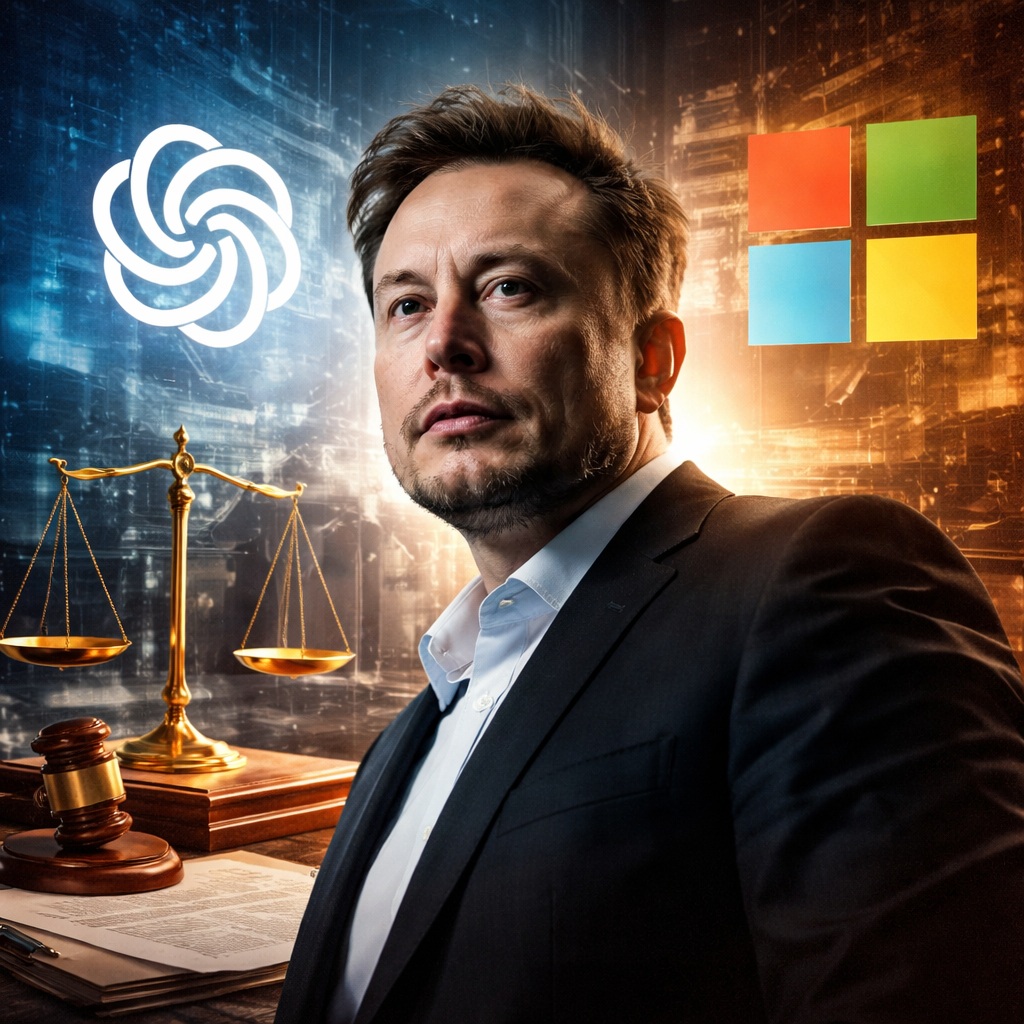
Billionaire CEO Claims ‘Wrongful Gains’ From Early Support of OpenAI as Legal Clash Threatens to Redraw AI Industry Boundaries

Elon Musk has launched one of the most consequential legal challenges in the tech industry’s history, seeking as much as $134 billion from OpenAI and Microsoft in a sweeping lawsuit alleging the companies reaped “wrongful gains” from his early backing of OpenAI. The high-profile filing, submitted in U.S. federal court ahead of a scheduled jury trial in Oakland, California, accuses both organizations of betraying their founding principles and profiting massively from a relationship Musk says he helped build.
THE LEGAL CLAIM: WHAT MUSK ARGUES
Musk’s lawsuit centers on the argument that he invested roughly $38 million in seed funding for OpenAI in its earliest phase, when it was founded with a nonprofit mission aimed at advancing artificial intelligence safely and for the benefit of humanity. According to the court filing, OpenAI now boasts a valuation in the hundreds of billions, and Microsoft — OpenAI’s key commercial partner — has similarly benefited from the venture. Musk’s legal team claims that a substantial share of those gains were wrongfully derived from his initial contributions.
In quantifying the damages, expert testimony attached to the petition estimates that OpenAI’s gains attributable to Musk’s early support range from approximately $65.5 billion to $109.4 billion, while Microsoft’s gains span roughly $13.3 billion to $25.1 billion. The combined figure approaches $134 billion.
Musk’s lawyers argue that, like an early investor in a startup, he should be entitled to a share of profits many times greater than his original contribution — but that those gains were instead absorbed by other parties.
REPRESENTATIONS AND RESPONSES
OpenAI has publicly rejected Musk’s claims, characterizing them as baseless and part of what it calls an ongoing harassment campaign. Its leadership has also pointed to unsealed court documents suggesting Musk sought greater control over the organization or influence over its AI roadmap, including proposals involving his family’s long-term leadership of advanced AI efforts.
Microsoft, too, has denied allegations of wrongdoing, with legal representatives asserting there is no credible evidence the company “aided and abetted” any violation of OpenAI’s original nonprofit charter or Musk’s expectations.
THE INDUSTRY IMPLICATIONS
Beyond its extraordinary dollar figure, the lawsuit has resonated well beyond the courtroom, exposing deep tensions in the philosophy of AI development. Musk’s claim essentially posits that a nonprofit entity that later forges lucrative commercial partnerships — particularly with a behemoth like Microsoft — must account for the economic benefits that accrue to all contributors.
Some analysts say the case could reverberate broadly through startup investment frameworks, nonprofit governance structures, and the way early-stage commitments are formalized — especially when nascent missions evolve into global commercial juggernauts.
The complaint also shines a spotlight on the ongoing competition between Musk’s current AI venture, xAI — developer of the Grok chatbot — and its larger rivals, underscoring how disputes over corporate vision and market share have spilled into the legal arena.
COURT ROADMAP AND NEXT STEPS
A federal judge in California has declined to dismiss the core elements of Musk’s lawsuit, allowing the case to proceed to trial before a jury. Both OpenAI and Microsoft had attempted to limit aspects of the claims, especially around the expert’s calculations of damages, but the court’s ruling means the broader confrontation will unfold in open court.
Legal observers note that the trial — set for spring — will not only address Musk’s financial claims, but also broader questions about the ethical obligations of organizations that transition from nonprofit origins to profitable enterprises, and the extent to which early contributors are protected when missions evolve.
CONCLUSION
Elon Musk’s ambitious lawsuit against OpenAI and Microsoft — demanding up to $134 billion in claimed “wrongful gains” — has quickly become a focal point for debates over innovation, altruism, governance, and aggressive expansion in the AI age. Whatever the outcome, this case is poised to leave a lasting imprint on how technology funding relationships and corporate transformations are viewed and adjudicated across Silicon Valley and beyond.