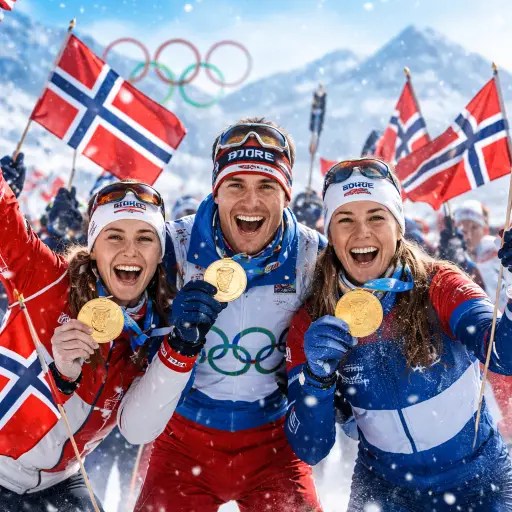
Dominant displays in biathlon and cross-country skiing propel the Nordic nation to a historic milestone, reinforcing its legacy as the greatest powerhouse in Winter Games history.

In a performance that will resonate far beyond the snow-covered arenas of this year’s Winter Olympics, Norway has shattered its own gold medal record, delivering a masterclass in endurance, precision and tactical brilliance that has once again placed the Nordic nation at the summit of global winter sport.
The surge was driven primarily by commanding displays in biathlon and cross-country skiing, disciplines that form the cultural and competitive backbone of Norwegian winter identity, where athletes combined flawless shooting accuracy with relentless pace on the trails to overwhelm rivals and secure decisive victories.
Biathlon events proved particularly fruitful, as Norwegian competitors demonstrated extraordinary composure on the shooting range under the most intense Olympic pressure, pairing near-perfect marksmanship with explosive ski speed that frequently left competitors chasing shadows across the course.
In cross-country skiing, the story was one of sustained dominance, with Norwegian racers dictating tempo from the opening stretches, executing disciplined team strategies in relay competitions and showcasing unmatched stamina in distance races that turned final climbs into triumphant processions toward gold.
The record-setting haul not only adds another chapter to Norway’s storied Olympic narrative but further cements its standing as the most successful nation in Winter Games history, a distinction built over generations of systematic development and an unbroken commitment to excellence in cold-weather sport.
Athletes and officials were unanimous in attributing the achievement to long-term investment in youth development programs that begin at the grassroots level, where community clubs introduce children to skiing and shooting sports early while emphasizing enjoyment, technical fundamentals and gradual progression.
Behind the scenes, sports science innovation has played a pivotal role, with national training centers employing advanced performance analytics, biomechanical assessments and individualized recovery protocols designed to maximize efficiency while safeguarding athlete health over extended competitive careers.
High-altitude simulation, data-driven pacing strategies and meticulous equipment optimization have become standard components of preparation, reflecting a seamless integration of traditional outdoor culture with cutting-edge technological support that has widened the performance gap between Norway and its closest challengers.
International observers have pointed out that Norway’s winter climate alone cannot explain such sustained superiority, noting instead the structural coherence linking schools, regional clubs, elite academies and national federations in a unified pathway that steadily transforms young enthusiasts into Olympic champions.
Equally significant is the national philosophy that discourages early over-specialization and promotes balanced athletic development, a model that prioritizes long-term resilience and psychological well-being while still producing competitors capable of peaking on the world’s grandest stage.
As celebrations unfold and the Winter Games approach their ceremonial conclusion, Norway’s new gold standard stands as a defining hallmark of this Olympic edition, symbolizing not merely a tally of victories but the culmination of decades of strategic vision, cultural passion and unwavering collective discipline.
With a fresh generation already carving tracks across local hills and firing practice shots on community ranges, the message from Norway’s record-breaking campaign is unmistakable: sustained investment, scientific rigor and grassroots unity remain the surest route to enduring Olympic supremacy.