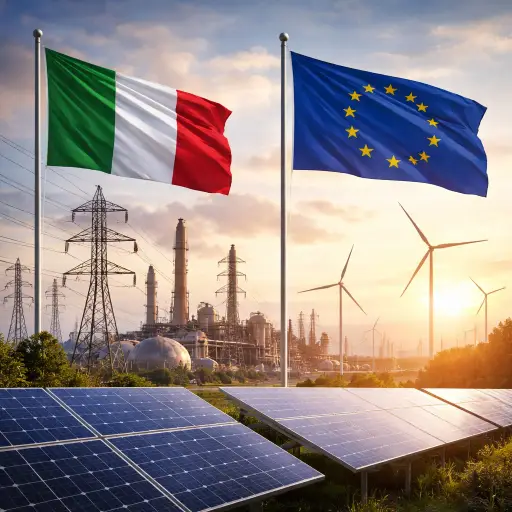
Rome moves to strip carbon permit costs from electricity pricing, triggering a high-stakes clash with EU climate authorities and reshaping the debate over decarbonisation and economic relief.

A fresh confrontation is unfolding between Italy and the European Union as Prime Minister Giorgia Meloni’s government advances a controversial overhaul of how electricity prices are calculated, opening a new front in the debate over energy sovereignty and climate discipline.
The proposal aims to remove the cost of carbon permits from wholesale power pricing, a move designed to ease domestic energy bills for households and industry but one that has already prompted pointed warnings from Brussels about the integrity of the bloc’s climate architecture.
At the center of the dispute lies the EU Emissions Trading System, the mechanism that places a market price on carbon emissions and forces power producers to buy allowances for every ton of carbon dioxide they release into the atmosphere, costs that are typically passed through into wholesale electricity prices.
In Italy’s power market, where gas-fired plants frequently determine the marginal price of electricity, the carbon component embedded in generation costs can significantly influence final pricing, especially during periods of volatility in fuel markets or tightening emissions caps.
Rome’s plan would effectively decouple those carbon permit costs from the formula used to calculate wholesale electricity prices domestically, limiting the extent to which fluctuations in the carbon market directly impact consumer and industrial power bills.
Government officials frame the initiative as an economic safeguard rather than a climate retreat, arguing that Italian families and manufacturers have absorbed disproportionate costs in recent years and require structural relief to restore competitiveness and purchasing power.
Energy-intensive sectors such as steel, chemicals and ceramics have warned that persistently elevated electricity prices risk accelerating deindustrialisation, particularly as global competitors outside the European Union operate under less stringent carbon regimes.
Supporters of the reform contend that the current pricing mechanism amplifies volatility by linking electricity costs too closely to marginal fossil generation and carbon allowances, creating distortions that penalise countries more exposed to imported gas.
Brussels, however, sees a deeper risk in the Italian approach, cautioning that the credibility of the Emissions Trading System depends on a transparent and undiluted carbon price signal that shapes investment decisions across the single market.
European Commission officials have signaled concern that unilateral changes to wholesale pricing structures could conflict with internal market rules and potentially fragment the coherence of EU climate policy at a moment when member states are expected to accelerate decarbonisation efforts.
The political timing has added fuel to the confrontation, as Italy moves through a sensitive electoral phase in which energy costs remain a potent issue for voters still feeling the strain of inflation and uneven economic recovery.
Critics argue that the government’s initiative carries clear political incentives, positioning Rome in visible opposition to Brussels while offering immediate, tangible relief to households and small businesses ahead of key electoral tests.
Meloni’s allies reject that characterization and insist the reform is consistent with Italy’s broader transition strategy, which includes expanding renewable capacity, modernising the electricity grid and promoting new investments in storage and low-carbon technologies.
Market analysts are divided over the potential consequences, with some warning that limiting carbon cost pass-through could dampen incentives for cleaner generation if fossil-based power appears artificially cheaper relative to renewable alternatives.
Others counter that the carbon price would still apply at the producer level under the EU system, meaning generators would continue to face the same compliance costs even if retail and wholesale pricing mechanisms are partially adjusted.
Technical implementation remains complex because Italy’s electricity market is tightly interconnected with neighboring countries through cross-border flows, raising questions about arbitrage opportunities and regulatory alignment within the broader European framework.
Business associations have largely welcomed the government’s move, arguing that climate ambition must be paired with mechanisms that protect the industrial base and prevent strategic sectors from relocating outside the Union.
Environmental groups, by contrast, warn that obscuring the visibility of carbon pricing could weaken public understanding of the transition’s costs and benefits, undermining the behavioral and investment shifts necessary to achieve long-term emissions reductions.
The clash between Rome and Brussels highlights a broader tension running through the European project, as governments attempt to reconcile climate leadership with domestic economic pressures and political accountability.
Whether the dispute evolves into a legal confrontation or produces a negotiated compromise, Italy’s energy gamble has already reignited fundamental questions about how far member states can recalibrate common climate tools in pursuit of national economic priorities.