After a devastating crash that nearly ended his career, Danish cyclist Michael Valgren climbs back to the top with an emotional victory that redefines resilience

Professional cycling has always been a sport of extremes — breathtaking speed, relentless suffering, and moments of triumph that can redefine a career in the span of a single climb. Few stories capture that reality more powerfully than the remarkable return of Danish rider Michael Valgren, who has completed one of the most emotional comebacks in recent cycling memory.
For Valgren, the road back to victory was not simply long. At times, it seemed impossible.
During a race several seasons ago, the Danish rider was involved in a horrific crash that left him with a fractured pelvis and a long list of severe injuries. The accident was the kind that sends shockwaves through the peloton — the type that forces riders, teams, and fans to confront the fragility that hides behind elite athletic performance.
The injuries were devastating. Recovery was uncertain. For many athletes, such trauma would mark the quiet end of a career.
For Valgren, it became the beginning of a long and painful battle.
Before the crash, Valgren had built a reputation as one of Denmark’s most talented and aggressive riders. Known for his tactical intelligence and his ability to attack on short climbs, he had already achieved important victories and established himself as a dangerous competitor in classic-style races.
But the crash changed everything.
The fractured pelvis alone required extensive rehabilitation, while other injuries compounded the challenge. Recovery was measured not in weeks but in years. The simple act of riding a bike again became a milestone rather than a routine.
Professional cycling, however, moves quickly. New talents emerge, teams evolve, and results lists continue to grow without waiting for those on the sidelines.
For a long stretch, Valgren watched from the outside.
Rehabilitation was physically demanding and mentally draining. Hours of physiotherapy replaced hours in the saddle. Progress came slowly — sometimes painfully slowly.
Yet those close to the rider say his determination never faded.
The goal was simple: ride again at the highest level.
Returning to competition alone would have been considered a success. Winning again, particularly at the top tier of professional cycling, seemed like a distant dream.
Still, Valgren kept working.
Season after season, his strength gradually returned. Confidence followed. The peloton began to see glimpses of the rider who once attacked with fearless timing and tactical instinct.
The defining moment came on the rolling roads of Tirreno–Adriatico.
The prestigious stage race is often a proving ground for riders preparing for the classics and grand tours. It is also notoriously unpredictable, with stages that favor daring attackers willing to gamble against stronger teams and faster sprinters.
As the race approached its decisive moments, Valgren sensed an opportunity.
On a climb that split the front group, he accelerated.
It was the kind of move that once defined his racing style — sharp, decisive, and perfectly timed. One by one, rivals lost contact. The peloton hesitated just long enough for the Danish rider to gain precious seconds.
Then he rode alone.
The road ahead stretched through the hills as Valgren pushed forward, knowing the chasing group behind him contained riders capable of closing the gap at any moment. Every pedal stroke carried the weight of years of recovery.
The gap held.
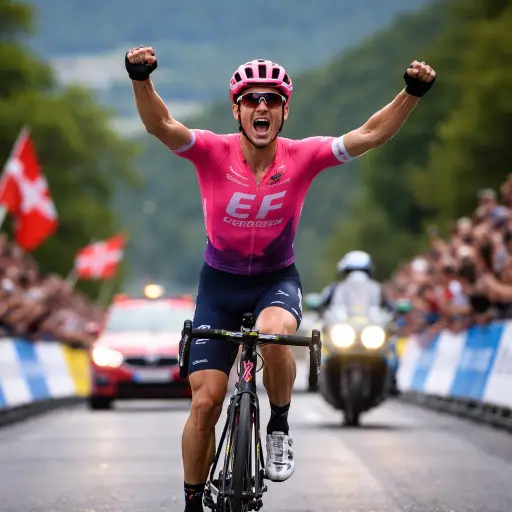
When he crossed the finish line, the significance of the moment was unmistakable. It was his first top-level victory in eight years — and easily the most emotional of his career.
Cycling victories often come with celebration, but this one carried something deeper.
For Valgren, the win represented more than a result on a stage race. It was proof that the long struggle back from injury had not been in vain. It was validation of every painful rehabilitation session, every uncertain return to training, every moment when quitting might have seemed easier.
Riders from across the peloton congratulated him at the finish.
In a sport that demands both brutality and solidarity, the respect of fellow competitors can be the highest form of recognition.
Comeback stories resonate deeply in professional cycling because the sport is uniquely unforgiving. Riders compete for hours under extreme physical stress, often on dangerous terrain and at high speeds.
Crashes are an unavoidable risk.
What separates great riders is not only how they win, but how they respond when everything falls apart.
Valgren’s victory serves as a powerful reminder of that truth. It shows that even after catastrophic setbacks, the possibility of redemption can still exist on the open road.
Whether this victory marks the start of a late-career resurgence or stands as a singular emotional triumph remains to be seen.
But in many ways, that question no longer matters.
For one unforgettable day at Tirreno–Adriatico, Michael Valgren proved something more important than form or rankings. He demonstrated that resilience, patience, and belief can carry an athlete back from the darkest moments of a career.
The road that once nearly ended his journey ultimately delivered one of its most inspiring chapters.