Brussels weighs flexibility on green targets while member states confront supply risks

Across Europe, a quiet but consequential shift is taking shape. Policymakers who once spoke with near-unanimous urgency about accelerating the green transition are now recalibrating their tone, as energy security concerns rise to the forefront of the political agenda. Faced with persistent supply constraints and volatile gas markets, the European Union is increasingly considering whether parts of its climate strategy should be slowed, adjusted, or temporarily softened.
The debate reflects a broader tension that has become difficult to ignore: how to balance long-term decarbonization goals with the immediate need to keep homes heated, industries running, and electricity grids stable. In recent months, energy shortages have exposed structural vulnerabilities in Europe’s transition away from fossil fuels, forcing leaders to confront the limits of current infrastructure and the pace of change.
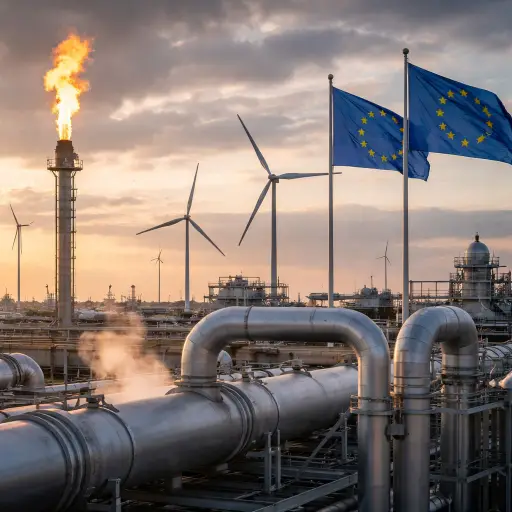
At the heart of the discussion is a recognition that the transition itself depends on stability. Renewable energy capacity continues to expand across the bloc, but it has not yet reached a level where it can fully compensate for disruptions in traditional energy sources. Wind and solar remain subject to variability, while energy storage systems and grid upgrades lag behind demand. As a result, natural gas—once viewed primarily as a bridge fuel—is regaining strategic importance.
Officials in Brussels are now examining whether certain regulatory timelines tied to emissions reductions and energy reforms should be made more flexible. The aim is not to abandon climate commitments, but to introduce a degree of pragmatism in their implementation. Behind closed doors, policymakers acknowledge that rigid adherence to earlier targets may risk undermining both economic resilience and public support.
The situation has been particularly acute in countries with large industrial bases. Manufacturing sectors, already under pressure from global competition, have warned that unstable or high-cost energy supplies could erode their competitiveness. Energy-intensive industries, including chemicals and steel, have called for clearer assurances that power will remain both available and affordable during the transition period.
Germany, Europe’s largest economy, has emerged as a focal point of this evolving strategy. Long a leader in renewable energy deployment, the country is now planning to expand its gas-fired power capacity as a safeguard against shortages. The move marks a notable shift in emphasis, underscoring the extent to which reliability concerns are shaping policy decisions.
German officials argue that additional gas infrastructure is necessary to stabilize the grid as renewable generation continues to grow. The expansion is intended as a temporary measure, designed to ensure that intermittent energy sources can be backed up during periods of low output. Yet the decision has also sparked debate, with critics warning that increased reliance on gas could delay progress toward emissions reduction targets.
Elsewhere in the bloc, similar conversations are unfolding. Several member states are reassessing the timelines for phasing out certain fossil fuel assets, while others are exploring new supply agreements to reduce exposure to external shocks. The diversification of energy sources—once framed primarily in environmental terms—is now equally a question of geopolitical and economic security.
The energy shock has also highlighted disparities within the European Union. Countries with more developed renewable infrastructure have generally weathered supply disruptions better than those still heavily dependent on imports. This uneven landscape has complicated efforts to maintain a unified approach, as national priorities increasingly shape policy preferences.
Public sentiment is another factor influencing the debate. While support for climate action remains strong, rising energy costs have heightened sensitivity to the economic implications of policy decisions. Governments are acutely aware that the success of the transition depends not only on technological progress but also on maintaining public trust.
In response, European institutions are seeking to strike a careful balance. Investments in renewable energy, hydrogen development, and grid modernization continue to be promoted as central pillars of the bloc’s long-term strategy. At the same time, there is a growing willingness to acknowledge that the path to decarbonization may not be linear.
Energy analysts note that such adjustments are not unusual in large-scale transitions. Periods of acceleration are often followed by phases of consolidation, as systems adapt to new realities. The current moment, they suggest, may represent a necessary recalibration rather than a retreat.
Still, the stakes are high. The European Union has positioned itself as a global leader in climate policy, and any perceived weakening of its commitments could have broader implications. International partners are watching closely, particularly as other major economies grapple with similar challenges.
For now, the bloc appears to be navigating a delicate middle course—holding onto its long-term vision while adapting to immediate pressures. Whether this approach will succeed in preserving both energy security and climate ambition remains an open question.
What is clear is that the energy transition, once framed primarily as an environmental imperative, has entered a new phase—one defined as much by resilience and realism as by aspiration.