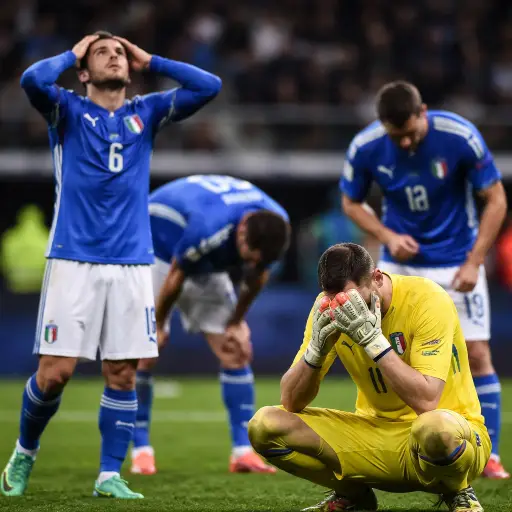
Penalty heartbreak against Bosnia deepens a crisis that now demands urgent reform in Italian football

The silence that followed the final penalty was deafening. As the decisive shot rippled the net, confirming Italy’s elimination at the hands of Bosnia, a familiar and painful reality set in: the Azzurri will not be at the World Cup once more. For a nation that defines itself through footballing heritage, artistry, and pride, the moment felt less like a defeat and more like a reckoning.
This is no longer an isolated failure. It is a pattern—one that has now stretched across three consecutive qualification cycles. Italy, four-time world champions and historically one of the sport’s defining forces, have again fallen short when it mattered most. And this time, the manner of the defeat has only intensified the scrutiny.
The match itself was tense, cagey, and ultimately unresolved over regular and extra time. Italy struggled to impose themselves, displaying flashes of technical quality but lacking cohesion and cutting edge in the final third. Bosnia, organized and resilient, absorbed pressure and waited for their moment. When the game drifted into penalties, the tension became almost unbearable.
What followed was heartbreak. Missed chances, hesitant steps, and ultimately, failure from the spot. The images of Italian players collapsing to the turf—hands on heads, faces buried in shirts—captured more than just the pain of a single night. They symbolized a deeper crisis that has been years in the making.
Across Italy, the reaction was immediate and fierce. Television studios erupted in debate, newspapers ran front pages filled with disbelief and anger, and fans took to the streets and social platforms demanding accountability. The questions are no longer about a single coach or a single generation of players. They are systemic.
How did a footballing giant reach this point?
At the heart of the issue lies a complex web of structural challenges. Italian football, once synonymous with tactical innovation and defensive mastery, has struggled to adapt to the modern game’s pace and intensity. Youth development systems have come under criticism, with many arguing that young Italian players are not being given enough opportunities at the highest levels. Clubs increasingly rely on foreign imports, while domestic talent often stagnates.
There is also a question of identity. For decades, Italy’s strength lay in a clear footballing philosophy—disciplined, intelligent, and ruthlessly efficient. Today, that identity appears blurred. Coaches have rotated, strategies have shifted, and consistency has been elusive. The result is a national team that often looks uncertain, caught between tradition and transition.
Leadership, too, is under the microscope. The Italian Football Federation now faces mounting pressure to enact meaningful change. Calls for reform range from grassroots investment to a complete overhaul of league structures and player development pathways. Some voices are even advocating for a cultural reset—an acknowledgment that past glory cannot sustain present success.
Yet amid the frustration, there remains a sense of painful irony. This is not a nation devoid of talent. Italy continues to produce technically gifted players, creative midfielders, and capable defenders. But talent alone is no longer enough. In an era where preparation, data, and long-term planning define success, Italy appears to be playing catch-up.
For the players, the emotional toll is profound. Representing Italy carries a unique weight, one steeped in history and expectation. To fall short—again—means confronting not only personal disappointment but also the knowledge of letting down millions. The images from the pitch told that story clearly: exhaustion, disbelief, and a sense of something slipping away.
For the fans, the pain cuts even deeper. The World Cup is more than a tournament; it is a shared cultural moment, a time when the nation unites across regions and generations. To be absent once is a shock. Twice is a crisis. Three times becomes something far more serious—a rupture in identity.
And yet, within this crisis lies an opportunity.
Moments like these, as painful as they are, can serve as catalysts for change. Italian football has reinvented itself before, emerging from setbacks with renewed strength and clarity. The challenge now is whether it can do so again in a rapidly evolving global landscape.
The path forward will require honesty, courage, and patience. Quick fixes will not suffice. Rebuilding trust—in the system, in the team, and in the future—will take time. But the alternative, continuing along the current trajectory, is unthinkable for a nation with such a rich footballing legacy.
As the dust settles on another devastating night, one truth stands above all: this is no longer just about missing a tournament. It is about redefining what Italian football is—and what it aspires to be.
The world will move on to the next World Cup. Italy, for the third time in a row, will watch from the outside.
What happens next will define whether this is the end of an era—or the beginning of a long-overdue rebirth.