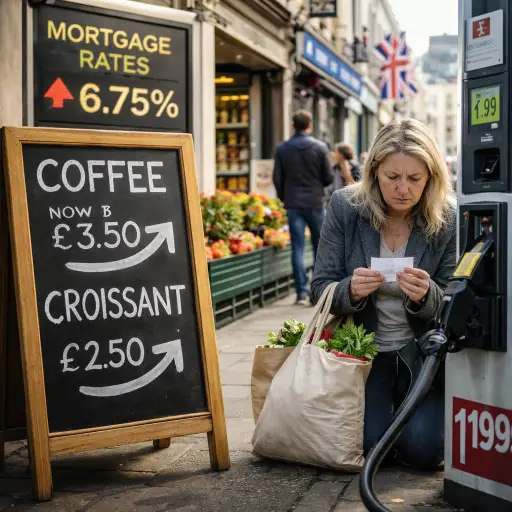
Energy costs surge, mortgage pressures mount, and inflation fears spread across Europe

A fresh wave of price increases is sweeping across the United Kingdom, as businesses brace for sustained economic pressure driven by geopolitical instability and soaring energy costs. From small cafés to major retailers, companies are preparing to pass rising expenses directly onto consumers, intensifying concerns over a prolonged cost-of-living squeeze.
Across high streets and industrial hubs alike, executives report that the latest shock to global energy markets has sharply increased operational costs. The disruption, linked to ongoing conflict dynamics affecting supply chains and fuel availability, has forced firms into difficult decisions. Many now say price rises are not only unavoidable but imminent.
“We’ve held back as long as we could,” said one mid-sized food distributor based in the Midlands. “But energy bills, transport, packaging — everything has gone up at once. There’s no buffer left.”
The result is a coordinated shift in pricing strategies. Businesses that previously absorbed cost increases in hopes of stabilizing demand are now signaling rapid adjustments. Analysts suggest this could trigger a renewed spike in inflation expectations, particularly as price hikes begin to cluster across multiple sectors simultaneously.
Energy remains the central pressure point. Wholesale gas and electricity prices have climbed sharply in recent weeks, reversing a period of relative stability. For energy-intensive industries such as manufacturing, hospitality, and food production, the impact has been immediate. Smaller firms, often operating on tighter margins, appear especially vulnerable.
In urban centers, cafés and restaurants are already updating menus, while retailers are quietly revising shelf prices. Logistics firms warn that higher fuel costs will soon translate into increased delivery charges, further feeding into consumer prices.
At the same time, households are facing a separate but compounding challenge: rising mortgage rates. Financial markets have reacted swiftly to inflation concerns, pushing borrowing costs higher. Lenders have adjusted their offerings accordingly, with new mortgage deals reflecting a steeper cost of borrowing than many homeowners had anticipated.
For millions of households, this creates a dual pressure. Everyday expenses are increasing just as housing costs rise, leaving less room for discretionary spending. Economists warn that this combination could significantly dampen consumer demand in the months ahead.
“The timing is particularly difficult,” said a London-based housing analyst. “People are seeing higher food and energy bills at the same moment their mortgage payments are climbing. That overlap is what makes this situation so challenging.”
The housing market, which had shown signs of stabilization, is now entering a more uncertain phase. Prospective buyers are reassessing affordability, while existing homeowners on variable rates or nearing the end of fixed deals are preparing for higher monthly payments. Some lenders have begun tightening criteria, adding another layer of caution to the market.
Beyond the UK, similar dynamics are emerging across Europe. Countries heavily dependent on imported energy are experiencing parallel cost pressures, with governments scrambling to cushion the impact. Inflation fears are once again becoming a central concern for policymakers, who must balance economic stability with the risk of stifling growth.
Central banks face a particularly delicate moment. While earlier signals suggested a potential easing of monetary policy, the renewed inflationary pressure may force a reassessment. Interest rates, already elevated, could remain higher for longer than previously expected, reinforcing the upward trend in borrowing costs.
For businesses, the outlook remains uncertain. While some sectors may benefit from pricing power, others risk losing customers as affordability becomes a dominant issue. Retailers, in particular, are watching consumer behavior closely, noting early signs of reduced spending on non-essential goods.
“There’s a limit to what people can absorb,” said a senior retail executive. “At some point, higher prices start to change habits.”
Indeed, early indicators suggest consumers are already adjusting. Discount retailers report increased footfall, while premium brands note a more cautious purchasing pattern. Supermarkets are seeing shifts toward lower-cost alternatives, and hospitality venues are reporting shorter visits and smaller orders.
Government officials have acknowledged the mounting pressures but have so far offered limited new measures. Existing support schemes remain in place, but there is growing debate over whether additional intervention will be required if conditions worsen.
Business groups are calling for targeted relief, particularly in energy costs, to prevent a wave of closures among smaller firms. At the same time, consumer advocates warn that households may soon reach a tipping point if both prices and borrowing costs continue to rise.
The broader economic picture is one of renewed fragility. After a period of cautious optimism, the latest developments have reintroduced a sense of volatility. Markets remain sensitive to geopolitical developments, and any further disruption could amplify existing trends.
For now, the immediate reality is clear: prices are going up, and both businesses and consumers are preparing for a challenging stretch ahead. The extent to which the economy can absorb these shocks will depend on a complex interplay of policy decisions, market reactions, and the resilience of households already under strain.
As the situation unfolds, one question looms large: how long can the balance hold before temporary pressures become a more permanent feature of the economic landscape.