Economists warn of slowing growth and persistent inflation as energy-dependent economies face mounting pressure

As geopolitical tensions continue to disrupt global supply chains and energy markets, concerns over a return to stagflation are intensifying across Europe. Policymakers and economists are increasingly warning that the continent may be entering a prolonged period marked by weak economic growth combined with stubbornly high inflation — a scenario not seen in decades but now gaining renewed relevance.
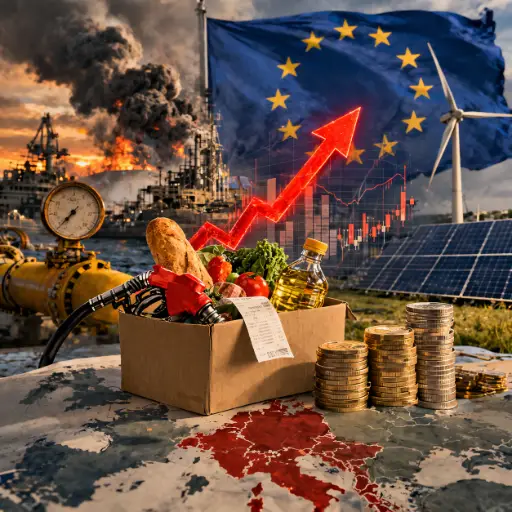
The current economic climate reflects a complex interplay between war-related disruptions and structural vulnerabilities within the European economy. Energy prices, long a critical driver of inflation, have remained volatile amid ongoing conflicts that have reshaped traditional supply routes. This volatility is feeding directly into consumer prices, while simultaneously eroding industrial competitiveness and dampening investment.
Germany and Italy, Europe’s largest manufacturing powerhouses, are emerging as particularly exposed. Both economies rely heavily on imported energy to sustain their industrial output. With energy costs elevated and supply uncertainty lingering, businesses in these countries are facing higher production expenses, forcing difficult choices between absorbing costs or passing them on to consumers. In either case, the impact reverberates through the broader economy.
In Germany, the industrial sector — historically the backbone of growth — is showing signs of strain. Energy-intensive industries such as chemicals, steel, and automotive manufacturing are operating under mounting pressure. Some firms have already scaled back operations or shifted production abroad, citing unsustainable costs. Meanwhile, business confidence indicators have softened, reflecting a cautious outlook among corporate leaders.
Italy faces a parallel challenge, albeit with its own structural nuances. Small and medium-sized enterprises, which form the backbone of the Italian economy, are particularly vulnerable to energy price shocks. Many lack the financial buffers to absorb prolonged cost increases, raising the risk of closures, job losses, and further economic contraction. At the same time, public debt constraints limit the government’s ability to provide extensive fiscal support.
Inflation, though no longer accelerating at its previous pace, remains persistently above target levels. Food and energy continue to drive price pressures, but core inflation — which excludes these volatile components — has also proven sticky. This persistence complicates the task of central banks, which must balance the need to control inflation with the risk of further slowing economic activity.
The European Central Bank finds itself navigating an increasingly narrow policy path. Higher interest rates, implemented to curb inflation, are beginning to weigh on borrowing and investment. Households are feeling the squeeze through rising mortgage costs and reduced purchasing power, while businesses face tighter credit conditions. The cumulative effect is a gradual cooling of economic momentum across the euro area.
Economists caution that the combination of these forces — elevated costs, weakened demand, and policy tightening — is characteristic of stagflationary dynamics. While the situation does not yet fully mirror historical episodes, the parallels are strong enough to raise concern among policymakers and market participants alike.
Compounding these challenges is the broader geopolitical environment. Continued instability not only affects energy markets but also undermines investor confidence and disrupts trade flows. Export-oriented economies, particularly Germany, are vulnerable to shifts in global demand and supply chain fragmentation. As international trade becomes more uncertain, the growth prospects for these economies become increasingly constrained.
Despite the mounting risks, there are also signs of resilience. Labor markets across much of Europe remain relatively strong, helping to support household incomes and consumption. Governments have introduced targeted measures to cushion the impact of energy costs, although the effectiveness of these interventions varies. Additionally, ongoing investments in renewable energy and diversification of supply sources may, over time, reduce the region’s exposure to external shocks.
However, these longer-term adjustments are unlikely to provide immediate relief. In the near term, the outlook remains clouded by uncertainty. Businesses are delaying investment decisions, consumers are becoming more cautious, and policymakers are grappling with difficult trade-offs.
For Germany and Italy in particular, the coming months will be critical. Their ability to adapt to higher energy costs, maintain industrial competitiveness, and support domestic demand will play a key role in determining the trajectory of the broader European economy.
As Europe confronts this evolving economic landscape, the specter of stagflation serves as a reminder of the delicate balance policymakers must strike. Avoiding a prolonged period of stagnation and high inflation will require coordinated efforts across fiscal, monetary, and energy policy — as well as a degree of stability in a world that currently offers little of it.
The path forward is uncertain, but the warning signs are increasingly difficult to ignore.