Government Moves to Curb Margins and Cut Diesel Tax Begin to Reshape Fuel Costs

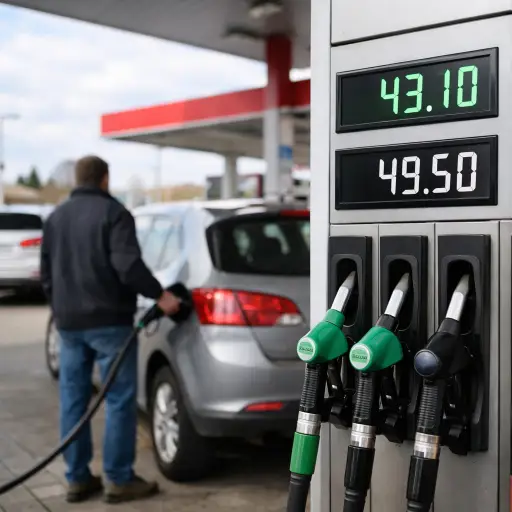
The Czech Republic’s fuel market has entered a new phase following the government’s decision to cap distributor margins and reduce excise duty on diesel. From midweek, petrol stations across the country have been required to comply with strict price ceilings, limiting petrol to no more than 43.15 crowns per liter and diesel to 49.59 crowns.
A visit to several filling stations in Prague and surrounding regions shows that the measures have already translated into visible changes for drivers. In many cases, prices have dropped to just below the new limits, while some stations have set their rates exactly at the capped thresholds.
At a busy station in Prague’s outer district, motorists queued steadily as they took advantage of the adjusted prices. “It’s definitely noticeable,” said a driver refueling his family car. “It’s not a huge drop, but compared to what we were paying before, it feels like some relief.” Nearby, price boards displayed figures hovering just under the maximum allowed, reflecting a cautious approach by operators.
Elsewhere, particularly along major transit routes, stations appeared to align prices precisely with the cap. Analysts suggest this could indicate that retailers are using the new limits as a benchmark, rather than competing aggressively below them. “When a ceiling is introduced, it often becomes a focal point for pricing,” noted one market observer. “The result is less variation and more uniformity across locations.”
Station operators themselves describe the transition as manageable but restrictive. While the rules bring a degree of predictability, they also limit flexibility in responding to wholesale price changes. “We have to follow the regulation, of course,” said an employee at a station near Brno. “But if purchase prices change quickly, we don’t have much room to react.”
The government introduced the measures in response to sustained pressure from rising fuel costs and public concern over price volatility. By targeting distributor margins and easing the tax burden on diesel, officials aim to shield consumers and businesses from further increases.
Initial observations suggest that the policy is achieving its immediate goal. Across the stations visited, fuel prices have clustered tightly around the regulated ceilings, with only minor differences between urban and rural areas. This marks a shift from previous months, when price disparities between regions were more pronounced.
However, the effects are not uniform everywhere. In some smaller towns, where prices had already been relatively low, the change is less visible. Stations that were previously operating below the cap have made only minimal adjustments. In contrast, higher-priced locations have seen more significant reductions, bringing them into compliance with the new rules.
For drivers, the response has been cautiously positive. “It helps, especially if you drive a lot for work,” said a courier refueling a diesel van in Central Bohemia. “But I’m curious how long it will stay like this.” Such sentiments reflect a broader uncertainty about the durability of the measures.
The reduction in diesel excise duty is particularly relevant for the Czech Republic’s logistics and transport sectors, which rely heavily on road freight. Industry representatives say the change could ease operational costs, though they stress the importance of long-term stability in policy. Frequent adjustments, they warn, can complicate business planning.
Economists highlight that while price caps can provide short-term relief, they may also carry risks. Limiting margins could discourage competition or affect supply if distributors find the market less profitable. “The key will be monitoring how suppliers respond over time,” said one analyst. “If margins become too tight, it could have unintended consequences.”
For petrol station operators, the new environment may shift competition away from fuel pricing toward services and convenience. Some stations are already emphasizing loyalty programs, car washes, and retail offerings as ways to attract customers within the constraints of regulated prices.
As the policy settles in, attention will turn to its longer-term impact on the Czech fuel market. For now, drivers across the country are seeing more stable and predictable prices at the pump—an outcome that, at least in the short term, aligns with the government’s intentions.