Early results signal a decisive shift as voters rally behind a new power center, raising expectations and questions across Bulgaria and beyond

A sweeping early lead for Rumen Radev and his newly formed movement, Progressive Bulgaria, is reshaping the political landscape in Bulgaria. Partial results released by the Central Election Commission of Bulgaria suggest a commanding advantage, with the party capturing a striking share of the vote after only a portion of ballots has been counted.
The scale of the lead has surprised even seasoned observers. While pre-election surveys hinted at strong support for Radev’s platform, few anticipated such a pronounced gap over established rivals. The outcome, if sustained through the full count, would mark one of the most decisive victories in Bulgaria’s recent democratic history and could usher in a new phase of governance defined by centralized political momentum.
At campaign rallies across the country, Radev positioned himself as a stabilizing force amid years of political fragmentation. His message combined calls for institutional reform, anti-corruption measures, and a recalibration of Bulgaria’s economic priorities. Voters appeared receptive, particularly in urban centers and among younger demographics seeking a break from entrenched party dynamics.
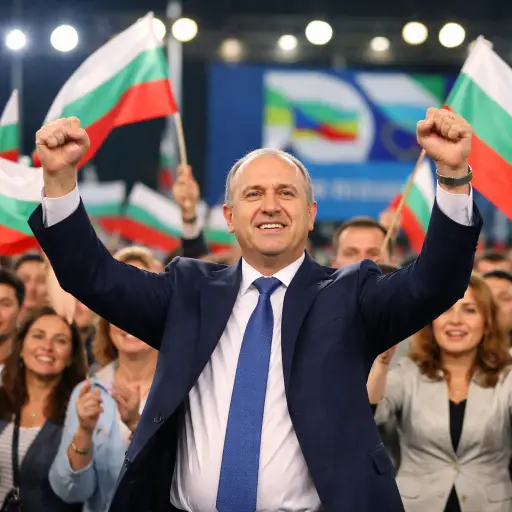
The atmosphere at Progressive Bulgaria’s headquarters reflected a sense of cautious triumph. Supporters gathered in large numbers, waving national flags and celebrating what they see as a turning point. Party officials, however, have been careful to temper expectations, emphasizing that the counting process remains ongoing and that final results will determine the scope of their mandate.
For many Bulgarians, the election has become a referendum on governance itself. The country has faced repeated cycles of political instability, including short-lived governments and stalled reforms. Against this backdrop, Radev’s ascent signals a potential consolidation of authority, though it also raises concerns about how such dominance will be exercised.
Opposition parties have responded with a mix of acknowledgment and apprehension. Some leaders conceded that the early figures reflect a clear shift in voter sentiment, while others urged patience until the full results are known. Behind the scenes, discussions are already beginning about how to navigate a political environment that could be dominated by a single force.
Analysts note that the implications extend beyond domestic politics. Bulgaria’s role within the European Union, its economic strategy, and its foreign policy orientation could all be influenced by the direction set by a Radev-led government. His previous tenure in public office has demonstrated a willingness to challenge established norms, suggesting that his party’s agenda may introduce both continuity and disruption.
Economic issues played a central role in the campaign, with voters expressing frustration over rising costs of living and uneven development. Progressive Bulgaria’s promises of targeted investment and administrative reform resonated strongly in regions that have felt left behind. Whether these commitments can be translated into effective policy will be one of the first tests of the party’s credibility.
At the same time, questions remain about coalition dynamics. Even with a substantial lead, the structure of Bulgaria’s parliamentary system often necessitates negotiation and compromise. The extent to which Progressive Bulgaria will need partners, and the nature of those alliances, could shape the legislative agenda in the months ahead.
International observers are closely monitoring developments, viewing the election as a bellwether for broader trends in European politics. The rise of a new political force anchored by a high-profile figure underscores the volatility and fluidity that continue to characterize democratic systems across the region.
For now, the focus remains on the ongoing count and the gradual confirmation of what appears to be a pivotal moment. If the current trajectory holds, Rumen Radev and Progressive Bulgaria will not only have secured a significant electoral victory but will also have redefined the contours of political power in Bulgaria.
The coming days are likely to bring greater clarity, but the message from voters is already unmistakable. A demand for change has translated into a powerful electoral signal, setting the stage for a period of transformation whose full impact is yet to unfold.