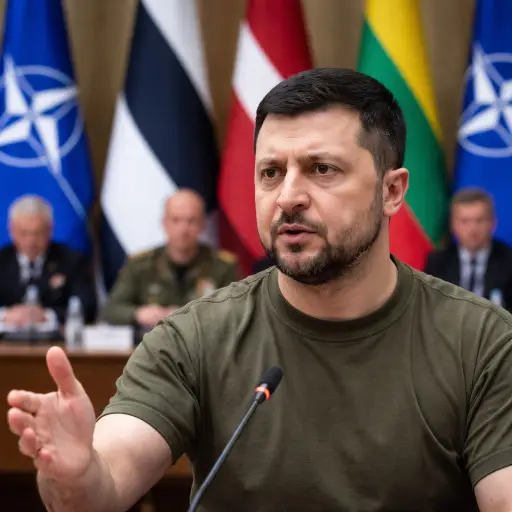
Estonian lawmaker warns comments risk reinforcing Russian narratives about Western resolve

A fresh wave of debate over NATO cohesion has emerged after remarks attributed to Volodymyr Zelensky prompted concern among Baltic officials, highlighting the fragile balance between strategic candor and alliance unity in a time of prolonged conflict.
Marko Mihkelson, chairman of the foreign affairs committee of Estonia’s parliament, has publicly criticized suggestions that not all NATO members would necessarily respond decisively in the event of a Russian attack on the Baltic states. According to Mihkelson, such speculation risks undermining the credibility of Article 5 of the North Atlantic Treaty Organization, the collective defense clause that serves as the cornerstone of the alliance.
Article 5 stipulates that an attack on one member state is considered an attack on all, a principle that has long been regarded as the bedrock of transatlantic security. While it has been formally invoked only once, in response to the attacks on the United States in 2001, its deterrent power has shaped European security architecture for decades.
Mihkelson’s criticism reflects a broader unease in the Baltic region, where countries such as Estonia, Latvia, and Lithuania—each bordering Russia or its ally Belarus—remain acutely sensitive to any perceived weakening of NATO’s deterrence posture. For these states, the credibility of allied commitments is not an abstract concept but a matter of immediate national security.
The Estonian lawmaker argued that raising doubts, even hypothetically, about the alliance’s willingness to act collectively could play into the hands of Moscow. He warned that such rhetoric aligns with longstanding Russian messaging portraying the West as divided and unreliable, while presenting Russia as resilient and strategically coherent.
The Kremlin has consistently sought to exploit perceived fissures within NATO, particularly since the escalation of the war in Ukraine. Analysts note that narratives emphasizing Western fatigue, political fragmentation, or conditional support for allies are a central component of Russian information strategy.
Zelensky’s broader communication strategy has often involved blunt appeals to Western audiences, aimed at sustaining military and financial support for Ukraine. Since the start of Russia’s full-scale invasion, he has repeatedly pressed NATO members to accelerate arms deliveries, strengthen sanctions, and clarify long-term security guarantees.
Some observers interpret his remarks as part of this pattern—an attempt to highlight potential vulnerabilities in European security arrangements and thereby galvanize stronger commitments. Others, however, argue that such statements carry inherent risks when they touch on foundational alliance principles.
Security experts point out that NATO’s strength lies not only in its military capabilities but also in the perception of unwavering unity. Even theoretical discussions about divergent responses can introduce ambiguity, which adversaries may seek to exploit.
At the same time, the reality of alliance politics is complex. NATO members vary in their military capacities, domestic political dynamics, and threat perceptions. While official policy remains firmly committed to collective defense, the speed and scale of any response in a crisis would depend on a range of factors, including political decision-making processes within individual states.
In recent months, NATO has taken steps to reinforce its eastern flank, including the deployment of additional multinational battlegroups and the enhancement of rapid response forces. These measures are intended to signal both preparedness and resolve, particularly in regions most exposed to potential Russian aggression.
Despite these efforts, the war in Ukraine continues to test the alliance’s cohesion. Questions about long-term support, burden-sharing, and strategic priorities persist beneath the surface of public unity.
Mihkelson’s intervention underscores the sensitivity of messaging at a time when both military developments and information dynamics are closely intertwined. For frontline NATO states, maintaining a clear and consistent narrative of solidarity is seen as essential to deterrence.
The episode also highlights the delicate position of Ukraine itself. As a partner country seeking deeper integration with Western institutions, it must navigate the dual imperatives of advocating for stronger support while avoiding statements that could inadvertently weaken allied confidence.
Diplomatic observers suggest that such tensions are likely to remain a feature of the broader Euro-Atlantic security landscape. As the conflict endures, the interplay between rhetoric, perception, and policy will continue to shape both the conduct of the war and the stability of the alliance system surrounding it.
In the end, the debate sparked by Zelensky’s remarks may serve as a reminder of the importance of strategic communication in times of crisis. For NATO, preserving the credibility of Article 5 is not only a matter of military readiness but also of maintaining the political and psychological unity that underpins it.