From small towns to regional centers, the Tisza leader draws swelling crowds and tests the limits of a fast-rising opposition movement

In the final stretch before Hungary’s parliamentary elections, Péter Magyar has turned the campaign trail into a marathon. The leader of the Tisza Party is crisscrossing the country with a pace that few in recent political memory can match, holding as many as five or six rallies a day in towns and cities that often sit far from the usual centers of national attention.
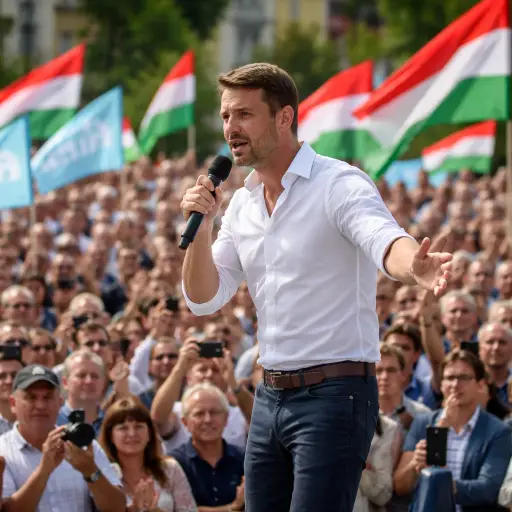
On a recent day, his itinerary included stops in Mosonmagyaróvár and Győr—two western Hungarian cities where turnout exceeded expectations. Public squares filled early, with supporters crowding close to makeshift stages, many raising phones to capture the moment. By the time Magyar arrived, often running behind schedule, the anticipation had already built into a palpable sense of momentum.
The scenes have become characteristic of his campaign. In place after place, from smaller municipalities to regional hubs, attendance has surged. Organizers describe a growing wave of interest that appears to cut across age groups and political backgrounds. Some attendees say they are longtime opposition voters, while others admit they are first-time participants, drawn by Magyar’s message of change and his unconventional path into frontline politics.
Magyar’s rhetoric blends criticism of the current political establishment with promises of institutional renewal. His speeches, delivered in a direct and conversational tone, often emphasize transparency, accountability, and what he calls a return to “ordinary political decency.” He frequently adapts his remarks to local concerns, referencing regional economic challenges, infrastructure gaps, or demographic pressures, a strategy that has resonated in areas where national campaigns are sometimes perceived as distant.
Yet the intensity of his schedule is as much a message as his words. By appearing in multiple locations each day, Magyar signals urgency and determination, projecting the image of a campaign that is both grassroots-driven and highly mobilized. His team operates with a tight logistical framework, coordinating travel, security, and event management at a rapid pace. Even so, delays are common, and the candidate often arrives visibly fatigued—only to launch into energetic addresses that last well beyond their planned duration.
Political analysts note that such a strategy carries both opportunity and risk. On one hand, the high visibility and personal engagement can deepen voter connection, particularly in regions that feel overlooked. On the other, the physical demands raise questions about sustainability, especially in the critical final days when discipline and message consistency are paramount.
For many voters, however, the spectacle itself is part of the appeal. The sense of witnessing a campaign in constant motion—one that prioritizes presence over polish—has created a narrative of authenticity that supporters find compelling. In interviews at recent rallies, attendees described a feeling that “something is happening,” even if they remain cautious about predicting electoral outcomes.
The broader political context remains complex. Hungary’s electoral landscape has long been shaped by entrenched party structures and well-established networks. Breaking through that environment requires not only enthusiasm but also organizational depth and voter turnout on election day. Whether Magyar’s rapid ascent and high-energy campaign can translate into measurable gains at the ballot box is the central question looming over the final stretch.
As the weekend approaches, the pace shows no sign of slowing. Additional stops are scheduled across multiple regions, each designed to reinforce the campaign’s central message: that change is possible, and that it begins with showing up—again and again, in every corner of the country.
For now, the crowds continue to gather, the speeches continue to echo through town squares, and Péter Magyar continues to move forward, one rally at a time.