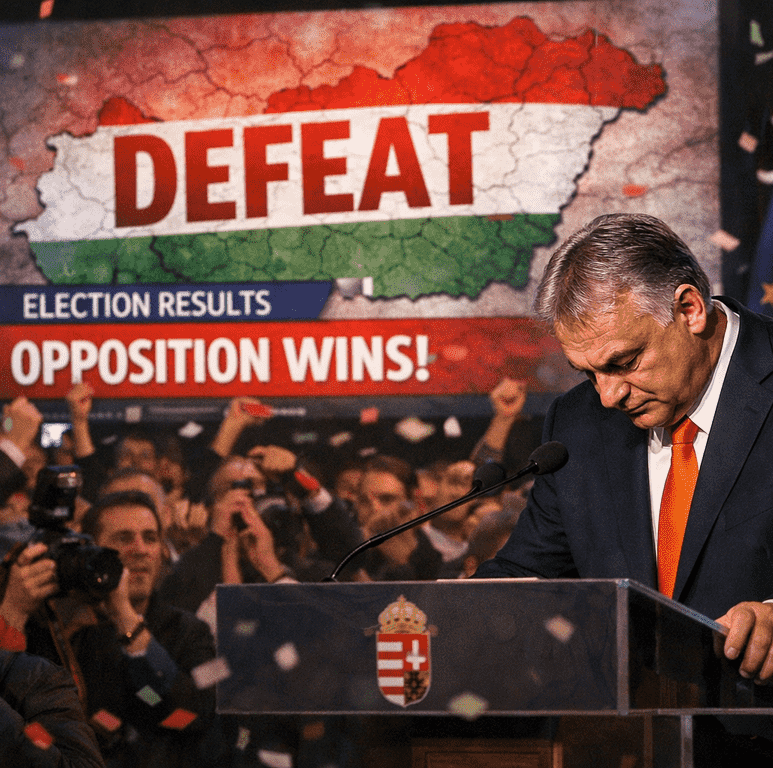
Backing from the Trump White House, sympathy from the Kremlin and years of Chinese investment strengthened the outgoing prime minister’s international profile. But Hungary’s election was ultimately decided by stagnation, public services, corruption and the sense that the Orbán cycle had run its course.

Foreign Desk | April 14, 2026
Outside support strengthened Orbán as a system leader. It did not answer the voters’ everyday concerns.
Viktor Orbán’s defeat in Hungary’s April 12 parliamentary election was not an ordinary electoral setback. It was the breakdown of the formula that had allowed him, for 16 years, to present himself as a strongman at home and an indispensable player abroad. The victory of Péter Magyar and Tisza, delivered in a high-turnout election and ending in a two-thirds parliamentary majority, shows that Orbán’s international relevance no longer translated automatically into domestic trust.
The first analytical correction matters. It is misleading to speak in the same way about ‘support from the United States’, Russia and China. On the American side, the most visible backing came not from the United States as a whole but from Donald Trump’s White House, JD Vance and the wider MAGA orbit. On the Russian side, there was clear political sympathy together with a flow of pro-Orbán narratives in information channels linked to Moscow. On the Chinese side, the support was mainly structural: investment, strategic partnership, industrial projects and political cooperation. Three different forms of influence, all constrained by the same limit: none of them could solve the central question Hungarian voters wanted to judge.
The real agenda: economy, healthcare and frozen EU funds
The 2026 vote was decided first of all as a retrospective judgment on the incumbent government. Voters looked at Orbán’s record and asked whether he still had a credible answer on the terrain of material life. For a decisive share of the electorate, the answer was no. After three years of economic stagnation and the worst inflation shock Hungary had experienced since the 1990s, the promise of stability lost credibility. Fidesz tried to shift the campaign toward war in Ukraine, the supposed choice between ‘war or peace’ and the geopolitical risks of change. But a large part of the electorate was more focused on healthcare, wages, the cost of living, schools and the quality of the state.
A second heavy burden was the freezing of billions of euros in EU funds over rule-of-law concerns. Orbán tried to frame the clash with Brussels as a test of national sovereignty. Many voters read it instead as a concrete price paid by the country. This is the core point: Trump, Putin and Xi could offer Orbán visibility, diplomatic support or investment. They could not lower food prices, improve hospitals or repair Hungary’s relationship with the European Union.
Trump’s Washington: loud endorsement, weak conversion
The American factor was probably the most spectacular and the least productive. JD Vance’s visit to Budapest just days before the vote had strong symbolic value: a sitting U.S. vice president publicly backing a foreign leader in a move that broke with long-standing diplomatic practice. In media terms, the visit fed Orbán’s preferred image as a central figure in the sovereigntist international. In electoral terms, however, the returns were limited.
There are two reasons. First, this kind of endorsement may energize the ideological core of Fidesz, but it does little to expand support toward the center. Second, it introduces a contradiction Orbán could not neutralize. A leader who built his identity on national sovereignty ended up being publicly sponsored by a foreign power. For moderate voters, that does not reinforce sovereignty; it undercuts it. In that sense, the Trump camp made a great deal of noise but offered no additional political help capable of converting international attention into new votes.
Moscow: strategic value abroad, political toxicity at home
The Kremlin’s support proved equally double-edged. For Moscow, Orbán was valuable because he acted as a disruptive ally inside the European Union, slowing sanctions, loans and common decisions on Kyiv. That is precisely why his defeat was read in Russia as a strategic loss. But what was useful to the Kremlin became increasingly problematic for Hungarian voters.
Orbán’s proximity to Putin weakened the message on which he had governed for years: that he alone defended Hungary’s national interest against all outside pressures. If a leader appears too useful to Moscow, he stops looking fully autonomous in Budapest. The same logic applied in the information sphere. Research published in the final days of the campaign showed that a significant share of pro-Orbán content circulating on Telegram came from Russian or pro-Russian sources and bore the hallmarks of an orchestrated campaign. Yet this, too, had limits. Telegram is less central in Hungary than Facebook and TikTok, and fear-based propaganda works only when it meets a government still seen as credible. Once trust erodes on the economy and institutions, even an aggressive narrative machine loses effectiveness.
Beijing: investment without electoral gratitude
The Chinese case is in some ways the most instructive because it highlights the difference between structural influence and popular consent. Unlike Trump and the Kremlin, Beijing did not stage an overt election intervention for Orbán. Its support flowed through the privileged relationship built over years: an ‘all-weather’ strategic partnership, infrastructure projects, battery plants, electric-vehicle investment and Hungary’s role as a gateway into the European market.
And yet this is exactly where Orbán’s strategy ran into its paradox. The government presented Chinese capital as proof that the Hungarian model was working. By 2026, however, that model looked to many voters like a system that offered subsidies and political protection to large foreign investors without delivering a tangible improvement in daily life. Orbán’s battery bet, instead of becoming the engine of a new upswing, turned into a political liability: a sector slowdown, doubts about the economic payoff, environmental concerns and the perception that local priorities were being subordinated to multinational interests.
The fact that Beijing moved quickly after the vote to congratulate Tisza and signal its willingness to work with Hungary’s new leadership clarifies the deeper point. China had invested in the Hungarian state and in a strategic relationship, not in a personal vote-producing machine for Orbán. Chinese capital could therefore reinforce the outgoing premier’s system of power without creating any electoral debt of gratitude.
Why Magyar changed the terms of the race
The final reason outside influence failed to convert into votes lies in the opponent Orbán faced. Péter Magyar was not the ideal adversary for Fidesz. He was not part of the old liberal opposition that Orbán knew how to fold into his usual frame of ‘nation versus globalists’. He was a former insider, a conservative with Fidesz roots, able to speak to national and right-of-center voters without accepting Orbán’s political grammar.
Magyar took two key words away from Orbán: nation and change. He shifted the contest toward corruption, rule of law, public services, EU funds and institutional balance. He also connected strongly with younger voters, the segment most clearly inclined to see yet another Orbán victory not as continuity but as the blocking of the future. With turnout running high, the electorate widened beyond the Fidesz core. Once the electorate widened, outside endorsements mattered far less than domestic credibility.
The broader lesson
The lesson of the Hungarian vote therefore goes beyond Orbán himself. Foreign powers can help stabilize a regime, provide it with resources, legitimacy and international cover. They cannot by themselves renew a worn-out social contract. In 2026 Hungarian voters did not only reject a leader. They rejected a model based on geopolitical balancing, economic patronage and the permanent mobilization of fear.
That is why support favorable to Orbán did not turn into additional votes. Trump’s camp mobilized the core, not the center. Proximity to Moscow fed suspicion of dependence that sat uneasily with sovereigntist rhetoric. Ties to China produced factories and infrastructure, but not political gratitude. When an election is decided by wages, hospitals, corruption and a desire for European normalization, external backing is not enough. For a leader at the end of a cycle, it can even become the clearest proof of how far he has drifted from the country he claims to embody.
Editorial note: this analysis is based on election results and public reporting available as of April 14, 2026