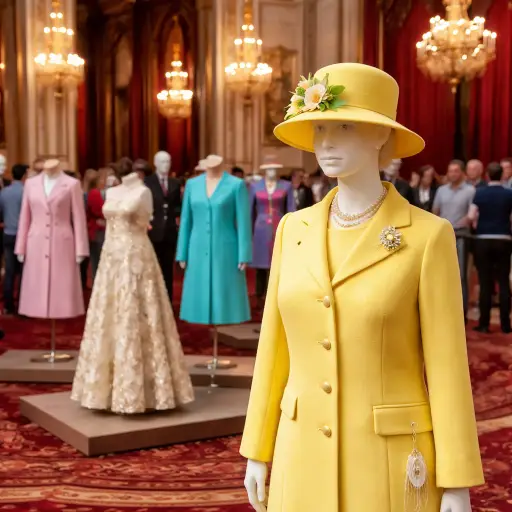
A landmark exhibition reveals how Elizabeth II used fashion as a language of visibility, continuity, and quiet power

There has never been much doubt that Queen Elizabeth II possessed a distinctive sense of style. Yet to describe her simply as well-dressed would be to miss the point entirely. For decades, she stood not only as a monarch but as a carefully curated visual presence—one whose wardrobe was as deliberate as any state document. Now, as Buckingham Palace opens its most ambitious exhibition to mark what would have been the centenary of her birth, the public is invited into a world where color, cut, and craftsmanship tell a story far deeper than fabric.
Inside the palace’s grand halls, visitors encounter an array of garments that chart the evolution of a reign unlike any other. From early, softly structured silhouettes of a young queen to the unmistakable, boldly colored coats of her later years, the exhibition is less a display of clothing than a study in communication. Each piece reflects a philosophy: to be seen clearly, to be recognized instantly, and to remain constant in a rapidly changing world.
The famous bright hues—sunlit yellows, vivid pinks, electric blues—were not chosen on a whim. In crowded public spaces, where thousands gathered for even a fleeting glimpse, visibility was essential. The Queen herself once acknowledged that she needed to stand out, to ensure that even those at the back could say they had seen her. In this sense, her wardrobe functioned as a democratic tool, bridging the distance between sovereign and subject.
Equally striking is the precision of tailoring. Coats fall with architectural clarity, dresses maintain impeccable structure, and no detail appears accidental. The exhibition highlights the work of the designers and dressmakers who collaborated closely with the Queen over decades, translating her requirements into garments that balanced elegance with practicality. Weighted hems ensured stability in unpredictable weather, while carefully placed seams allowed for ease of movement during long public engagements.
And then there are the hats. Displayed in a dedicated section, they form a visual archive of British millinery at its most inventive. Each hat, often adorned with flowers, feathers, or sculptural elements, was designed not merely as an accessory but as a signature. Together, they create a silhouette that became instantly recognizable across continents—a symbol of continuity in an era of constant change.
What emerges most clearly from the exhibition is the idea of consistency. While fashion trends shifted dramatically over the decades, the Queen’s style remained remarkably steady. This was not resistance to change, but rather a conscious decision to embody stability. In times of uncertainty, her unvarying appearance offered reassurance, a visual anchor for a nation navigating social and political transformation.
Yet there is also an undercurrent of subtle evolution. Earlier garments reveal a softer palette and more intricate detailing, reflecting post-war optimism and the traditions of court dress. Later pieces adopt cleaner lines and bolder colors, aligning with the demands of modern media and global visibility. The exhibition invites visitors to trace these shifts, not as departures, but as refinements of an established identity.
Beyond aesthetics, the wardrobe tells a story of duty. Every outfit was chosen with context in mind—state visits, ceremonies, moments of mourning or celebration. Fabrics, colors, and embellishments often carried symbolic weight, quietly acknowledging the cultures and traditions of the places she visited. In this way, clothing became a form of diplomacy, conveying respect without the need for words.
The decision to open this collection to the public feels particularly resonant now. In an age dominated by fast fashion and fleeting trends, the Queen’s approach offers a striking contrast. Her wardrobe was not about reinvention, but about refinement; not about spectacle, but about purpose. It suggests a different relationship with clothing—one rooted in longevity, meaning, and intention.
As visitors move through the exhibition, there is a sense of encountering not just garments, but moments. A coat worn during a historic visit, a dress associated with a milestone event, a hat that crowned countless appearances—each piece carries the imprint of time. Together, they form a portrait of a life lived in public view, yet carefully controlled in its presentation.
Ultimately, the exhibition is as much about perception as it is about fashion. It reveals how a monarch, bound by tradition yet operating in a modern world, used clothing to navigate visibility and distance, familiarity and formality. In doing so, Queen Elizabeth II created a visual legacy that endures beyond her lifetime.
To walk through these rooms is to understand that her style was never merely decorative. It was strategic, thoughtful, and deeply human in its intent to connect. And in that connection—bright, unmistakable, and enduring—lies the true power of the crown in color.