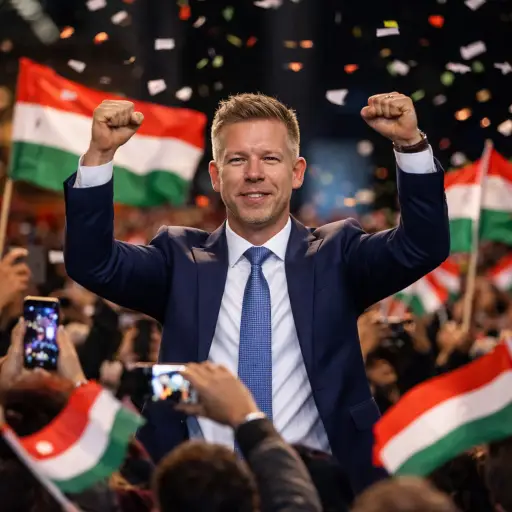
Peter Magyar’s victory reshapes Budapest’s role in Europe, delivering a setback to Moscow and Washington while opening a new chapter of domestic contestation

In a result that reverberated far beyond Budapest, Hungary’s long-dominant nationalist leader Viktor Orbán has been unseated by former ally turned challenger Peter Magyar, marking one of the most consequential political shifts in Europe in recent years. The outcome has been greeted with cautious optimism across European capitals, where leaders see an opportunity to recalibrate relations with a country that had increasingly positioned itself at odds with the European mainstream.
For over a decade, Orbán defined Hungary’s political identity through a blend of conservative nationalism, centralised power, and a distinctly eurosceptic tone. His government frequently clashed with Brussels over rule-of-law issues, migration policy, and the limits of national sovereignty within the European Union. Yet it was not only within Europe that Orbán found sympathetic ears. Both Moscow and, at times, elements within Washington’s political landscape viewed him as a useful counterpart — a leader willing to challenge liberal consensus and advocate for a more transactional approach to international relations.
Magyar’s victory disrupts that alignment. A former insider within Orbán’s political orbit, he built his campaign on promises of institutional reform, renewed engagement with European partners, and a recalibration of Hungary’s foreign policy posture. His message resonated with voters fatigued by years of political consolidation and eager for a change in tone, if not a complete ideological overhaul.
European leaders were quick to signal their approval. The election result is widely interpreted as a chance to bring Hungary back into closer alignment with EU priorities, particularly at a time when unity is seen as essential in addressing security concerns and economic pressures. Diplomats in Brussels describe the shift as a “window of opportunity,” though one that will require careful navigation.
The implications extend eastward. Moscow, which had cultivated a pragmatic relationship with Orbán, now faces the prospect of a less predictable partner in Budapest. While Hungary is unlikely to undergo an abrupt foreign policy reversal, analysts suggest that Magyar may seek to reduce the visibility of ties that had previously drawn criticism from European allies. Even incremental changes could alter regional dynamics, particularly in the context of energy policy and diplomatic coordination.
In Washington, the reaction is more nuanced. Orbán’s brand of politics had found admirers across parts of the American political spectrum, making his defeat symbolically significant. Yet U.S. policymakers are also aware that Hungary’s strategic importance lies less in personalities than in its positioning within Europe. A government more aligned with EU institutions could simplify transatlantic cooperation, but expectations remain measured.
Despite the international attention, the most immediate challenges facing Magyar are domestic. His victory does not erase the deep political divisions that have defined Hungary in recent years. Orbán’s influence remains substantial, supported by a loyal base and an entrenched political network that will continue to shape the country’s direction. The transition of power is therefore less a clean break than the beginning of a contested phase.
Economically, Hungary faces familiar pressures: inflation, investment uncertainty, and the need to maintain competitiveness within a shifting European market. Magyar’s ability to deliver tangible improvements will be critical in consolidating his mandate. At the same time, his pledge to strengthen democratic institutions will be tested by the realities of governing a system long dominated by his predecessor’s allies.
There is also the question of expectations. For many voters, the election represents not just a political смена but a broader hope for renewal. Managing that optimism — without overpromising or triggering backlash — will require a delicate balance. Early signals suggest Magyar is aware of the stakes, adopting a tone that emphasises continuity where necessary and reform where possible.
Across Europe, the mood is one of guarded celebration. Orbán’s defeat is seen as a symbolic turning point, a moment that suggests the resilience of democratic competition even in systems that appear firmly entrenched. Yet few are under the illusion that Hungary’s trajectory has been definitively reset. The country now enters a period of negotiation — between past and future, sovereignty and integration, stability and change.
For Moscow and Washington alike, the message is clear: Hungary’s political landscape is no longer as predictable as it once was. For Europe, the challenge will be to translate this moment into lasting alignment. And for Hungarians, the real test is only just beginning.
