Currency markets react to opposition momentum and renewed expectations that Hungary could regain access to frozen European Union funds

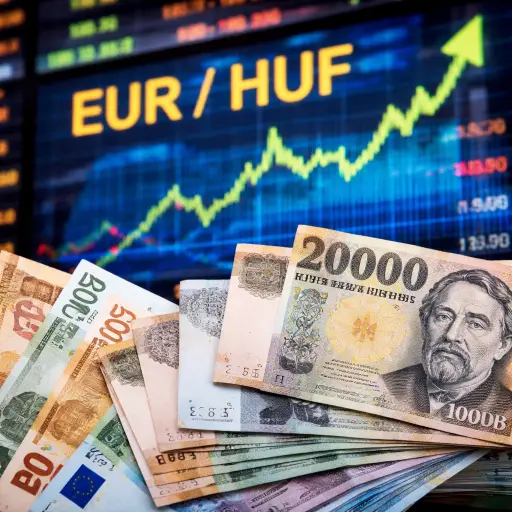
The Hungarian forint strengthened sharply against the euro at the start of the week, reaching its highest level in more than four years and signaling renewed investor confidence in the country’s economic outlook. The rally comes amid growing speculation that a potential shift in Hungary’s political landscape could unlock billions of euros in European Union funding that have long been withheld due to disputes over governance and rule-of-law concerns.
Currency traders and analysts point to a combination of domestic political developments and external financial expectations as the driving forces behind the forint’s rise. The possibility of an opposition victory in upcoming political contests has injected fresh optimism into markets, with investors betting that a change in leadership could ease tensions between Budapest and Brussels.
For years, Hungary has been locked in a protracted standoff with EU institutions over issues including judicial independence, media freedoms, and anti-corruption safeguards. As a result, access to substantial EU cohesion and recovery funds has been frozen, depriving the country of a key source of investment and fiscal support. The potential release of these funds is widely seen as a game changer for Hungary’s economy, which has faced persistent inflationary pressures and slower growth compared to regional peers.
Market participants say the forint’s appreciation reflects not only political expectations but also a broader recalibration of risk. Investors are pricing in the possibility of improved relations with the EU, which would significantly reduce uncertainty. That translates into stronger demand for Hungarian assets and, by extension, the currency.
The rally has also been supported by Hungary’s relatively high interest rates, which continue to attract carry trade flows. However, analysts caution that monetary policy alone cannot sustain the currency’s strength if structural and political risks remain unresolved. The prospect of renewed EU funding, they argue, is the more decisive factor in shaping medium-term sentiment.
Despite the upbeat mood in markets, the political outlook remains uncertain. Hungary’s current leadership has shown little inclination to fundamentally alter its stance toward EU oversight, and negotiations with Brussels have often stalled after periods of apparent progress. Even if an opposition victory were to materialize, restoring full access to EU funds would require time, institutional reforms, and sustained engagement with European authorities.
Economists note that the stakes are high. EU funds have historically played a crucial role in financing infrastructure, supporting regional development, and stabilizing public finances. Their absence has forced Hungary to rely more heavily on domestic borrowing and alternative financing sources, increasing vulnerability to external shocks.
The forint’s recent gains may therefore be as much about future expectations as present realities. While the currency’s performance sends a positive signal, it also underscores how closely Hungary’s economic fortunes remain tied to political developments and its relationship with the European Union.
Looking ahead, investors will be watching closely for concrete signs of policy shifts and diplomatic progress. Any indication that Hungary could move closer to meeting EU conditions is likely to reinforce the forint’s upward trajectory. Conversely, renewed tensions or political uncertainty could quickly reverse recent gains.
For now, the market appears willing to give Hungary the benefit of the doubt. The forint’s climb to multi-year highs reflects a belief that change may be on the horizon. Whether that optimism proves justified will depend on decisions made in the weeks and months ahead, both in Budapest and in Brussels.