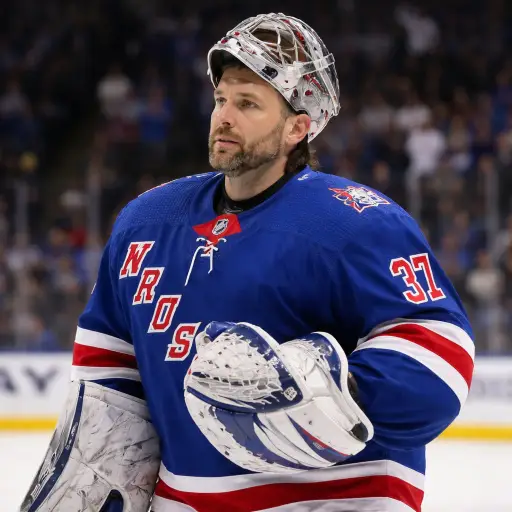
After nearly two decades, three Stanley Cups, and a career defined by resilience, the veteran goaltender readies himself for one last night in net with New York

The ice will feel the same, but the moment will not. As the lights come up in Florida and the puck drops for a late-night matchup, Jonathan Quick will step onto the rink knowing it is the last time he will do so as a National Hockey League player.
The veteran goaltender, now forty, has announced that he will retire following the game, closing a career that has stretched across nearly two decades and left an indelible mark on the sport. Wearing the jersey of the New York Rangers for the final time, Quick’s farewell will come far from where his story began—but fittingly, still under the bright lights of a league he helped define.
For many, Quick’s career will forever be tied to his years with the Los Angeles Kings, where he emerged as one of the most competitive and acrobatic goaltenders of his generation. It was there that he reached the pinnacle of the sport, backstopping the Kings to two Stanley Cup championships and delivering performances that remain etched in playoff lore.
His first championship run transformed him from a respected starter into a household name. Quick’s ability to combine explosive athleticism with relentless focus made him nearly impenetrable in net. Opponents struggled to solve him, and teammates fed off his confidence. The second title only reinforced his legacy, confirming that his earlier success was no fluke but the result of elite consistency at the highest level.
Years later, in a different uniform, Quick added another chapter to his story with the Vegas Golden Knights, capturing a third Stanley Cup and becoming part of a select group of players who have lifted hockey’s most coveted trophy with multiple organizations. While his role had evolved by then, his presence in the locker room and his experience remained invaluable.
The Stanley Cup itself has often been described as the ultimate test of endurance, skill, and mental strength. Quick met that challenge repeatedly, earning a reputation not only as a winner but as a competitor who thrived when the stakes were highest. His playoff performances, in particular, became a defining feature of his career—moments when reflexes sharpened, instincts took over, and pressure seemed to elevate rather than burden him.
Yet beyond the championships and statistics, Quick’s legacy is also one of adaptation. Over the course of nineteen seasons, the game changed around him. Styles evolved, younger goaltenders emerged, and the demands of the position intensified. Through it all, Quick found ways to remain relevant, adjusting his technique while preserving the aggressive edge that made him so difficult to beat.
Teammates and coaches have often pointed to his work ethic as a cornerstone of that longevity. Practices were rarely routine for Quick; they were opportunities to refine, to push, to compete. Even as the years accumulated, the intensity never fully faded. It is that same mindset that has carried him to this final game, one more chance to stand in the crease and face the game head-on.
The decision to retire, while expected given his age and the arc of his career, still carries emotional weight. For players, the end rarely arrives without reflection. There are memories of packed arenas, of silent locker rooms after losses, of celebrations that stretch late into the night. There are also the quieter moments—early mornings, long travel days, the steady rhythm of a life built around the game.
For Quick, those memories span cities, teammates, and eras. From Los Angeles to Vegas and now New York, his journey has traced the map of a league constantly in motion. Each stop added a layer to his identity, shaping him not only as a player but as a veteran presence capable of guiding younger teammates through the pressures of professional hockey.
As the final game approaches, the focus will inevitably shift between past and present. Fans will remember the sprawling saves, the playoff heroics, the unyielding competitiveness. On the ice, however, the task remains simple: stop the puck, give the team a chance, play one more game.
There is a certain symmetry in that. For all the accolades and milestones, the essence of goaltending has always been immediate, almost elemental. A shot comes, a decision is made, a save is attempted. In those fractions of a second, careers are built and defined.
When the final horn sounds, it will mark more than the end of a game. It will close a chapter that has spanned nearly twenty years, one defined by perseverance, excellence, and a refusal to yield. Quick will leave behind a legacy that extends beyond wins and trophies—a standard of competitiveness that younger players will continue to chase.
And yet, for all its finality, the moment will also carry a sense of continuity. The game will move on, as it always does, with new players stepping into roles once held by veterans like Quick. But the echoes of his career—the saves, the championships, the intensity—will remain part of the sport’s collective memory.
For one last night, though, the focus returns to the crease. The mask goes on, the crowd settles, and the puck drops. Jonathan Quick, as he has done for nearly two decades, takes his position and prepares to meet whatever comes next.