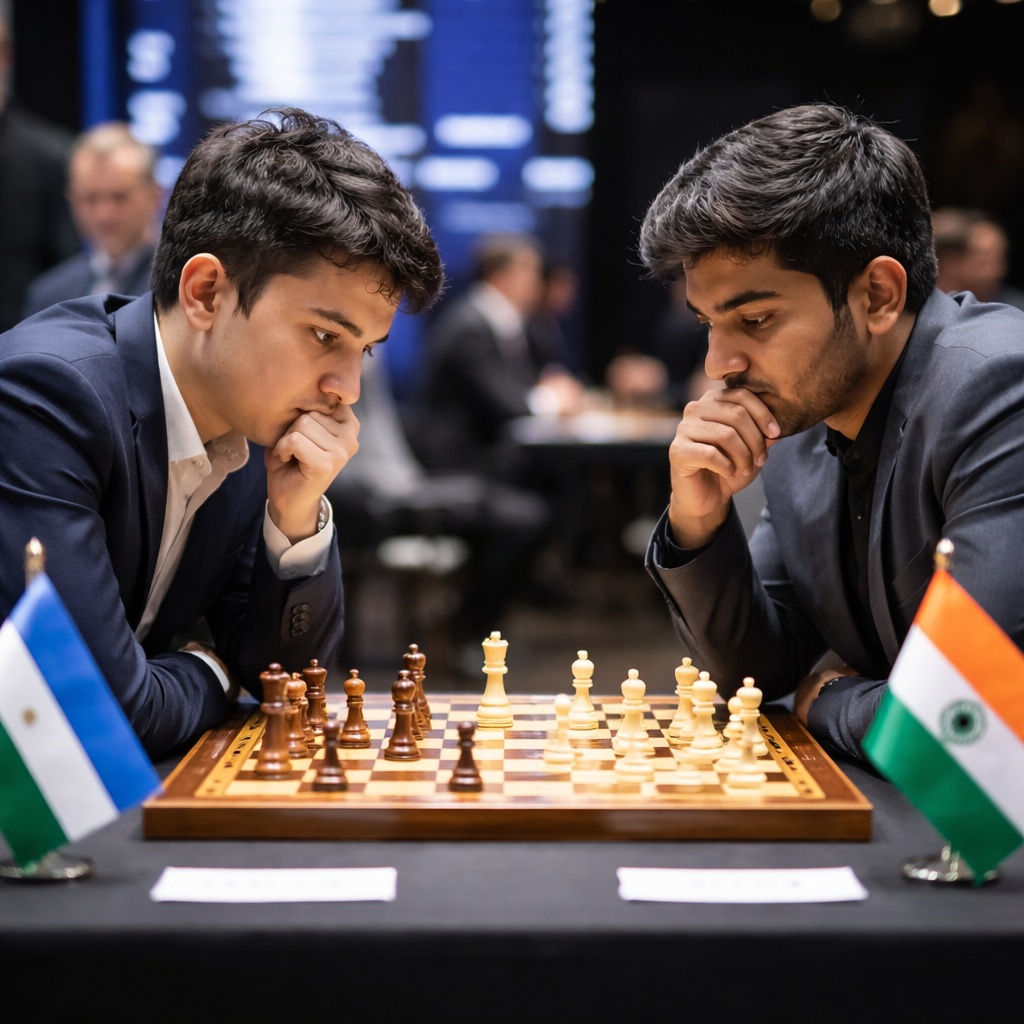
Sindarov’s commanding rise sets up a historic world championship clash against reigning prodigy Gukesh

In a defining moment for modern chess, twenty-year-old Uzbek grandmaster Javokhir Sindarov has surged to victory at the Candidates Tournament in Cyprus, securing his place as the next challenger for the world championship. His performance was not only decisive but carried a sense of inevitability, as he outpaced a field of seasoned elite players with composure far beyond his years.
Sindarov’s triumph signals more than just personal success. It marks a generational shift at the highest level of the game. With sharp preparation, fearless attacking play, and remarkable consistency, he established control of the tournament early and never relinquished it. Observers noted his ability to convert small advantages with clinical precision, a hallmark typically associated with far more experienced champions.
Now, he is set to face the reigning world champion, India’s Dommaraju Gukesh, who is even younger. The upcoming title match will feature the youngest pairing in the history of the world championship, underscoring a broader transformation within chess, where prodigies are rising faster and peaking earlier than ever before.
Gukesh, already a historic figure as the youngest undisputed world champion, has redefined expectations since claiming the crown. Known for his deep calculation and calm demeanor under pressure, he represents a new archetype of champion: technically flawless, psychologically resilient, and relentlessly ambitious. His ascent inspired a wave of young players worldwide, and now he faces one of the most formidable among them.
The contrast between the two players promises a compelling narrative. Sindarov’s dynamic style and willingness to take risks stand in intriguing opposition to Gukesh’s precision and strategic discipline. Analysts anticipate a match rich in both theoretical innovation and psychological tension, as each player seeks to impose his identity on the board.
The international chess federation has yet to announce the venue and schedule for the championship, but anticipation is already building across the global chess community. Fans and experts alike are framing the encounter as a symbolic passing of the torch, or perhaps the beginning of a rivalry that could define an era.
Beyond the immediate stakes, the match highlights the increasing globalization of chess. With competitors emerging from diverse regions and training systems, the traditional centers of dominance are giving way to a more distributed and competitive landscape. Sindarov’s success reflects the growing strength of Central Asian chess, while Gukesh’s continued prominence reinforces India’s status as a powerhouse of the modern game.
For both players, the upcoming championship represents a pivotal moment. For Sindarov, it is the culmination of years of rapid development and the opportunity to claim the highest honor in chess. For Gukesh, it is a test of his ability to defend his title against a challenger who embodies the same youthful hunger that propelled him to the top.
As the chess world awaits further details, one thing is already certain: a new chapter is about to unfold. Whether it ends with a successful defense or the crowning of a new champion, the match promises to capture the imagination of a global audience and redefine what it means to reach the summit of the game at such a young age.