Kyiv signals a turning point in modern warfare as unmanned systems seize enemy position without human casualties

In what could mark a defining moment in the evolution of modern warfare, Ukrainian President Volodymyr Zelenskyy has announced that Ukrainian forces have successfully captured an enemy position using exclusively robotic combat systems. The operation, described as unprecedented since the beginning of the war with Russia, was carried out without the deployment of infantry and resulted in no Ukrainian casualties.
The announcement, made via the social platform X, underscores a dramatic shift in battlefield tactics. “The occupiers surrendered, and the operation was carried out without infantry and without losses on our side,” Zelenskyy wrote, signaling both a tactical success and a potential strategic transformation.
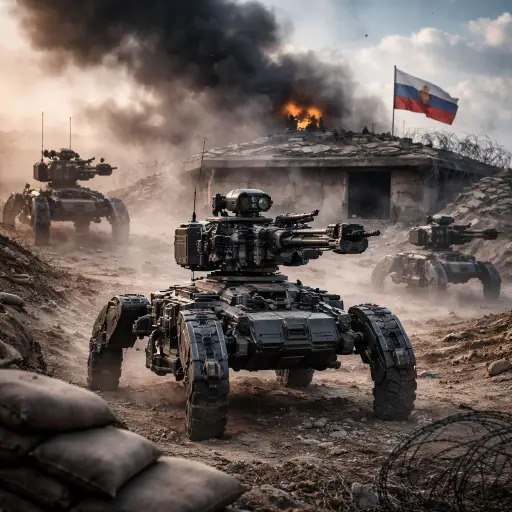
While details of the operation remain limited due to operational security, Ukrainian defense sources suggest that the assault involved a coordinated deployment of unmanned ground vehicles, aerial drones, and remote-controlled weapon systems. These technologies have been steadily integrated into Ukraine’s military strategy over the course of the conflict, but never before have they operated independently to seize and hold territory.
Military analysts say the implications are profound. For decades, discussions around autonomous warfare have remained largely theoretical or limited to experimental programs. Ukraine’s latest operation, however, appears to demonstrate a real-world application where machines, guided by human operators at a distance, can execute complex offensive maneuvers traditionally reserved for infantry units.
“This is not just a technological milestone, but a psychological one,” said a European defense expert familiar with the region. “If confirmed, it shows that warfare is entering a phase where human presence on the front line may no longer be necessary in certain scenarios.”
The use of robotic systems offers several immediate advantages. By removing soldiers from direct exposure, commanders can reduce casualties and maintain operational momentum. Additionally, unmanned systems can operate in environments considered too dangerous for humans, such as heavily mined areas or zones under constant artillery threat.
However, the development also raises serious ethical and strategic questions. Critics warn that increasing reliance on autonomous or semi-autonomous systems could lower the threshold for initiating combat operations. If the human cost is reduced, political leaders may face fewer domestic constraints when making decisions about escalation.
There are also concerns about the reliability and security of such systems. Electronic warfare remains a critical component of the conflict, with both sides attempting to jam or hijack each other’s drones and communications networks. A fully robotic assault, while impressive, may also be vulnerable to disruption if adversaries develop more sophisticated countermeasures.
For Ukraine, the announcement serves both military and symbolic purposes. It reinforces the country’s image as an innovative and adaptive force capable of leveraging technology to offset numerical disadvantages. It also sends a message to its allies, many of whom have provided advanced equipment and funding, that their support is translating into tangible results on the battlefield.
The broader international community is watching closely. NATO officials have previously emphasized the importance of integrating emerging technologies into defense strategies, but Ukraine’s experience provides a real-time case study under active combat conditions. Lessons learned here are likely to influence military planning far beyond Eastern Europe.
Russia has not officially commented on the specific incident described by Zelenskyy. However, Russian forces have also made extensive use of drones and electronic warfare capabilities throughout the conflict, suggesting that both sides are engaged in a rapidly evolving technological arms race.
Despite the focus on machinery, human decision-making remains central. Experts stress that these systems are not fully autonomous in the sense of operating without oversight. Instead, they rely on remote operators, artificial intelligence assistance, and pre-programmed directives to carry out missions. The balance between automation and human control continues to be a key area of debate.
For civilians and soldiers alike, the emergence of robotic warfare introduces a new layer of uncertainty. While it may reduce casualties for the side employing such systems, it also changes the nature of conflict in ways that are not yet fully understood. The battlefield becomes less visible, more remote, and potentially more continuous.
As the war continues, Ukraine’s reported success with a fully robotic assault may prove to be more than a single tactical achievement. It could represent the early stages of a broader transformation in how wars are fought, where algorithms and machines play an increasingly central role alongside human strategy and resolve.
Whether this development leads to shorter conflicts or more complex and prolonged engagements remains to be seen. What is clear, however, is that the line between science fiction and military reality is becoming increasingly blurred.
And on a battlefield defined by innovation as much as endurance, that shift may be one of the most consequential of all.