Former Vice President Re-enters Conversation Amid Transatlantic Political Uncertainty

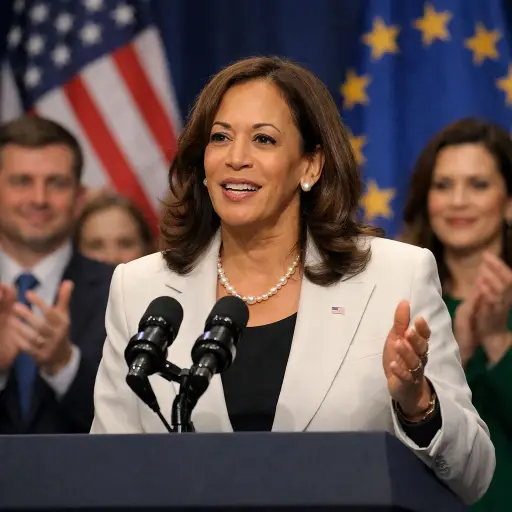
At a high-profile gathering in New York, former U.S. Vice President Kamala Harris delivered a message that was both cautious and unmistakably political: she is not ruling out another bid for the presidency. Speaking alongside several emerging figures within the Democratic Party, Harris acknowledged that a return to the national ticket in 2028 remains a possibility, reigniting speculation about the party’s future leadership.
The event, which brought together a mix of established and rising Democratic voices, was widely interpreted as an early staging ground for the next presidential cycle. While Harris stopped short of making a formal announcement, her remarks carried the tone of someone re-entering the arena rather than stepping away from it. Observers noted that her language balanced humility with resolve, reflecting both the weight of her previous defeat and the persistence of her political ambitions.
Harris’s reemergence comes at a moment of transition within the Democratic Party. With a generational shift underway, the field of potential candidates is becoming increasingly diverse, not only in background but also in political approach. Figures who shared the stage with Harris represent different wings of the party, from pragmatic centrists to more progressive voices. The gathering itself underscored a broader question: whether the party will coalesce around experienced leadership or pivot toward newer faces.
Her potential candidacy also carries implications far beyond the United States. In Europe, where political leaders closely monitor American electoral dynamics, Harris remains a recognizable and, in many cases, reassuring figure. During her tenure as vice president, she played a visible role in reaffirming transatlantic ties at a time of global uncertainty. Her diplomatic engagements, particularly with NATO allies and European Union institutions, helped reinforce a sense of continuity in U.S. foreign policy.
European officials are now watching closely for signs of who might shape Washington’s direction in the coming years. The possibility of Harris returning to the forefront introduces both familiarity and questions. On one hand, her previous experience suggests a commitment to multilateralism and cooperation. On the other, the evolving political landscape in both the U.S. and Europe means that past approaches may need recalibration.
Across the Atlantic, Europe is grappling with its own political shifts. Rising populist movements, economic pressures, and ongoing security concerns have created a complex environment in which U.S. leadership remains a crucial factor. Any indication of stability or predictability in American politics is therefore significant. Harris’s openness to another run could be interpreted as a signal that a segment of the Democratic establishment is seeking to reassert a steady, internationally engaged approach.
At the same time, her potential candidacy is not without challenges. Domestically, Harris would need to navigate a party that is increasingly fragmented and a voter base that is both energized and divided. Her previous campaign revealed strengths in coalition-building but also highlighted difficulties in sustaining momentum. A future run would likely require a recalibrated strategy, one that addresses both economic concerns at home and America’s role abroad.
The New York event served as a reminder that the race for the next presidential election is already quietly taking shape. While formal campaigns remain on the horizon, the positioning, messaging, and alliances being formed now will play a critical role in determining the outcome. Harris’s presence—and her carefully measured openness—places her firmly within that unfolding narrative.
For European audiences, the significance lies not only in who might lead the United States next but also in what that leadership represents. In a world marked by shifting alliances and uncertain trajectories, the prospect of a familiar figure returning to the global stage offers both continuity and the potential for renewed dialogue.
Whether Kamala Harris ultimately decides to run again remains to be seen. What is clear, however, is that her voice is once again part of the conversation—and that conversation is being heard far beyond American borders.