As Donald Trump’s political shadow stretches over Europe, even his closest ideological allies begin to keep their distance

In the shifting landscape of transatlantic politics, few figures loom as large—or as controversially—as Donald Trump. Once embraced by segments of Europe’s nationalist and far-right movements as a symbol of defiance against liberal internationalism, Trump is now increasingly viewed as a liability. Across European capitals, a quiet recalibration is underway, as political leaders who once echoed his rhetoric begin to put space between themselves and the polarizing American figure.
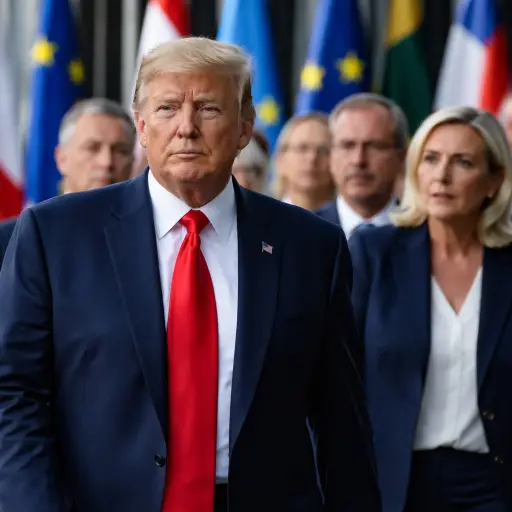
Nowhere is this shift more visible than within France’s far-right political sphere. According to reporting by Politico, Marine Le Pen recently urged members of her party, National Rally, to maintain distance from Trump. The message, delivered during an internal gathering, was clear: proximity to the former U.S. president carries growing political risks in Europe’s evolving electoral environment.
This marks a notable departure from earlier years, when Trump’s presidency energized populist movements across the continent. His criticism of the European Union, skepticism toward NATO, and hardline stance on immigration resonated with parties seeking to challenge the political mainstream. Leaders from Italy to Hungary found in Trump a transatlantic ally who legitimized their own agendas.
Yet the political climate has changed. European voters, while still receptive to nationalist messaging in some regions, have grown more cautious about overt associations with figures perceived as destabilizing or unpredictable. Trump’s continued dominance in American conservative politics—and the controversies that follow him—have made him a more complicated partner for European allies seeking broader electoral appeal.
For Le Pen, the calculation is particularly delicate. Having spent years working to “de-demonize” her party and expand its voter base beyond its traditional strongholds, she faces the challenge of balancing ideological consistency with political pragmatism. Publicly aligning too closely with Trump risks reinforcing the very perceptions she has sought to soften: that her movement is extreme, insular, and disconnected from mainstream concerns.
Similar dynamics are playing out elsewhere in Europe. In Italy, right-wing leaders have adopted a more cautious tone when referencing Trump, emphasizing national priorities over transatlantic ideological solidarity. In Central Europe, where leaders once openly praised Trump’s approach, there is now a noticeable shift toward more nuanced positioning. The goal is not to sever ties completely, but to avoid being defined by them.
This distancing does not necessarily signal a rejection of Trump’s ideas. Many of the themes he championed—border control, economic nationalism, and skepticism of supranational institutions—remain central to Europe’s right-wing platforms. What has changed is the strategic calculation around branding and electability. In an era of closely contested elections, perception matters as much as policy.
The broader geopolitical context also plays a role. Europe’s security concerns, particularly in light of ongoing tensions on its eastern flank, have reinforced the importance of stable transatlantic relations. Trump’s past criticisms of NATO and ambiguous stance toward traditional alliances have raised questions among European leaders about the reliability of U.S. commitments under his influence. Even those who share aspects of his worldview must contend with the practical implications of such uncertainty.
At the same time, Trump’s enduring influence within the United States ensures that he cannot be ignored. European leaders continue to watch American politics closely, aware that shifts in Washington can have immediate and far-reaching consequences. The challenge lies in navigating this reality without becoming politically entangled in it.
For now, the strategy appears to be one of cautious distance. Public statements are measured, references are indirect, and endorsements are notably absent. Behind closed doors, however, the conversation is more candid: Trump, once seen as a catalyst for political change in Europe, is increasingly viewed as a complicating factor.
As Europe approaches another cycle of electoral tests, this recalibration will likely continue. The continent’s right-wing movements are not abandoning their core messages, but they are refining how those messages are presented—and who they are associated with. In this evolving landscape, Trump’s role has shifted from inspiration to obstacle, a symbol whose political weight is no longer universally advantageous.
The transatlantic alliance has always been shaped by personalities as well as policies. Today, as Europe redefines its political identity in a complex global environment, the figure of Donald Trump serves as a reminder that influence, no matter how powerful, can also become a burden.