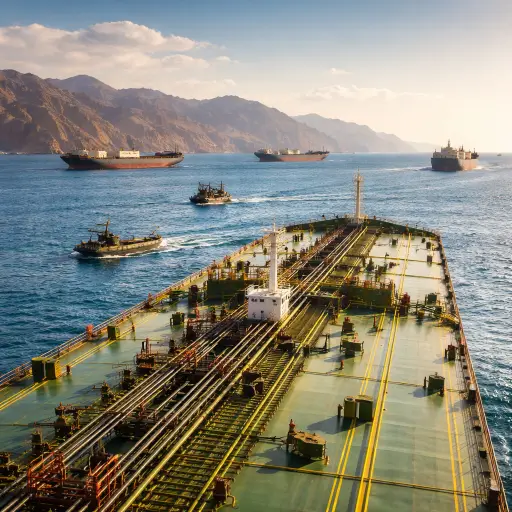
A fleeting maritime reprieve tied to a Lebanon ceasefire rattles oil markets and exposes the limits of diplomacy in one of the world’s most strategic waterways

The narrow waters of the Strait of Hormuz, long regarded as one of the most sensitive choke-points in global trade, became the center of renewed geopolitical tension as Iran abruptly reversed course on maritime access within the span of a day. The episode, unfolding against the backdrop of a fragile ceasefire in Lebanon, sent shockwaves through energy markets and underscored the volatility of a region where diplomacy and deterrence remain tightly intertwined.
Iranian Foreign Minister Abbas Araghchi announced that the strait would be fully reopened to all commercial shipping for the duration of the ceasefire in Lebanon, signaling what appeared to be a calculated gesture of de-escalation. According to Iranian authorities, vessels were instructed to follow pre-coordinated transit routes, suggesting a controlled reopening designed to maintain oversight while allowing the flow of goods to resume.
The announcement had an immediate and dramatic effect. Oil prices, which had been buoyed by fears of prolonged disruption in the Gulf, dropped sharply as traders responded to the prospect of restored shipping lanes. The Strait of Hormuz handles a significant share of the world’s oil supply, and even temporary closures or threats to navigation can trigger outsized reactions in global markets. The reopening, however brief, was interpreted as a signal that Tehran was willing to ease pressure, at least conditionally.
Yet the optimism proved short-lived. Despite the reopening, the United States did not lift its existing blockade of Iranian ports, a move that Tehran had implicitly linked to broader de-escalation. The continued restrictions appeared to undercut the diplomatic gesture, reinforcing Iran’s long-standing argument that unilateral concessions would not yield reciprocal steps from Washington.
In response, Iran announced that it had once again closed the strait, effectively nullifying its earlier decision. The reversal came swiftly, leaving shipping companies and energy markets scrambling to reassess risk. Tankers already en route were forced to reconsider their positions, while insurers began recalculating premiums amid renewed uncertainty.
The rapid sequence of events highlights the precarious balance in the region. The Strait of Hormuz is not merely a passage for oil tankers; it is a strategic lever wielded by Iran in its broader confrontation with Western powers. By linking the reopening to the ceasefire in Lebanon, Tehran signaled that regional conflicts are deeply interconnected, and that developments in one arena can have immediate consequences in another.
Analysts note that the episode reflects a broader pattern in Iran’s approach: calibrated escalation combined with tactical flexibility. The initial reopening allowed Tehran to position itself as responsive to regional stability efforts, while the subsequent closure reinforced its willingness to act decisively when its conditions are not met. This dual messaging is aimed both at international audiences and domestic constituencies, projecting strength without foreclosing the possibility of negotiation.
For global energy markets, the incident serves as a stark reminder of structural vulnerability. Even in an era of diversified supply, the concentration of critical النفط flows through a single maritime corridor leaves the system exposed to geopolitical shocks. The brief dip in prices following the reopening was quickly overshadowed by renewed volatility, illustrating how rapidly sentiment can shift.
Shipping firms, meanwhile, face an increasingly complex operating environment. The requirement to adhere to designated routes during the reopening hinted at a future in which access to key waterways may be subject to tighter controls and political conditions. The sudden closure that followed only amplifies concerns about predictability and safety.
Diplomatic efforts continue behind the scenes, with regional and international actors seeking to stabilize the situation. The linkage between the Hormuz decision and the Lebanon ceasefire suggests that any lasting resolution will require a broader framework addressing multiple flashpoints simultaneously. Isolated agreements may offer temporary relief, but they remain vulnerable to collapse when underlying tensions persist.
As the situation evolves, the Strait of Hormuz once again stands as both a symbol and a fault line. Its waters reflect the shifting currents of power, negotiation, and conflict that define the region. For now, the brief reopening serves less as a turning point than as a reminder of how quickly stability can give way to renewed confrontation.