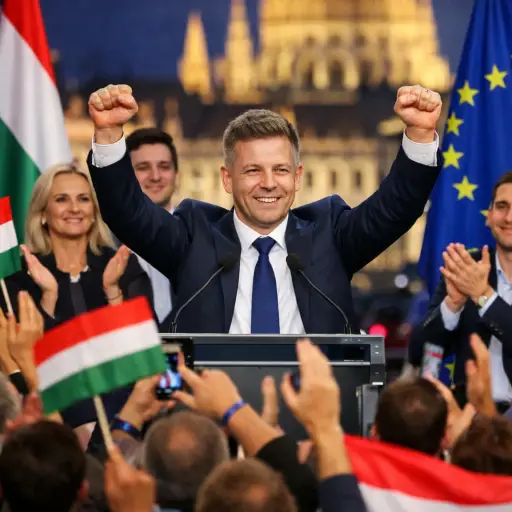
A political earthquake has reshaped Hungary’s landscape, delivering a decisive victory to Péter Magyar’s Tisza movement and ending a long era of uninterrupted rule.

With all remaining ballots accounted for, Tisza has secured a dominant 140 seats in the 199-member parliament, a result that signals not only a change in government but a profound shift in the country’s political direction.
The scale of the victory leaves little ambiguity. Tisza did not merely win—it overwhelmed. For many voters, the outcome represents a clear mandate for renewal after years under the leadership of Prime Minister Viktor Orbán, whose tenure stretched across more than a decade and a half. The election has thus become a defining moment, marking the first genuine transfer of power in a generation.
Magyar, a relative newcomer who rose rapidly from within the political establishment before breaking away, has managed to channel widespread public dissatisfaction into a cohesive and disciplined campaign. His message combined promises of institutional reform, economic recalibration, and a rebalancing of Hungary’s position within Europe. That combination appears to have resonated across both urban centers and rural constituencies, bridging divides that had long favored the incumbent government.
Throughout the campaign, Tisza positioned itself as a corrective force rather than a purely oppositional one. Magyar’s rhetoric emphasized transparency, rule of law, and the restoration of checks and balances—issues that had become central to domestic debates and to Hungary’s relationship with its European partners. At the same time, he avoided alienating conservative voters by framing his agenda in terms of national renewal rather than ideological rupture.
The defeat of Fidesz, once considered electorally unassailable, raises immediate questions about the future of the party and of Orbán himself. For years, the governing party maintained a firm grip on political institutions, media influence, and electoral strategy. Its loss suggests that the underlying coalition supporting it had begun to fragment, possibly accelerated by economic pressures, public fatigue, and a shifting generational outlook.
Early reactions from within Fidesz have been measured, with senior figures acknowledging the outcome while stopping short of outlining a clear path forward. Whether the party will attempt to regroup under its long-standing leadership or pivot toward internal reform remains uncertain. What is clear is that Hungarian politics has entered a more competitive phase, one in which dominance can no longer be taken for granted.
For Tisza, the challenge now moves from campaigning to governing. A parliamentary majority of this magnitude provides the numerical strength to pass legislation without reliance on coalition partners. Yet it also raises expectations. Voters who backed the movement will be looking for swift and tangible changes, particularly in areas such as public administration, judicial independence, and economic policy.
Internationally, the result is likely to be closely watched. Hungary’s relations with the European Union have been strained in recent years, often marked by disputes over democratic standards and policy alignment. Magyar has signaled an intention to reset that relationship, suggesting a more cooperative tone while maintaining an emphasis on national sovereignty. Whether this balance can be achieved in practice will be a key test of the new administration.
Economic considerations will also play a central role in the months ahead. Inflationary pressures, fiscal stability, and investment confidence remain pressing concerns. Tisza’s leadership has indicated that it will pursue reforms aimed at improving transparency and attracting foreign investment, but such measures will require careful implementation to avoid short-term disruption.
Beyond policy, there is a broader question of political culture. The election outcome reflects a desire among many Hungarians for a different style of governance—one that is less confrontational and more inclusive. Whether Tisza can foster that shift will depend not only on its legislative agenda but on how it engages with opposition voices, civil society, and the media.
As the new parliamentary term approaches, the atmosphere in Budapest is one of cautious anticipation. Supporters of the incoming government view the moment as an opportunity to reset the country’s trajectory. Critics, meanwhile, will be watching closely to see whether campaign promises translate into meaningful change.
What is undeniable is that Hungary stands at a turning point. The emphatic nature of Tisza’s victory has opened the door to a new political chapter, one defined not by continuity but by transformation. The coming period will reveal whether that transformation can meet the high expectations now placed upon it.