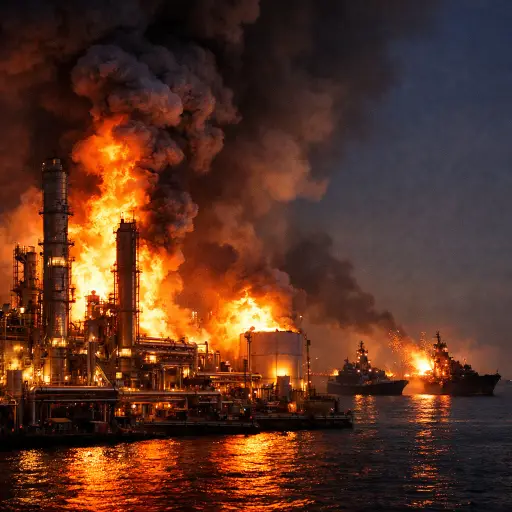
Coordinated attacks on Russian energy infrastructure and naval assets highlight shifting dynamics in the conflict’s maritime and economic fronts

In a series of coordinated overnight operations that underscore a widening battlefield, Ukrainian defense forces targeted multiple strategic assets tied to Russia’s oil industry and naval presence. The strikes, carried out under the cover of darkness, hit key facilities across western Russia and the occupied Crimean Peninsula, igniting fires and raising fresh questions about the resilience of critical infrastructure far from the front lines.
According to Ukraine’s General Staff, the operation focused on four significant nodes within Russia’s oil network. Among them were refineries in Novokuybyshevsk and Syzran, both located in the Samara region, long regarded as an important hub for fuel processing and distribution. Additional targets included the Vysotsk oil terminal on the Baltic Sea and a pumping station in Tikhoretsk, in the Krasnodar region. In each location, fires reportedly broke out following the strikes, suggesting at least partial disruption of operations.
While independent verification remains limited, imagery circulating on social media and local reports from Russian regions point to large plumes of smoke and emergency responses at multiple sites. Russian authorities have not fully detailed the extent of the damage, though regional officials have acknowledged incidents at energy facilities, attributing them to drone activity.
The scale and geographic spread of the attacks mark a notable evolution in Ukraine’s operational reach. By targeting infrastructure deep inside Russian territory, Kyiv appears to be intensifying efforts to strain the logistical backbone that supports both military operations and economic stability. Oil refineries and export terminals play a dual role in fueling the war effort and sustaining state revenues, making them high-value targets in a prolonged conflict.
Analysts say the choice of targets reflects a calculated attempt to create ripple effects beyond immediate physical damage. Disruptions in refining capacity can affect fuel supply chains, while attacks on export terminals risk complicating maritime shipments and insurance conditions in already volatile markets. Even temporary outages can force costly repairs and heightened security measures, increasing pressure on Russia’s industrial sector.
Simultaneously, Ukrainian forces reported successful strikes against three Russian military vessels in Crimea. Though details remain sparse, the incidents are believed to have occurred near key naval positions along the peninsula’s coast. Crimea has long served as a central hub for Russia’s Black Sea Fleet, making any damage to naval assets particularly sensitive.
The maritime dimension of the conflict has grown increasingly significant. Control over the Black Sea affects not only military maneuverability but also trade routes, including vital grain shipments. By targeting naval vessels, Ukraine signals its intent to challenge Russia’s dominance in these waters and disrupt its ability to project power from occupied territory.
The psychological impact of such operations should not be underestimated. Repeated strikes deep inside Russia may erode perceptions of security among both officials and civilians, while also forcing the diversion of air defense systems away from the front lines. This redistribution of resources could have tactical implications in contested regions closer to Ukraine’s borders.
For Moscow, the attacks present a complex dilemma. Strengthening defenses across a vast territory requires significant investment and coordination, particularly against increasingly sophisticated drone tactics. At the same time, maintaining uninterrupted energy production remains critical for both domestic consumption and export commitments.
International observers are closely watching how these developments might influence the broader trajectory of the conflict. While Ukraine’s Western allies have largely supported its right to defend itself, strikes on infrastructure inside Russia occasionally raise concerns about escalation. So far, Kyiv has framed such operations as legitimate military actions aimed at weakening the adversary’s war capabilities.
Energy markets, too, are sensitive to such incidents. Even localized disruptions can contribute to price volatility, especially when they involve export terminals connected to global supply chains. The Vysotsk terminal, for instance, plays a role in shipping refined products through the Baltic, linking regional events to international economic repercussions.
Despite the intensity of the overnight strikes, the longer-term impact remains uncertain. Industrial facilities are often designed with redundancies, and rapid repair efforts can mitigate sustained disruption. However, repeated attacks could gradually degrade capacity, compounding effects over time.
What is clear is that the conflict continues to expand beyond traditional battlefields. Infrastructure, logistics, and maritime assets have become integral components of modern warfare, blurring the line between military and economic targets. Ukraine’s latest actions illustrate a strategy that seeks not only to counter advances on the ground but also to weaken the systems that sustain them.
As both sides adapt to evolving tactics, the pattern of strikes and countermeasures is likely to intensify. The events of this latest night operation offer a snapshot of a war that is increasingly defined by reach, precision, and the strategic targeting of critical assets.
In the absence of a clear path to de-escalation, such developments reinforce a central reality: the conflict is entering a phase where distance offers diminishing protection, and where the boundaries of the battlefield are continuously being redrawn.