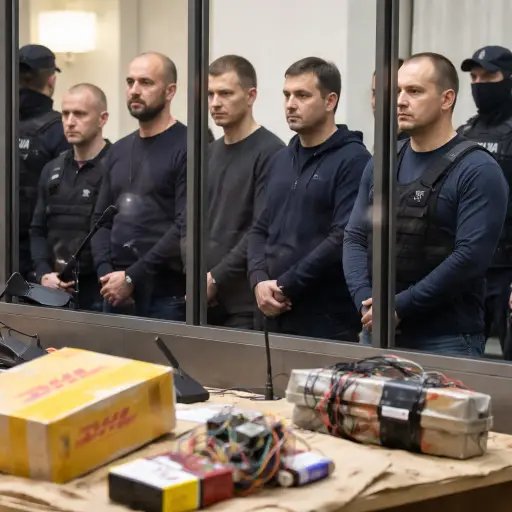
Five defendants face charges over explosive shipments across Europe as investigators warn of a wider covert network still at large

In a tightly watched courtroom in Vilnius, five defendants stood before judges accused of participating in a covert sabotage campaign that stretched across multiple European countries. Prosecutors allege that all five were recruited by Russia’s military intelligence agency, the GRU, and played roles in preparing and dispatching explosive parcels that detonated in transit hubs in Germany, Poland, and the United Kingdom.
The case has drawn significant attention from European security services, which increasingly warn of hybrid threats blending espionage, cyber operations, and physical sabotage. According to Lithuanian prosecutors, the accused worked in coordination with handlers linked to the GRU, using commercial courier networks to move improvised explosive devices concealed in ordinary shipments.
The parcels were reportedly routed through major logistics providers, including DHL and DPD. Authorities say the devices were designed to detonate during handling or sorting, creating both physical damage and psychological impact. While no mass casualties were reported, the incidents triggered widespread alarm across European transport and security systems.
Investigators describe the operation as deliberately decentralized. The defendants are accused of handling specific logistical tasks — assembling components, packaging devices, or arranging shipments — without necessarily having full visibility of the broader network. This compartmentalization, officials argue, is characteristic of modern intelligence-linked sabotage efforts, making such operations harder to detect and dismantle.
Lithuanian authorities emphasized in court that the case likely represents only part of a larger structure. Law enforcement agencies across the region continue to search for additional suspects believed to be involved in planning, coordination, or execution. “This is not an isolated group,” a senior investigator said outside the courtroom. “What we are seeing is a network with multiple layers, and some of those layers remain active.”
The prosecution’s case relies on a combination of forensic evidence, intercepted communications, and international intelligence cooperation. Officials highlighted the role of cross-border collaboration in tracking the movement of suspicious packages and identifying patterns that linked incidents across different countries.
Security analysts note that the use of civilian logistics infrastructure marks a significant evolution in sabotage tactics. By exploiting trusted commercial systems, perpetrators can bypass traditional security scrutiny and create disruption with relatively limited resources. “It’s a low-cost, high-impact approach,” said one European security expert. “And it’s extremely difficult to defend against without extensive coordination between governments and private companies.”
Russia has consistently denied any involvement in acts of sabotage across Europe. Officials in Moscow have rejected the allegations surrounding the case, maintaining that such claims are politically motivated. The position echoes previous denials reported by Agence France-Presse and other international outlets covering similar accusations.
The trial unfolds against a backdrop of heightened tensions between Russia and European states, with security agencies warning of an uptick in covert operations targeting infrastructure, supply chains, and public confidence. The Vilnius case is seen as one of the most concrete legal tests of these concerns, moving beyond intelligence assessments into judicial scrutiny.
Inside the courtroom, proceedings have focused on establishing the chain of responsibility — from alleged recruiters and coordinators to those physically handling the packages. Defense lawyers have challenged the prosecution’s interpretation of evidence, arguing that their clients lacked knowledge of the parcels’ contents or ultimate purpose.
Legal experts say the outcome of the trial could have broader implications for how European courts handle cases involving alleged state-linked sabotage. Questions of attribution, intent, and the use of intelligence-derived evidence are expected to play a central role in the proceedings.
For now, the five defendants remain at the center of a case that reflects a shifting security landscape in Europe — one where the boundaries between war, espionage, and crime are increasingly blurred. As the trial continues, authorities warn that the threat it represents has not yet been fully contained.