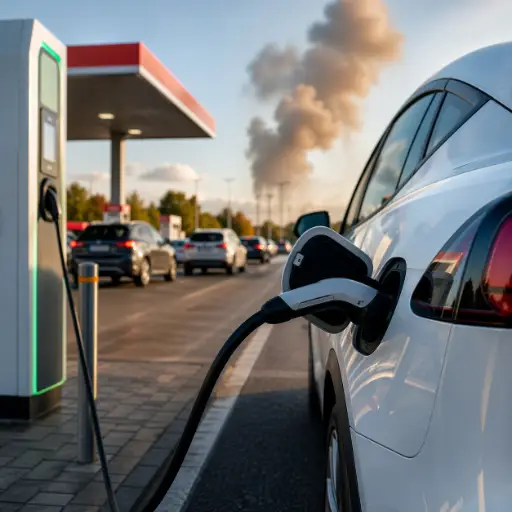
Rising petrol and diesel costs push consumers toward electric mobility, with record growth reshaping the automotive landscape

As fuel prices climb at their fastest pace in years, European consumers are responding with a decisive shift in how they move. Petrol and diesel, long the backbone of personal and commercial transport, have become increasingly expensive, placing pressure on households and businesses alike. At the same time, a parallel trend is gaining momentum: a surge in demand for electric vehicles that is beginning to redefine the region’s automotive market.
Across major European markets, nearly 560,000 new electric cars were registered in the first quarter of the year, representing a sharp increase of 29.4 percent compared to the same period last year. The figures underscore a growing alignment between economic pressures and long-term environmental goals, as drivers seek alternatives to volatile fuel costs.
The rise in fuel prices has been driven by a complex mix of factors, including geopolitical uncertainty, supply constraints, and ongoing adjustments in global energy markets. For consumers, the result is immediate and tangible. Filling a tank has become significantly more expensive, and for many, the unpredictability of costs has added a new layer of financial concern.
“It’s not just about the price itself, but the lack of stability,” says one transport analyst based in Western Europe. “Consumers are increasingly looking for predictability, and electricity—despite its own fluctuations—offers a more controllable cost structure than fossil fuels at the moment.”
This shift in perception is proving critical for the electric vehicle sector. What was once seen primarily as an environmentally conscious choice is now increasingly viewed as an economy one. Lower running costs, combined with expanding charging infrastructure and improving battery technology, are making electric cars more accessible to a broader segment of the population.
Automakers are responding quickly. Many manufacturers have accelerated their electrification strategies, expanding their portfolios of battery-electric models and investing heavily in production capacity. Waiting times for some popular electric vehicles have shortened as supply chains stabilize, further encouraging adoption.
Government policies continue to play a supporting role. Incentives such as purchase subsidies, tax benefits, and stricter emissions regulations are reinforcing the transition. In several countries, the phase-out timelines for internal combustion engine vehicles are becoming clearer, sending a strong signal to both consumers and industry.
Yet the transition is not without challenges. Charging infrastructure, while expanding, still varies significantly between regions. Urban areas tend to be well served, but rural and cross-border routes can present difficulties for drivers considering the switch. Additionally, the upfront cost of electric vehicles remains higher than that of traditional cars, even if long-term savings can offset the difference.
Despite these hurdles, the momentum appears undeniable. Industry experts point to a tipping point where economic necessity aligns with technological readiness. The current spike in fuel prices may not be permanent, but it is accelerating behavioral changes that could have lasting effects.
“There’s a psychological shift happening,” notes the analyst. “Once consumers make the move to electric and experience the benefits firsthand, they are unlikely to go back.”
The broader implications extend beyond individual drivers. Energy markets, urban planning, and even geopolitical strategies are being influenced by the transition. Reduced dependence on imported fossil fuels is becoming an increasingly important objective for European policymakers, adding another layer of urgency to the electrification push.
As the automotive sector navigates this period of transformation, one thing is clear: the relationship between fuel prices and consumer behavior has entered a new phase. What began as a reaction to rising costs is evolving into a structural change in mobility.
For now, the roads of Europe reflect this dual reality. Traditional vehicles still dominate, but electric models are appearing with growing frequency. Charging stations are becoming as familiar as petrol pumps, and the quiet hum of electric engines is gradually joining the soundscape.
If current trends continue, the surge in fuel prices may be remembered not only as a period of economic strain, but as a catalyst that accelerated Europe’s journey toward a cleaner and more resilient transport future.